Tour de Fleece is an annual spinning event where crafters spin during every day the cyclists of the Tour de France ride. This year the dates are 1st July 2022- 24th July 2022. This will be my second TDF (I’m not part of any groups) so I have a better idea of how to structure my spinning this year (and know that the time goes much faster than you think it will!)
Last year I used TDF to finish some WIP’s and I challenged myself to spend 1 hour a day on any fibre craft. This year I want to use TDF to make a big dent in my fleece stash so I’m going to aim to spend at least 1 hour a day on either spinning or fibre prep (carding/combing/wool picking). I’m not going to be too strict about timings – this is just what I feel is an achievable guideline.
Like last year I will be taking progress photos to hold myself accountable and will be posting these daily on my instagram and also in a blog post at the end of each week (the first weekly wrap up will be Sunday 10th July).
If you are also joining in with Tour de Fleece (whether part of a group or going it alone like me!) I’d love to hear how you get on – feel free to share your progress/goals in the comments section and if you want to find out what I got up to last TDF I’ve included links to my posts below.
When I began exploring the wool from different breeds of sheep I decided it would be nice to have a tactile record as well as written notes. I had seen several people making colour study blankets or wall hangings documenting natural dyes, so thought a breed study blanket would be a good way of displaying my work with fleece. I decided that each square should be representative of the project/s that I make with the fleece – a sort of mini version to cross reference. Since I work with multiple fleeces at any one time, I don’t plan for the squares to be in strict order, however hopefully they will follow some sort of chronology as I go.
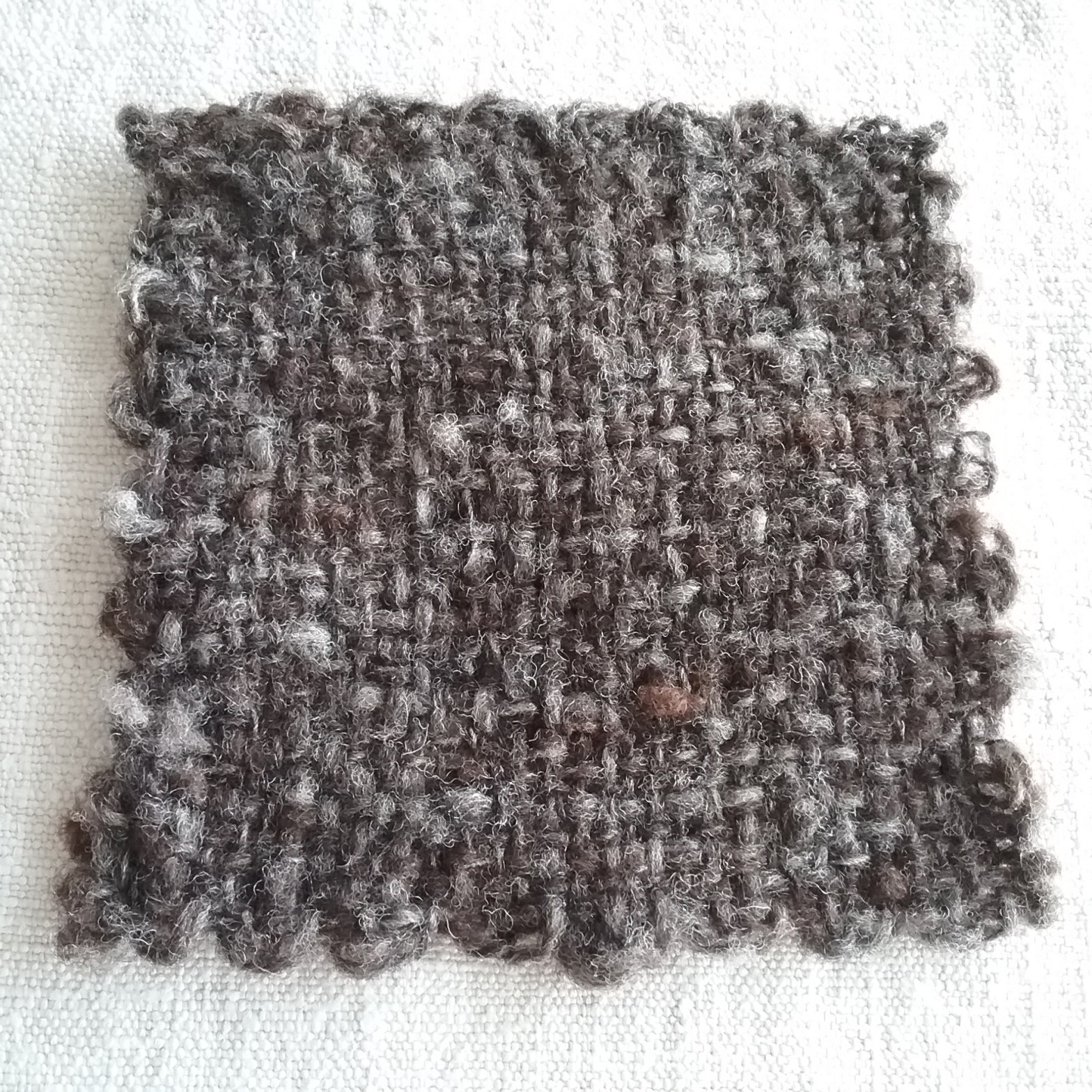
My main Ryeland project was the woven poncho, so my breed study square needed to be plain weave. The easiest way to weave small squares is on a pin loom. These can be DIYed (there are lots of tutorials online), but I recently attended a local yarn fair where a lovely vendor was selling beautiful handmade pin looms so I decided to buy one. There are two directions of weave you can make on a pin loom; bias and straight (links will take you to some good Youtube tutorials). In order to match the weave of my poncho I opted for a straight weave – the process of which I show below.
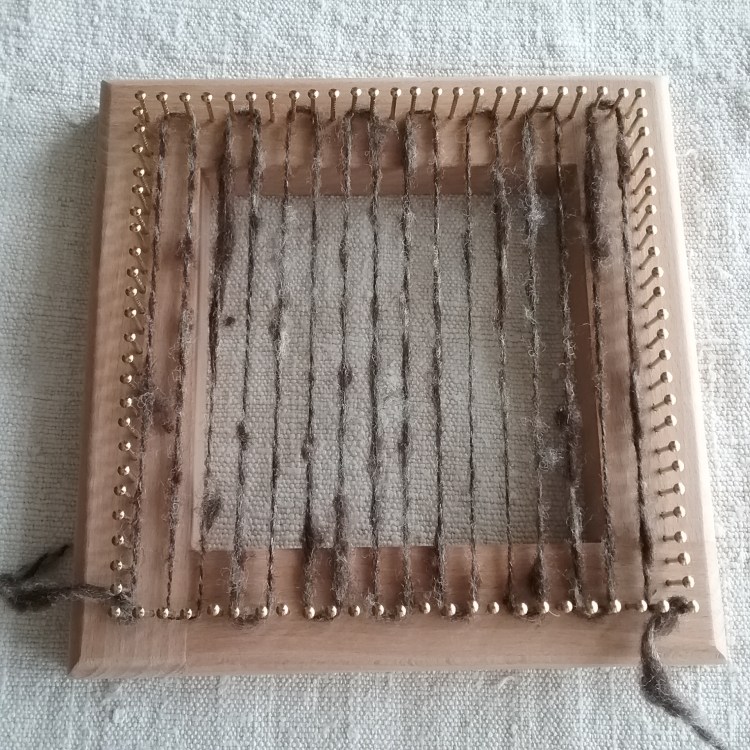
1st warp threads starting from bottom left corner to bottom right
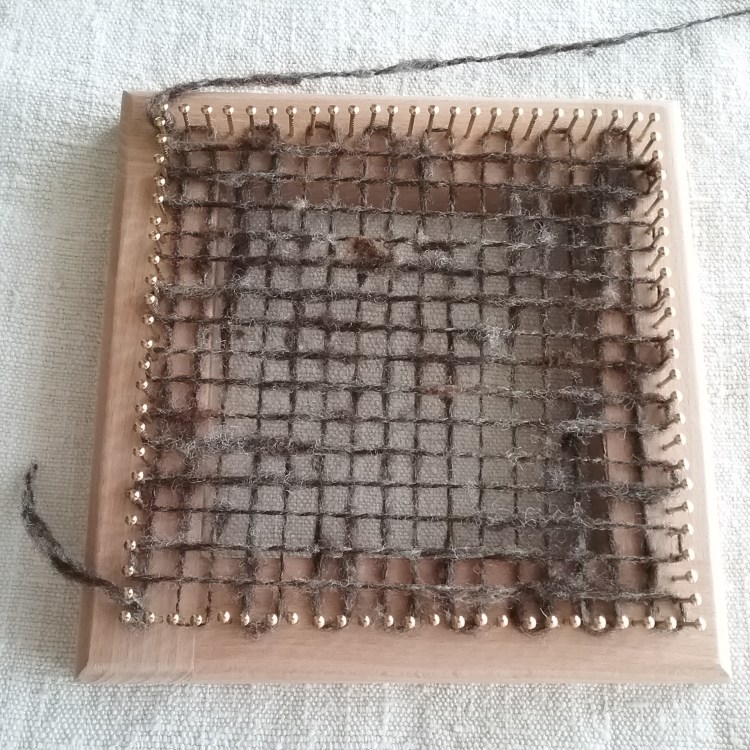
1st weft threads starting from bottom right to top right (I found it easier to rotate the loom 90° to do this).
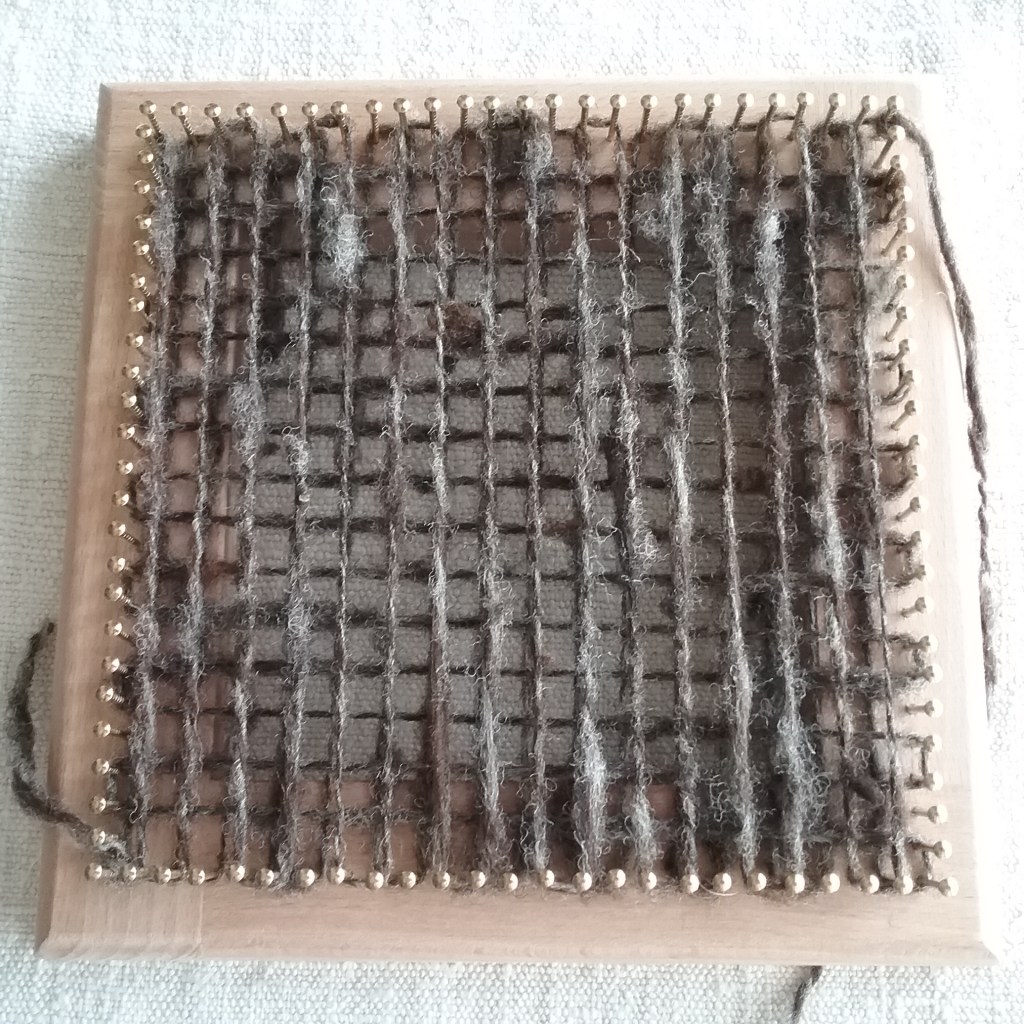
2nd warp threads in the spaces between
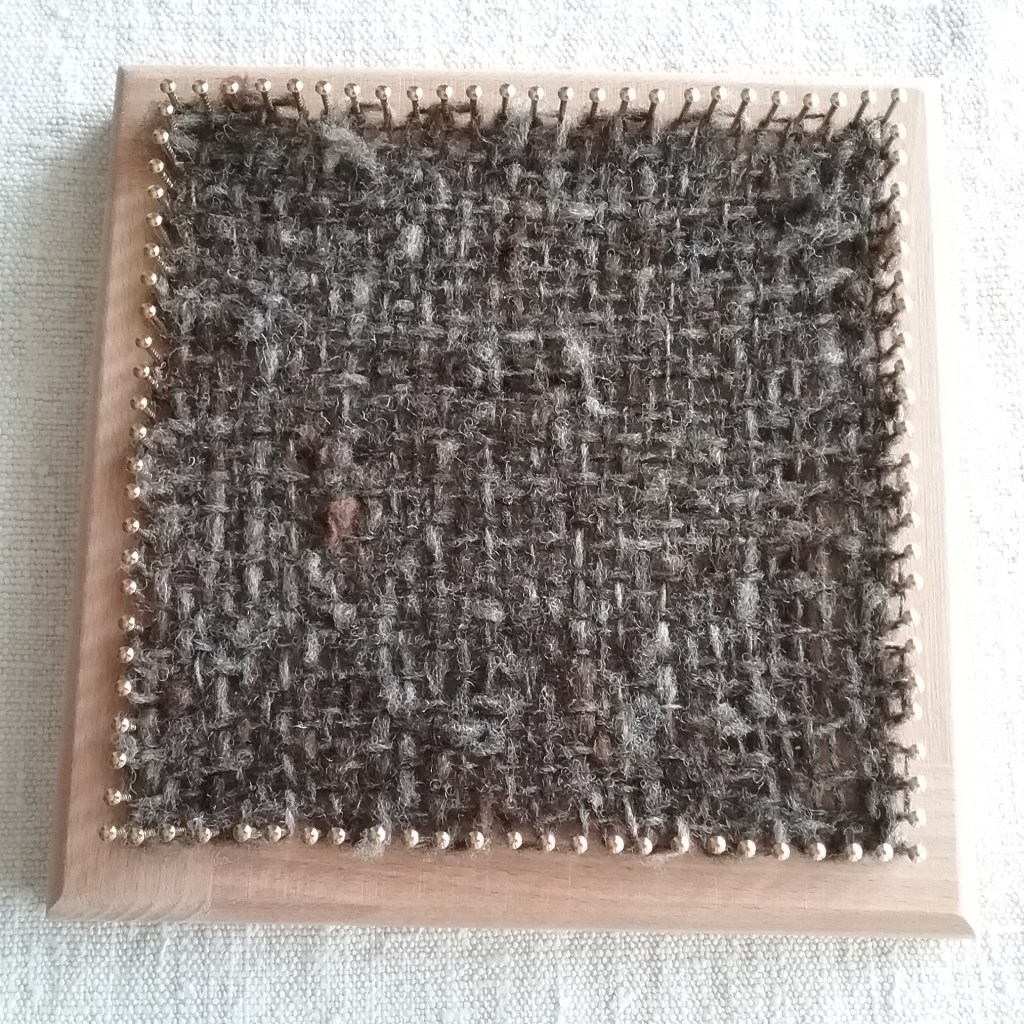
After weaving over and under the warp threads in the rows between the 1st weft threads
The square was then taken off the loom and washed to allow the fibres to full (fluff up and fill the gaps).
This breed study blanket will constantly evolve and will probably never be 100% complete – at least not anytime soon (there are over 60 different breeds of sheep in Britain alone)! I’m very pleased with how my first square has come out though and am looking forward to having more pin loom adventures in the future.
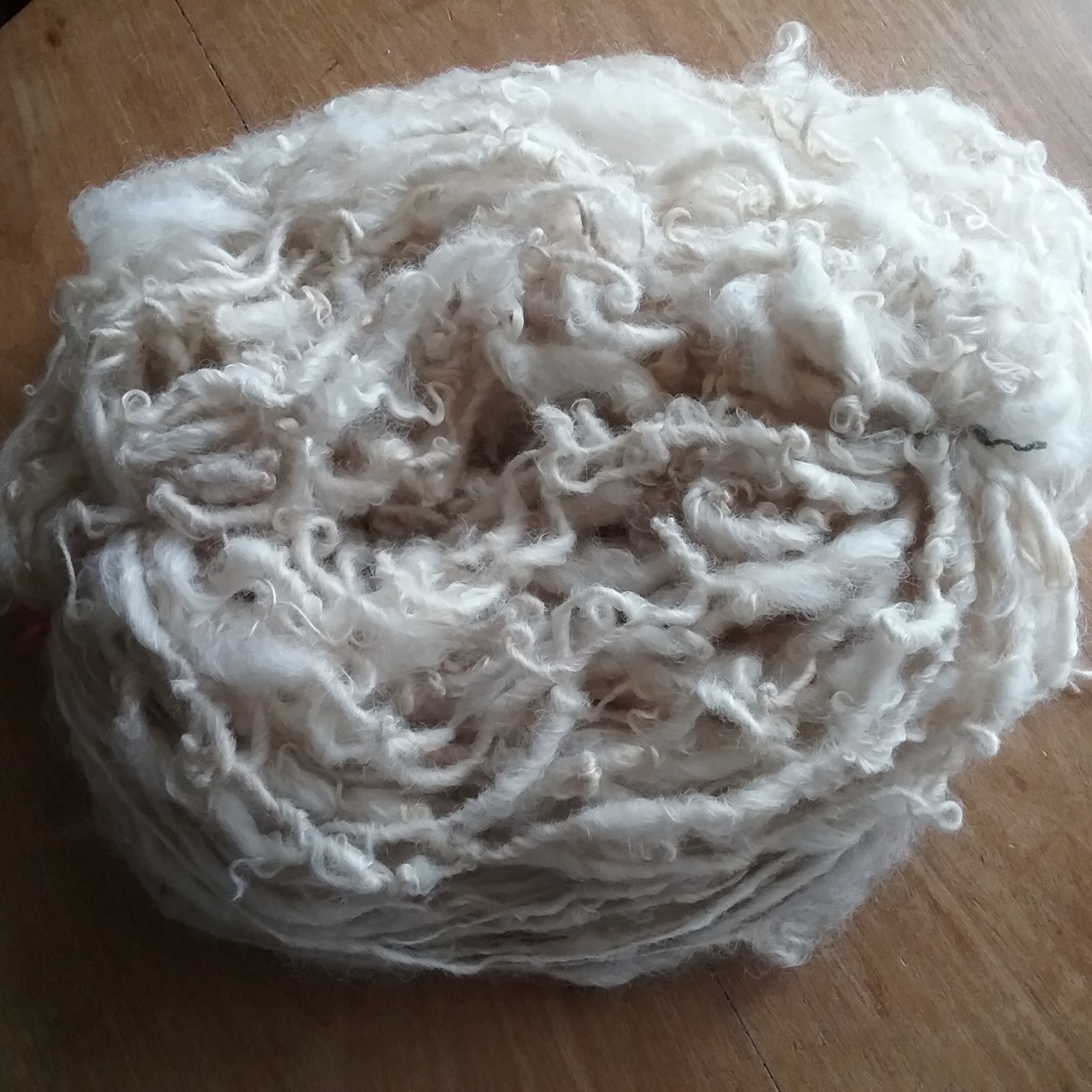
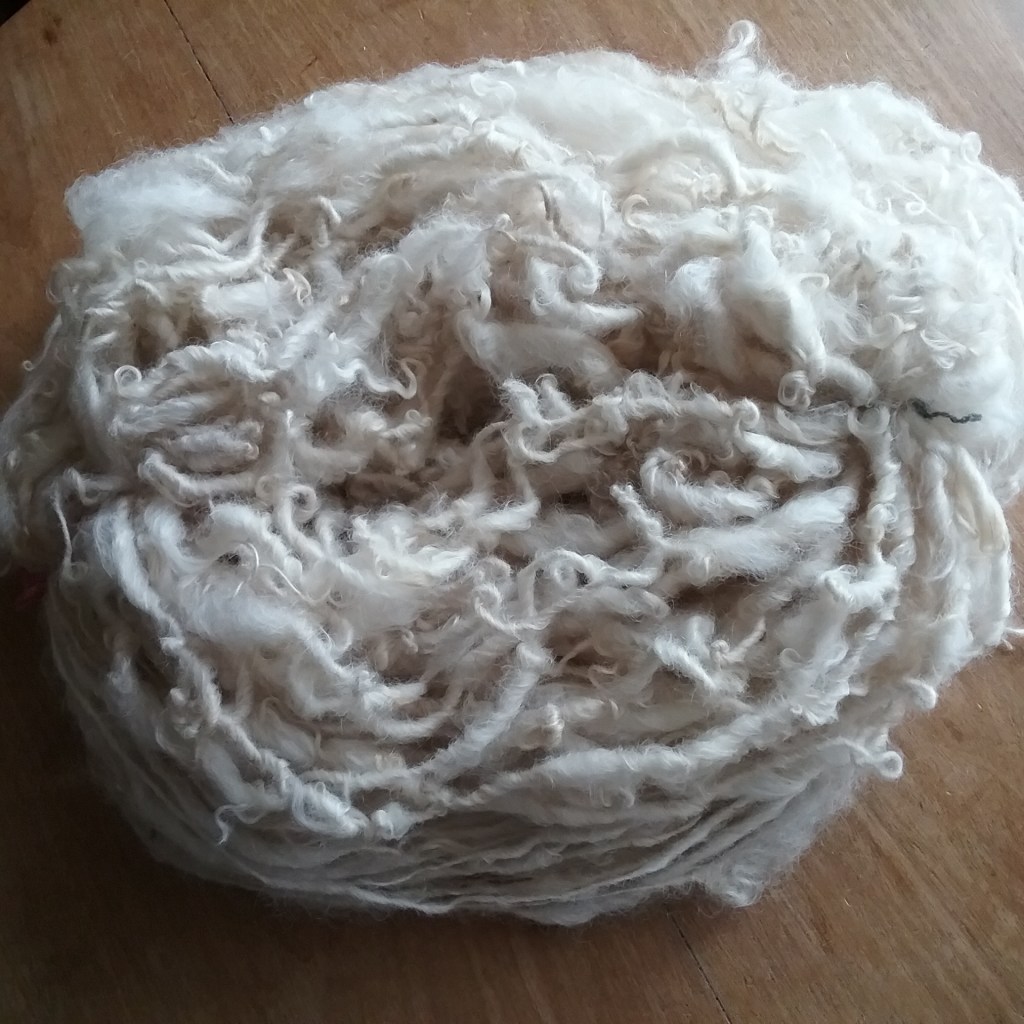
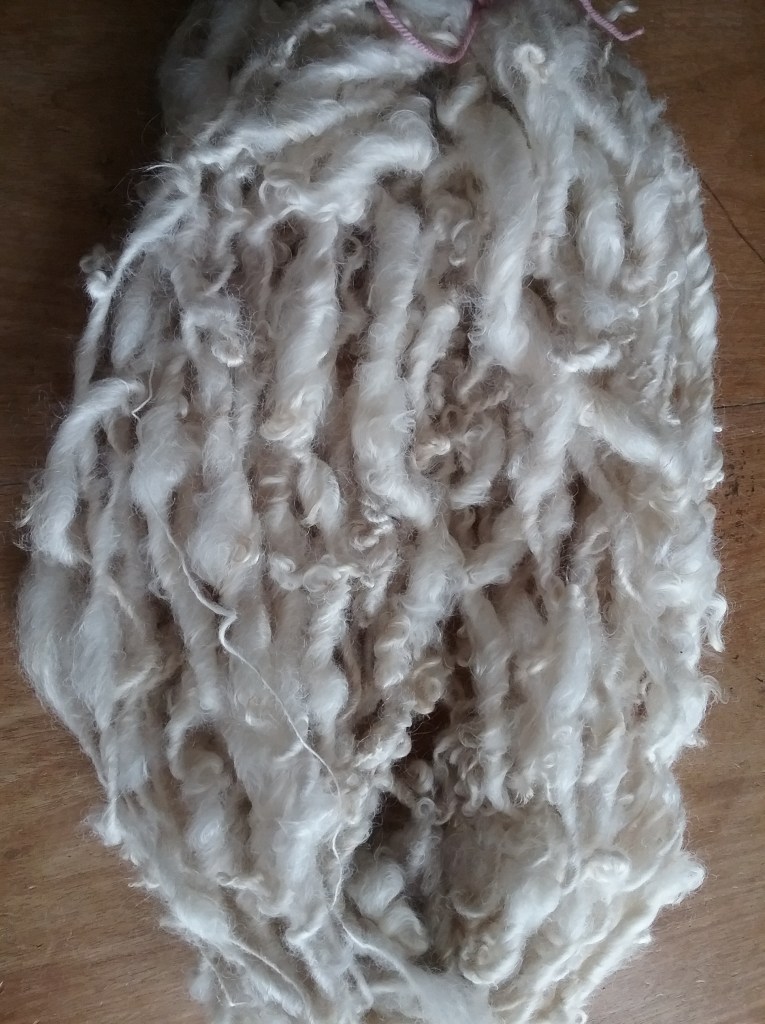
Usually long stapled fleeces are combed and spun worsted style to create an even yarn, however I like to try and keep the quirks of each fleece in the finished wool. I decided I would spin the fleece as it came without any preparation apart from some light teasing apart of the fibres to help keep the shape of the locks. Unfortunately back in 2020 when I washed my fleece, the orifice on my standard flyer was too small for locks to pass through; however I recently fitted a jumbo flyer to my wheel so I can now spin thicker yarns.
Attempting a Coreless Corespun
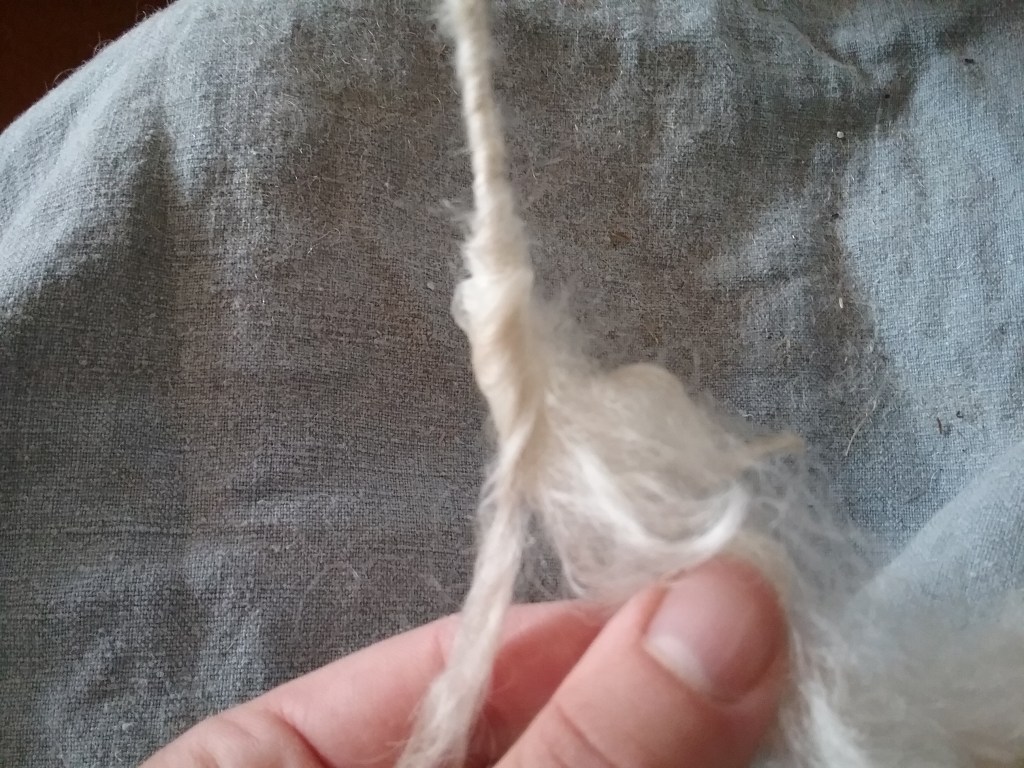
Core spinning is usually done by allowing loose fibre to wrap around a pre-spun or commercial ‘core’ yarn instead of drafting in the usual manner (a good link to this technique on Youtube is here). This core gives added strength and the yarn has a different look. I’ve tried core spinning with roving several times before, but I felt that the Lincoln Longwool fleece would be too slippery to catch properly onto a core, so I decided to try what many people call a coreless core spun. This technique is a little tricky to get the hang of as it involves drafting half of the fleece in your hands to make a core while simultaneously wrapping the other half around the core you’ve just spun. Hopefully the photo below demonstrates this somewhat:
The fleece on the left is being drawn out more than the fleece in my right hand which is wrapping around it.
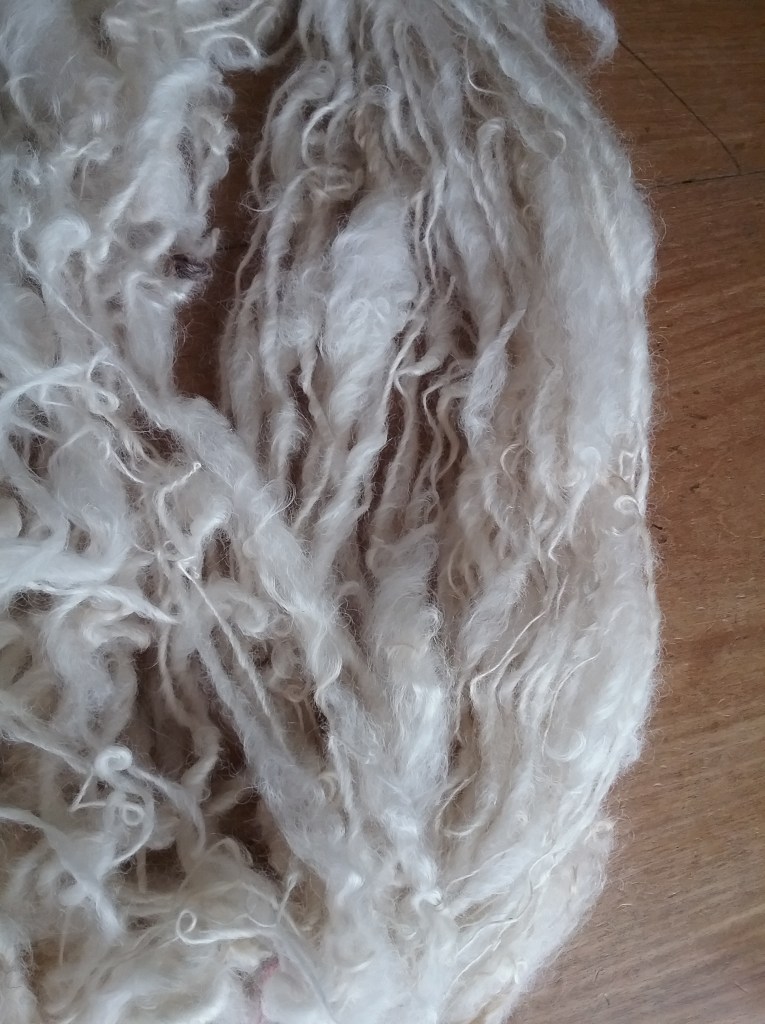
During my first attempt I drafted the fibres a little too much as there were some very thin sections and fewer locks showing. By my second bobbin full I was drafting the fibre less, treadling at a slower speed and allowing a little more twist to build up in the drafting zone to help create a thicker yarn. To help prevent over drafting I found it was useful to hold the two halves of fleece as if you were plying them together. My first and second attempt are shown below:
1st Attempt2nd Attempt
Although challenging, this fleece is making highly enjoyable spinning and as the yarn has a wide diameter, it is spinning up quite quickly. I don’t plan to ply my yarn as I feel this could flatten the locks out (however there are certainly lots of art yarn type plying possibilities) and I will update this post when I have attempted washing a skein to see how the locks behave after, as, still being a ‘single’ the yarn is a little energised straight off the bobbin. Textured yarns like this tend to be shown off best in weaving, so I think this yarn will be reserved for adding texture and contrast to woven projects, rather than a project in itself.
Hello everyone, I have had further computer problems since my last post which have kept me from blogging, but hopefully these are now fixed. I’ve been working on several things recently, some are bigger projects and are taking quite a long time to complete, so I thought I would share a few of my current WIP’s.
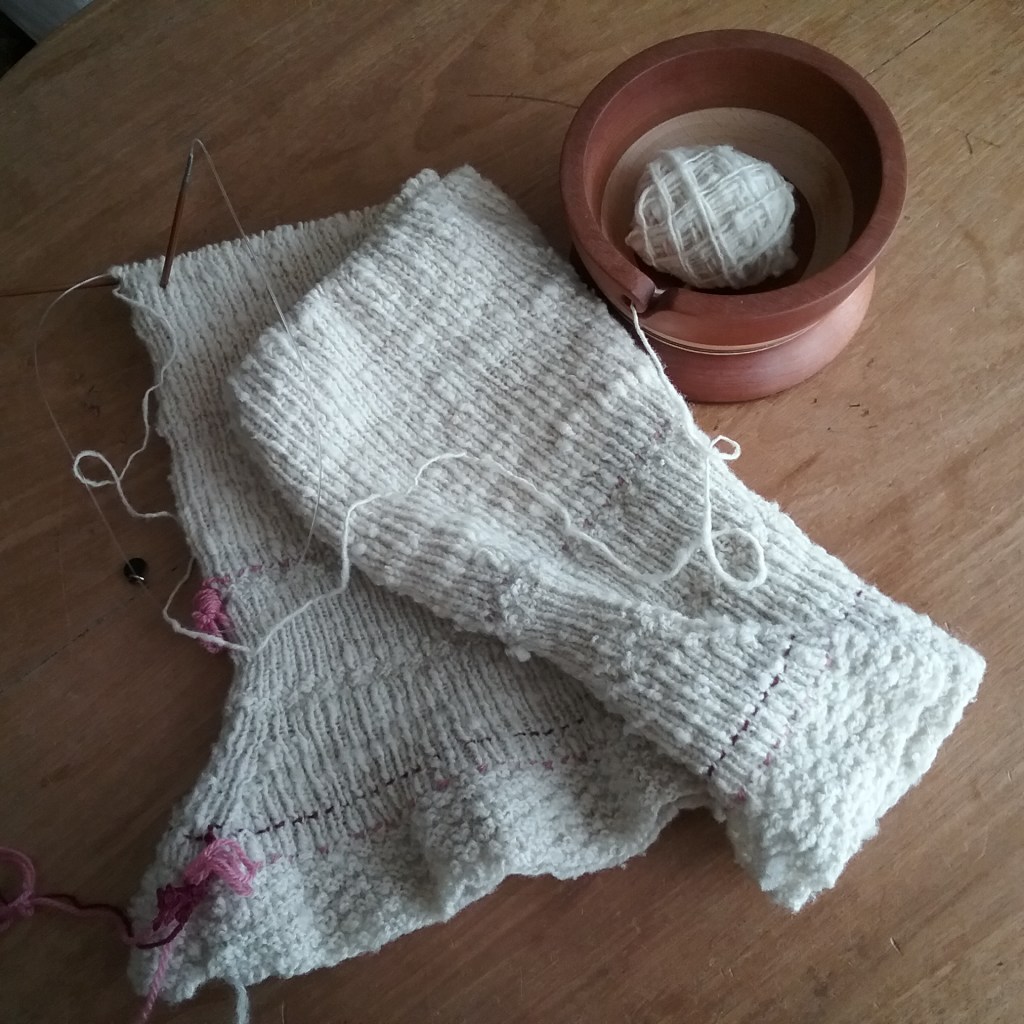
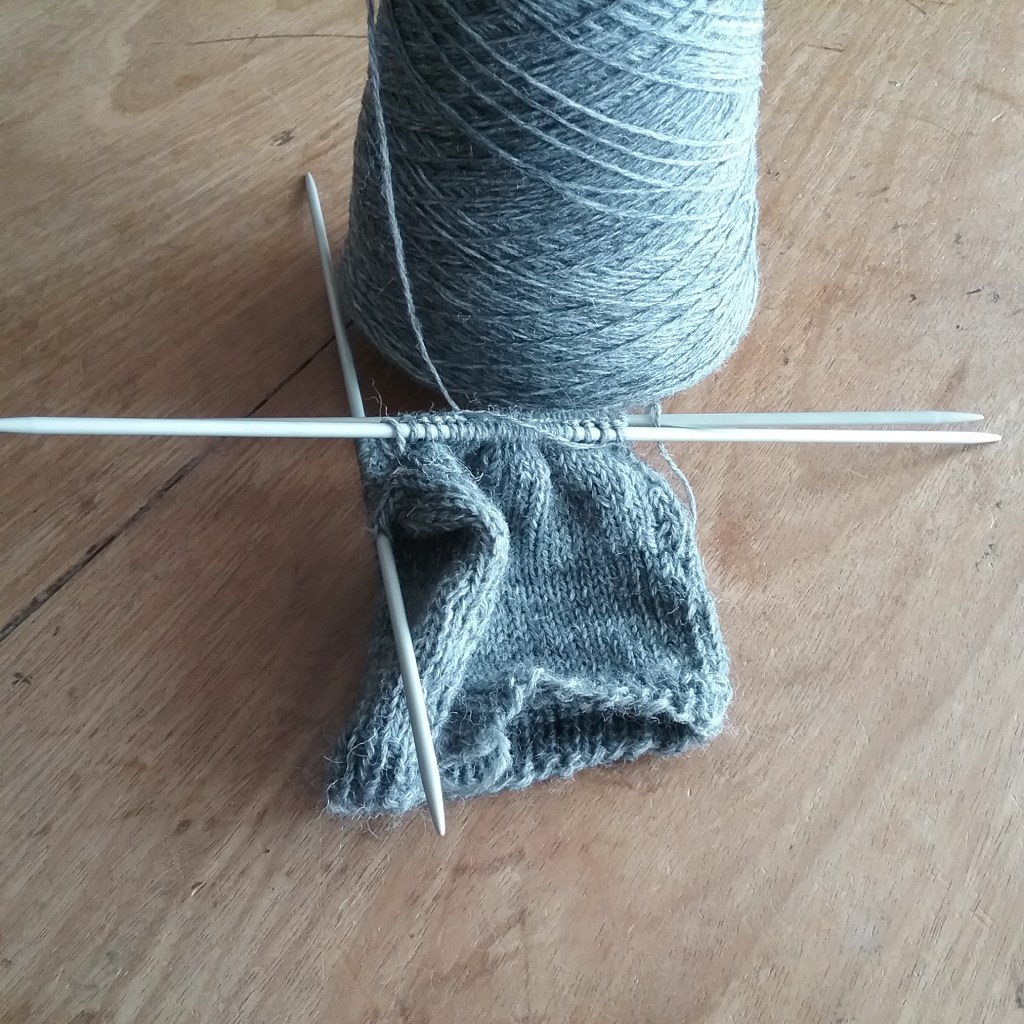
Knitting this year did not get off to a good start; January saw me frogging a lace pattern fingerless glove I began last October, when it was just 2 rows from completion. Even though I had followed the instructions for calculating the size it was too big, but this didn’t show until it was nearly complete. Disheartened after pulling it all out, I opted to put that project aside and instead throw myself into a different knitting challenge. I decided to attempt knitting myself a jumper from my handspun clun forest wool. I knew I probably wouldn’t have the patience to knit a standard jumper, so I opted to make things even more complicated for myself by using an original Victorian knitting pattern to attempt to knit a jumper with ‘leg o-mutton’ style sleeves. With the help of several ‘lifelines’ in case it all went wrong I’ve knitted about halfway up the body of the jumper now.
Halfway through the jumperSecret mystery project
I’ve also cast on another little project that remains a secret for now as it is a gift to a friend.
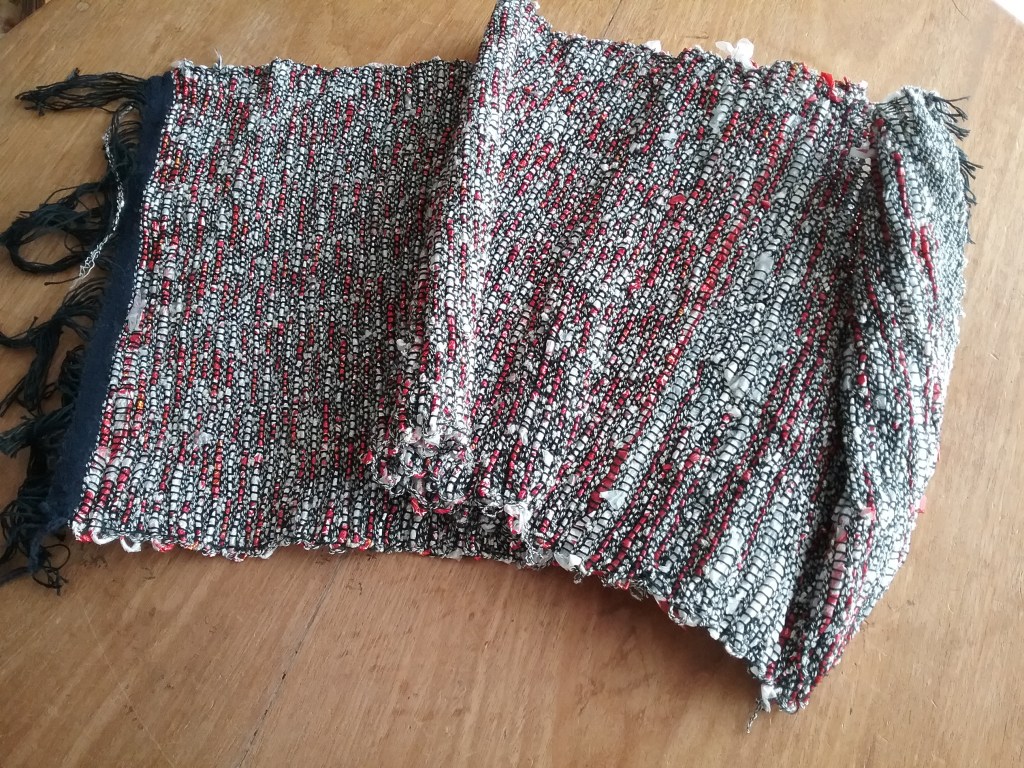
I had been pondering how to use the plastic sweet wrapper yarn I made last Tour de Fleece and after ruling out knitting and crochet (the foil in the wrappers made it too stiff) I decided to try weaving it. I wove one row of sweet wrapper yarn every two rows of black and white yarn from my stash in the hope that after washing, the fabric would have less gaps than if I just used the sweet wrapper yarn. This was the result…
I willdo a full write up of each project when they are finished. Now I can use my computer again I’m excited to get back to the usual more regular posts. Let me know what you are working on in the comments below!
Hello everyone, my computer has had problems for the past couple of weeks, so I have been unable to blog. It is temporarily fixed so, at least for now I can post again.
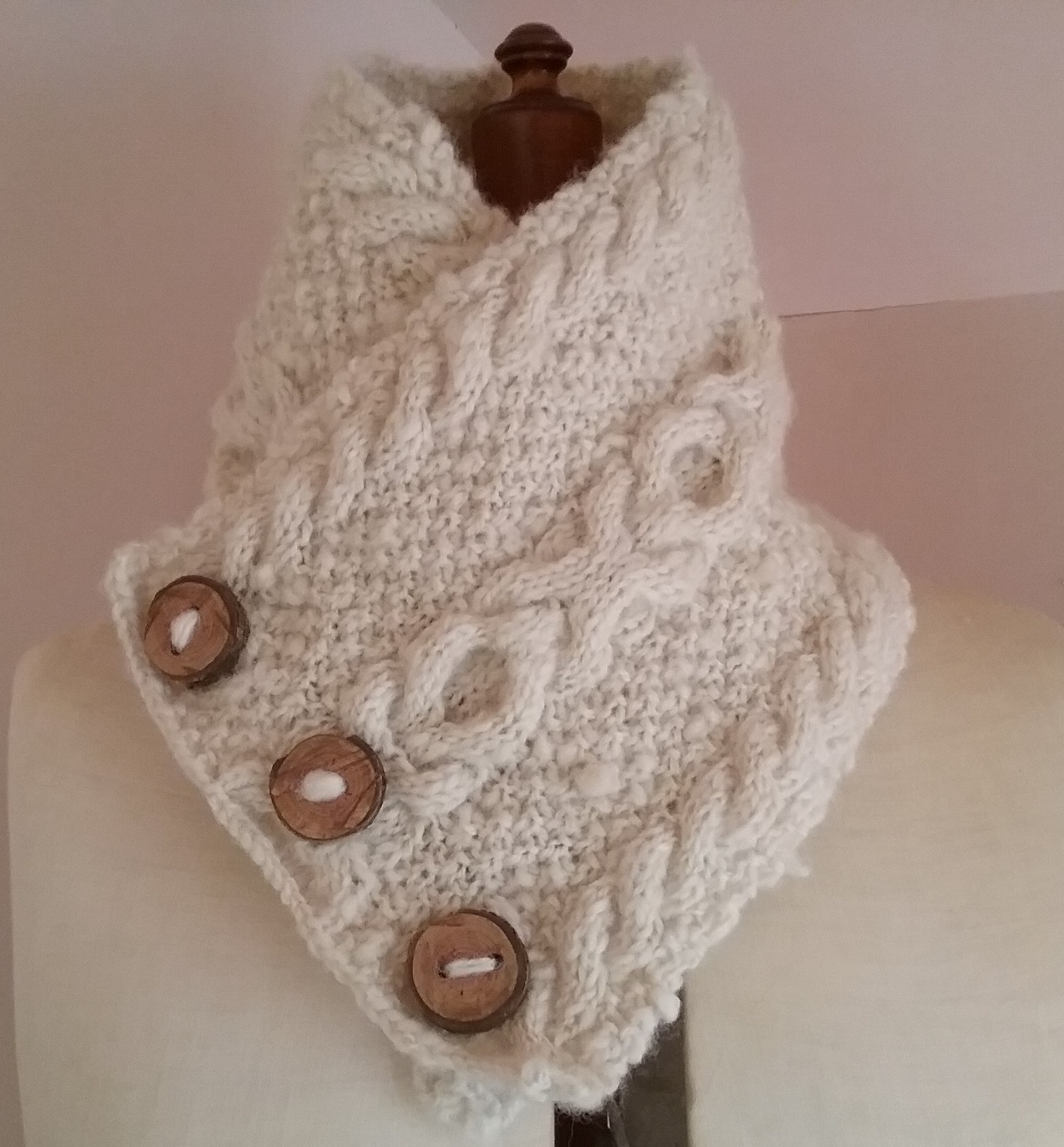
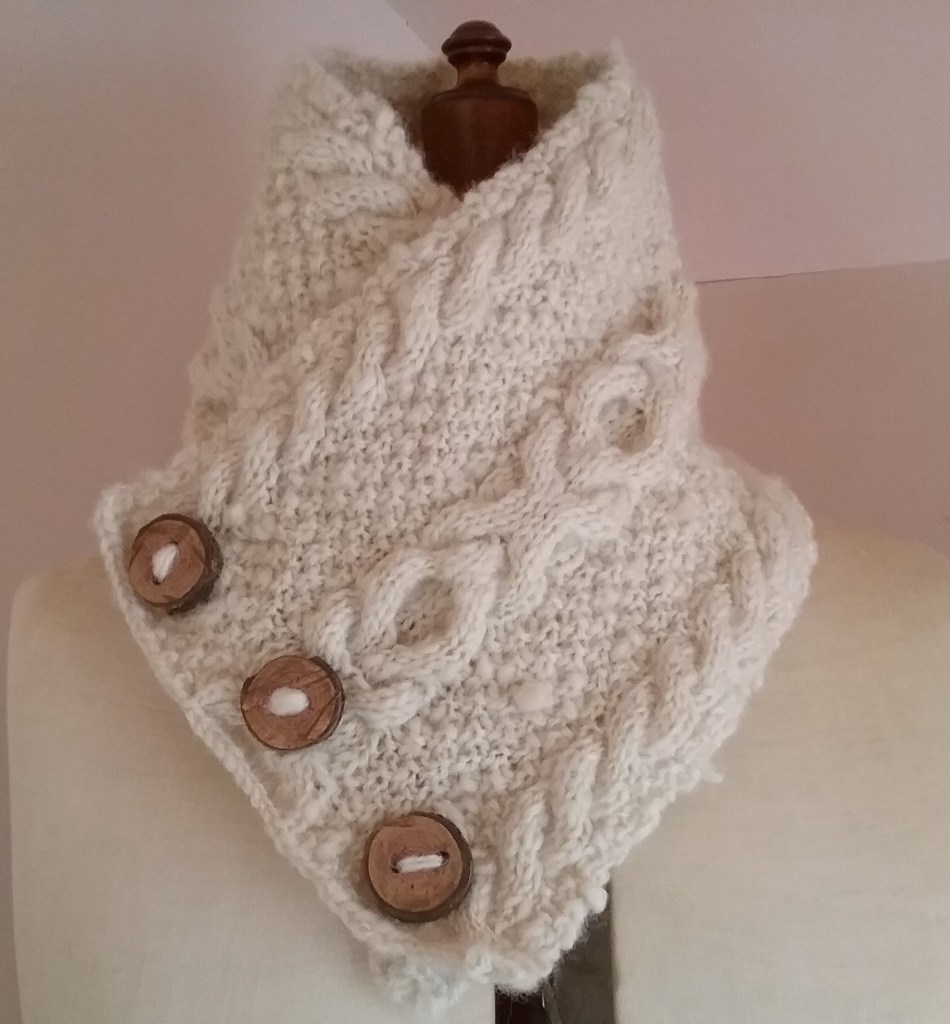
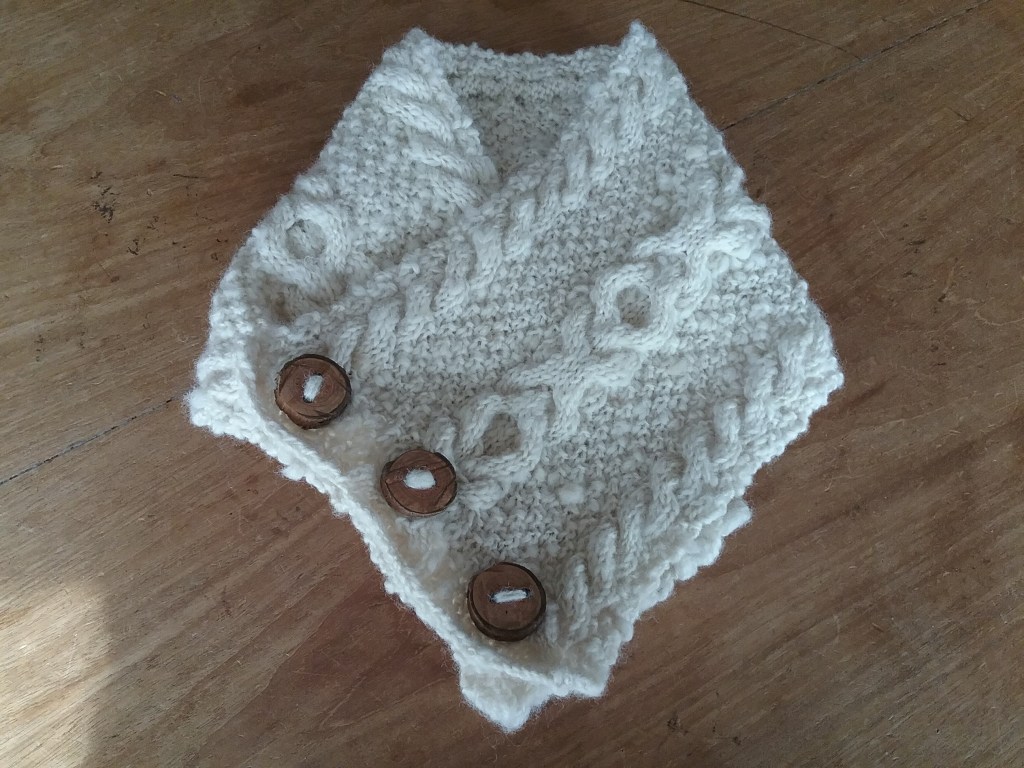
Inspired by the rich history of smuggling associated with Romney Marsh I decided at least one project I made from Romney wool should pay homage to this. In 2020 I purchased the cable button collar knitting pattern from the Wensleydale Longwool shop at virtual fibre east. I had never knitted cable before and the central pattern on the cowl reminded me of an owls face and eyes. I felt this would be a brilliant way to symbolise the ‘owlers’ of Romney Marsh.
I won’t go into details of the pattern as it is linked above, however I did change the button hole placement as I couldn’t seem to get them evenly spaced and the right width on my cowl following the pattern (probably to do with the fact that I was using handspun Romney fleece instead of the Wensleydale its designed for). Having never knitted cable before I found it was very easy to follow and the Romney wool has a stiffness about it that helps show off the cable pattern and keep its shape.
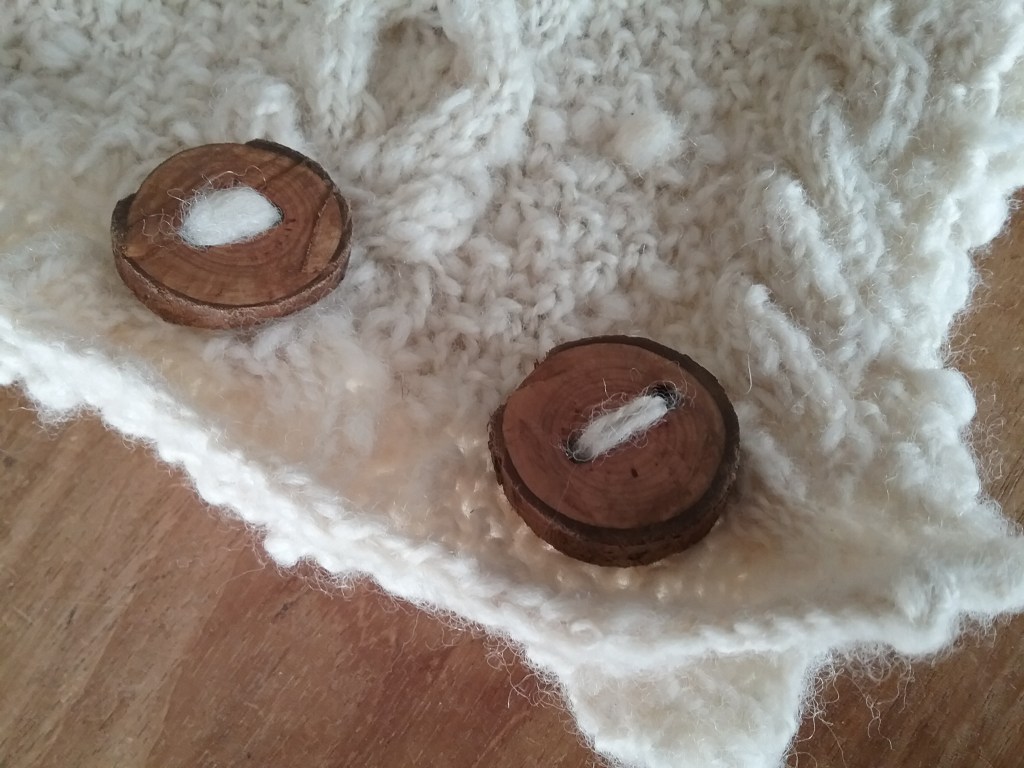
After knitting the cowl, the next stage was to add some buttons. This proved to be the hardest part of the process as no matter how many buttons I tried, I wasn’t quite happy with them. I wanted the cowl to have a natural look, so I decided to make my own buttons. These were made by sawing three sections of a small fallen branch of the required diameter, sanding them down either side and then oiling them to finish. When they were dry I could sew them onto the cowl as per the instructions. These are the first wooden buttons I have ever made, so if anyone has any tips, do let me know in the comments.
Although it’s taken me a year to finally put the finishing touches on this project, I’m really pleased with how it’s turned out. The cabling makes it a very thick fabric so it’s incredibly warm and will be perfect when winter comes again.
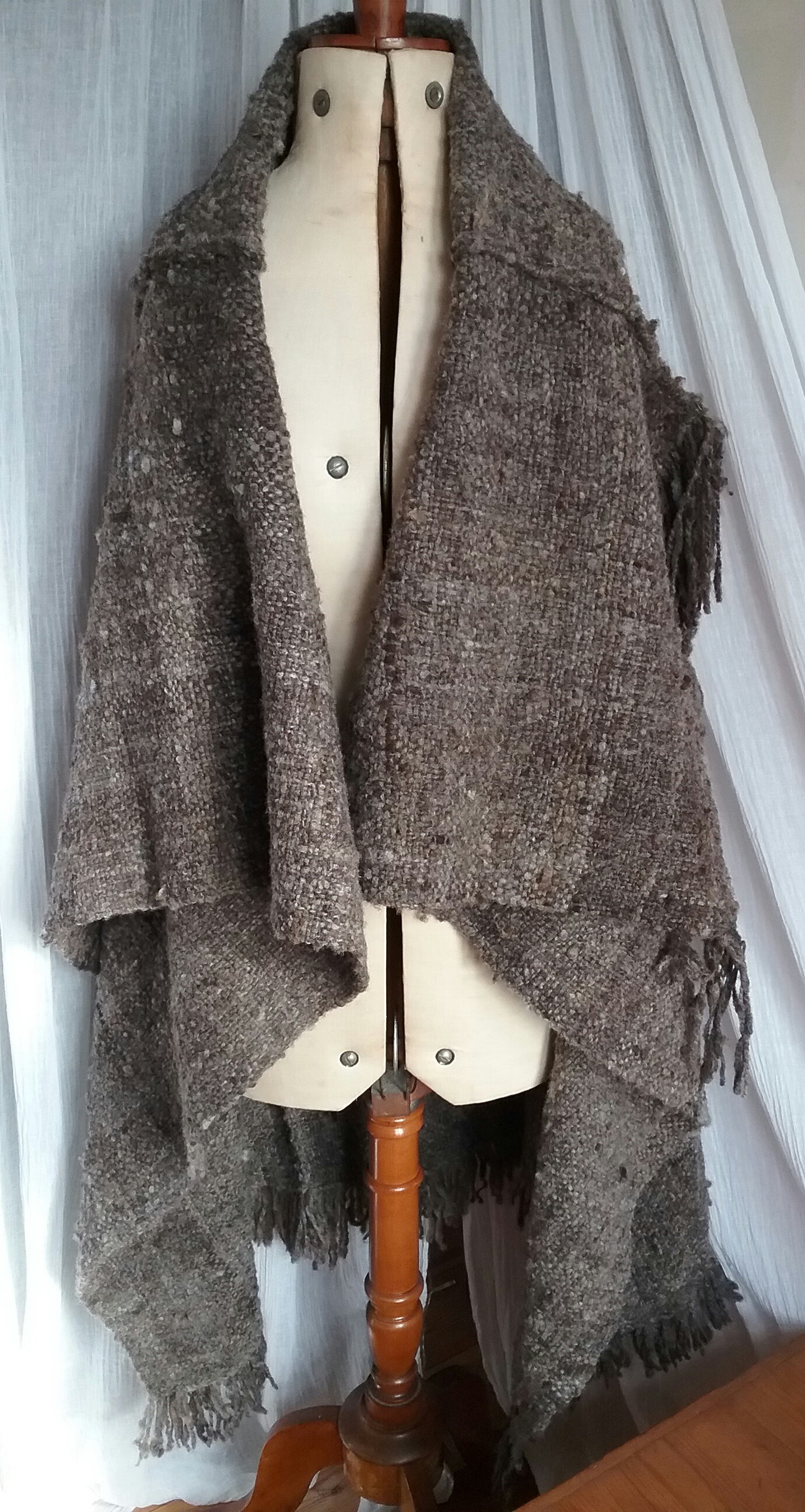
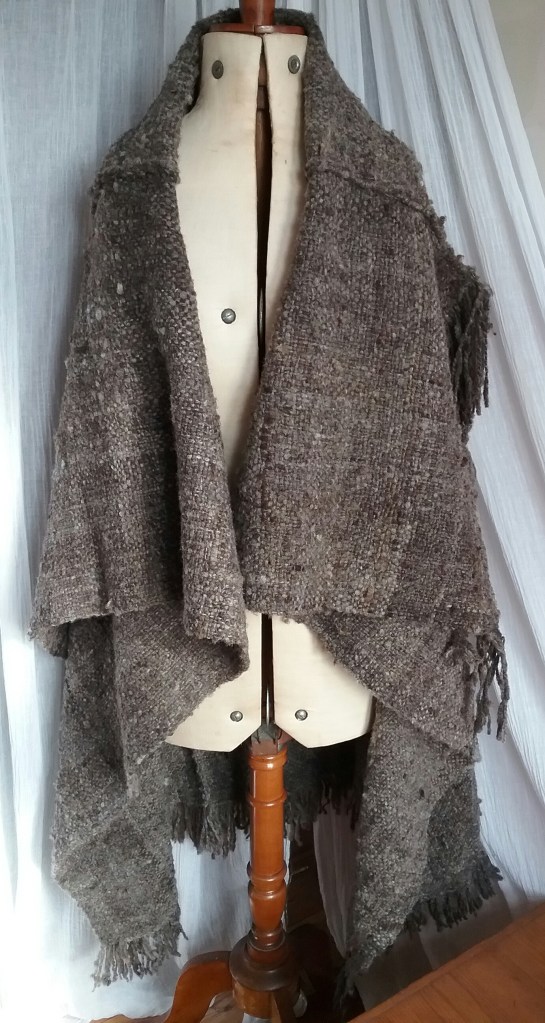
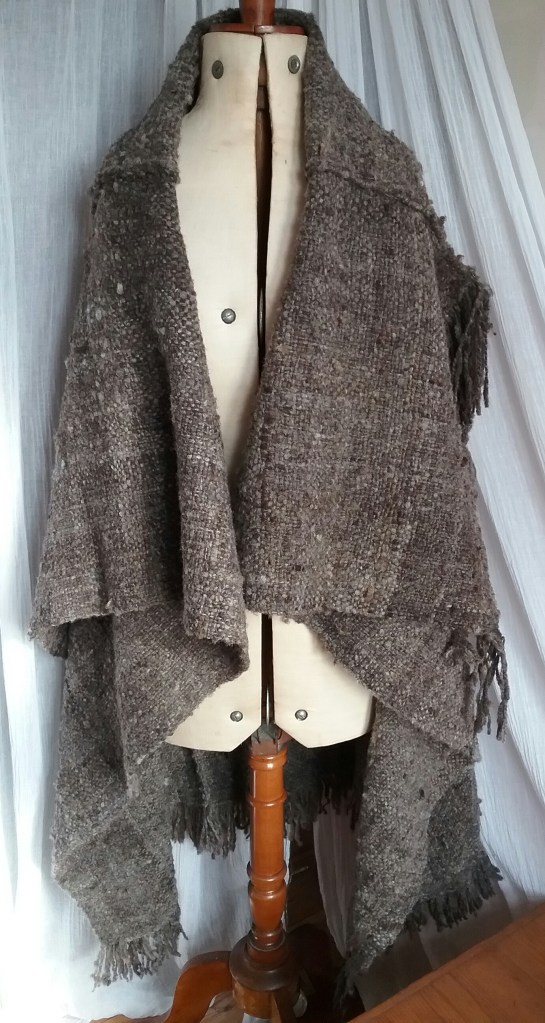
In March 2021 I put out a blog post showing my progress of some woven ryeland fabric, which I have finally turned into something. It’s been a long while in the making as my original idea didn’t work, so it sat folded on a chair while I pondered what to do about it. Although this was a simple project I’ve learnt a lot from it and made several mistakes, so I thought I’d talk through it from the very beginning explaining how it’s evolved. If you’d prefer to skip the background and just see the final project, you can jump straight to that section here.
The Original Plan
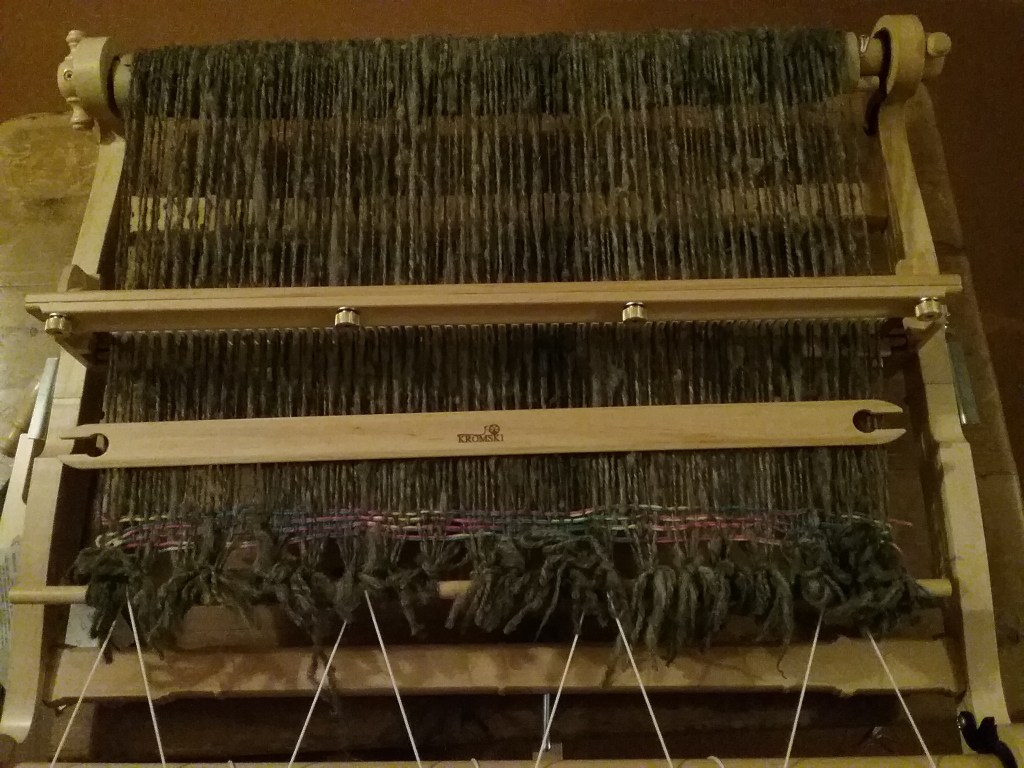
I’d seen a style of woven jumper by Fran Casseli in Ashford’s The Wheel Magazine (Issue 32) and thought it would look very nice in the Ryeland. I had already calculated the total yardage of wool I had, so I did some quick calculations to find the warp length that I would need. I then directly warped my rigid heddle the full width using a 5dpi reed (I use a weavers choice heddle that lets me swap out my dents rather than buying each size of reed). The idea was to weave the front and back of the jumper on one warp and the sleeves on another narrower warp, thereby reducing the amount of threading. Although I had taken into account extra length for loom waste and shrinkage in the wash, I did not take into account how woollen yarn behaves when warping.
Ryeland Warp Ready for Weaving
So, I wound the warp onto the loom and began pleasantly weaving the first length. I used a piece of waste yarn the length my first half needed to be as a measure that wound onto the front beam with my weaving. After reaching the end of the first piece I had a feeling that I was more than halfway along the warp, but since I couldn’t do anything about this, I hemstitched the end, left a gap and then continued weaving the second piece. I then removed the weaving from the loom, separated the pieces and washed them. This was the point I realised what had gone wrong.
Woollen yarn is particularly good for knitted items because of its ability to stretch and shrink, unfortunately I hadn’t taken into account that it does the same thing when used in weaving. It stretches when put under tension on the loom and then springs back when that tension is removed even before washing. Its springy nature also makes it a little harder to manage when direct warping (not to mention that my setup was not ideal and my warping peg fell off the stool it was clamped to twice!). This is probably why worsted yarn is normally used for weaving! Both my pieces of cloth were slightly different sizes and were too short to use for the original jumper idea.
Thinking of Another Solution
Still wanting to turn my fabric into a jumper I turned to my Saori weaving book for some inspiration. Saori clothing takes an ‘origami for clothes’ approach, so I found a boat neck jumper that I could make by sewing my two existing pieces together as one and weaving another length the same size. Unfortunately I misread the diagram and mistakenly added two measurements together so my second piece of weaving was too long for that jumper. Not despairing, I found another pattern that used two pieces the length I had and tacked it together. When trying it on however, I realised that the woollen fabric was too bulky in this style to drape nicely, and looked more like a marshmallow. As the fabric was a relatively loose weave, cutting it was out of the question and at this point I was running low on ryeland yarn. I folded the three lengths of fabric and sat them on a chair while I debated what to do about them.
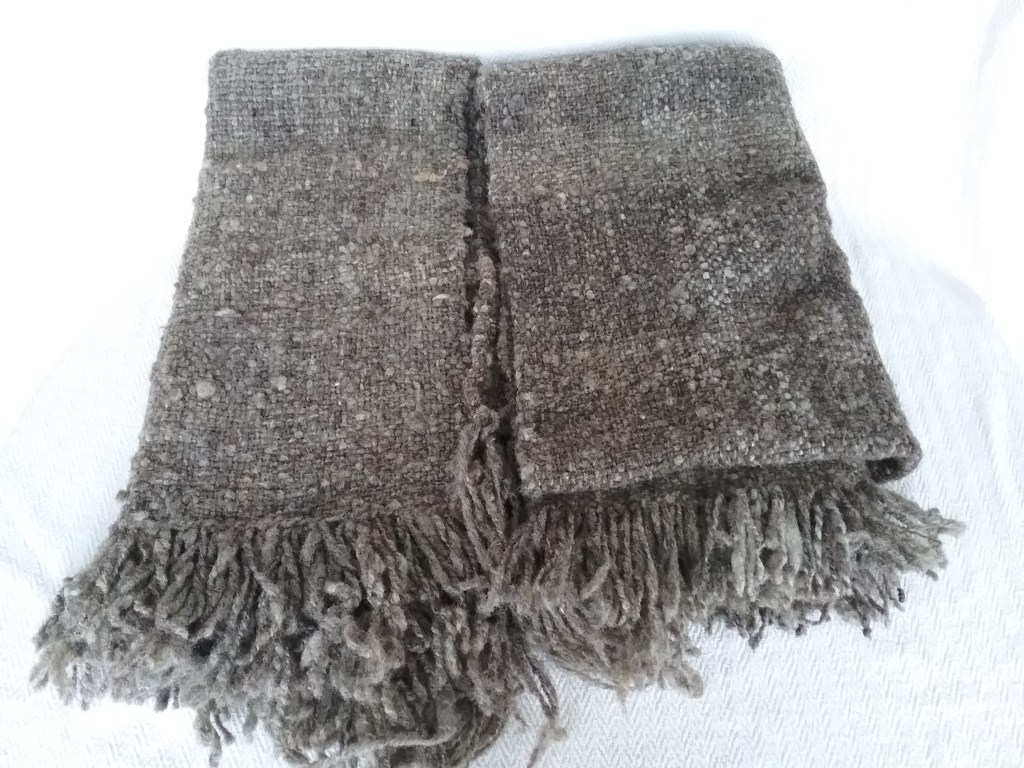
Woven Ryeland fabric after washing
I considered that the Ryeland might look nice stitched together as a blanket, but still didn’t want to give up on the idea of a piece of clothing. There was a circle poncho pattern in the Saori book that I’d wanted to make for a long time, but didn’t think I had enough yarn to make it from the ryeland. I decided that whatever I did I was going to have to weave another length, so if I ran out of yarn I would just have to source some more ryeland fleece.
Third Time Lucky
Using the same 5dpi full width set up on my rigid heddle I set to work warping the loom. To try and have less waste (and an accurate length) of warp I decided to try out indirect warping, turning my loom upside down and using the warping pegs (there are a couple of good tutorials for indirect warping from Kromski and Ashford). Once I’d established my threading cross I found it quite easy to do and it saves your legs and back from walking and bending. My previous tensioning issues were also solved as the warp is not threaded under tension.
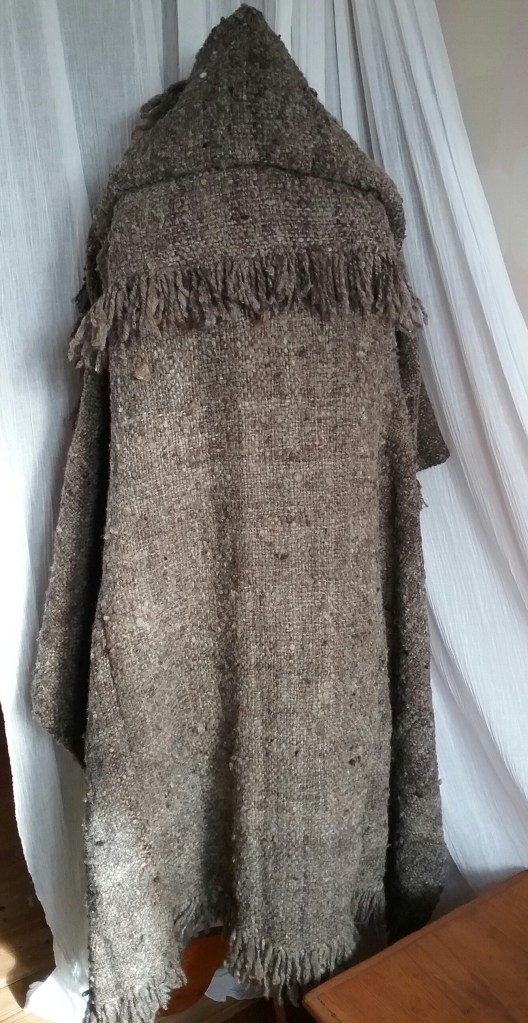
After weaving and washing I could begin assembly. The first job was to join the two short pieces together to make one length. I had grown very fond of the fringe, so wanted to preserve as much of it as possible. I decided to overlap the two ends so that the neat fringe of one was on top and the knotted fringe of the other was at the back and got trimmed down. I did this on the sewing machine, but the fabric was probably a bit too thick as it got caught on the presser foot a few times.
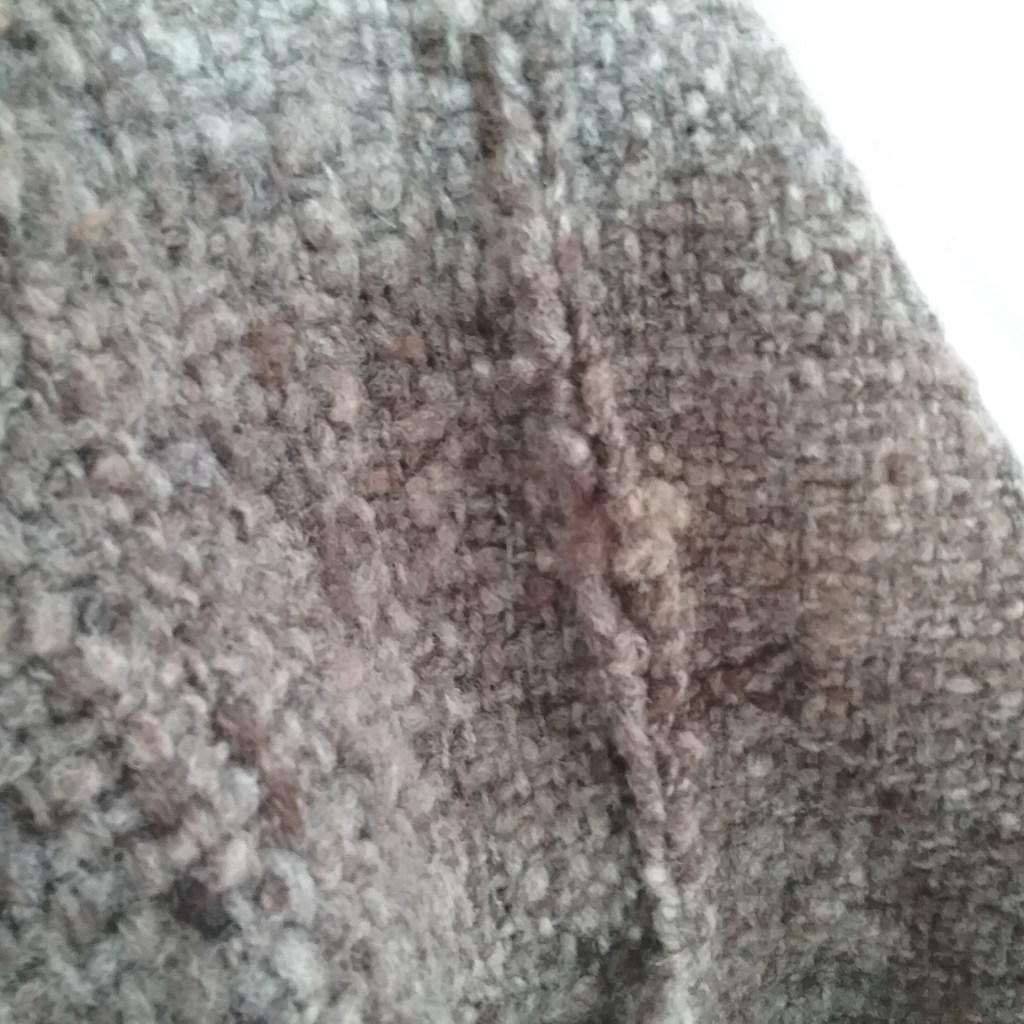
Then I laid out all the pieces and decided on the asymmetrical arrangement as none of them were quite the same length. This decided, I tacked them down to check the fit before setting to work hand stitching the long seams into place as per the pattern. I could have used a sewing machine, but I wanted to sew using the ryeland wool, which needed a tapestry needle. The seams were sewn right sides together with a short backstitch for strength and a slit left for the armholes (pattern can be found on page 104 of ‘Saori Self-Innovation Through Free Weaving’ Book). Finally I evened up the fringe at both ends and it was ready to wear.
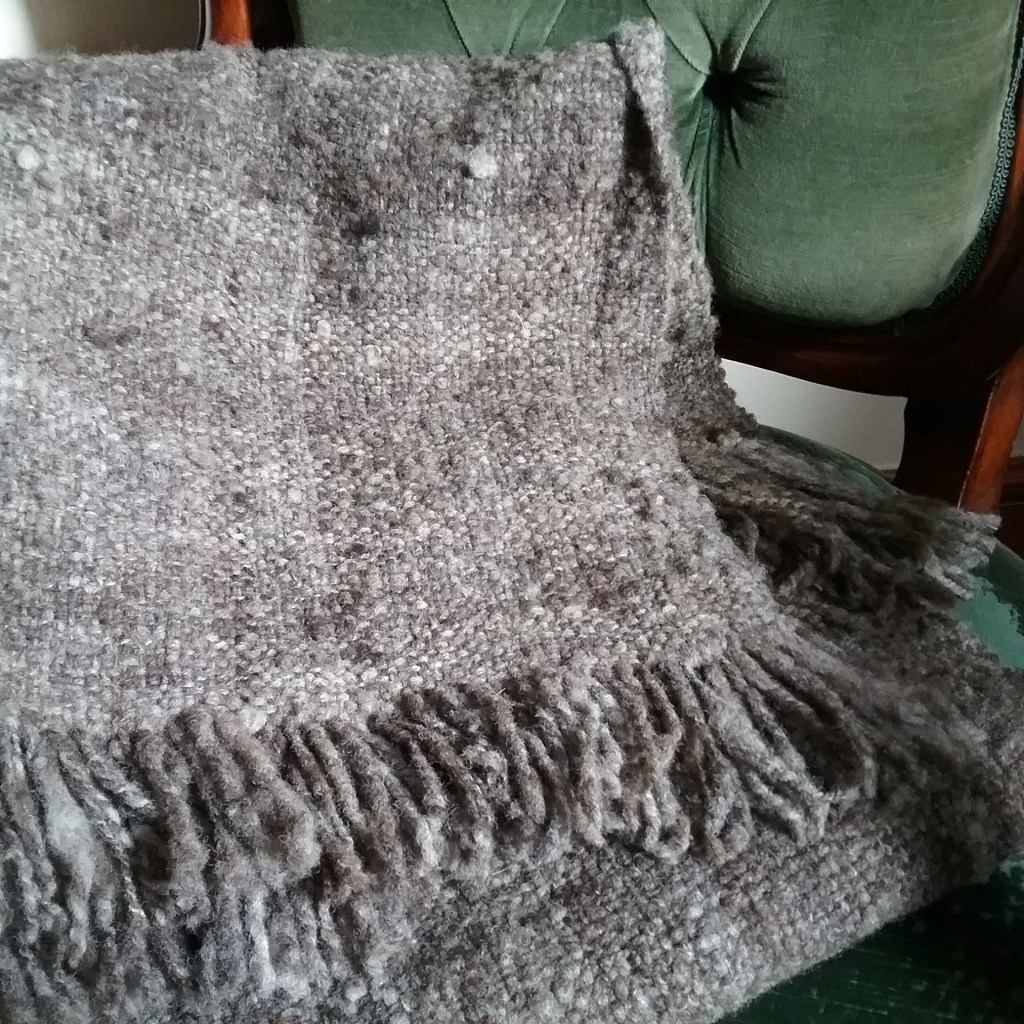
Front of PonchoBack of Poncho showing fringe seamBackstitched SeamAs a Blanket
I am very happy with how this eventually turned out, it works both as a very cosy poncho/jacket, but also can be used as a blanket, so is the best of both. I’m also glad I took the time to think about it as it’s forced me to try indirect warping which has been on my to-do list for quite some time. In spite of my worries about having enough wool, I still have a couple of balls left at the end of it, which shows just how much fabric can be made from one small fleece.
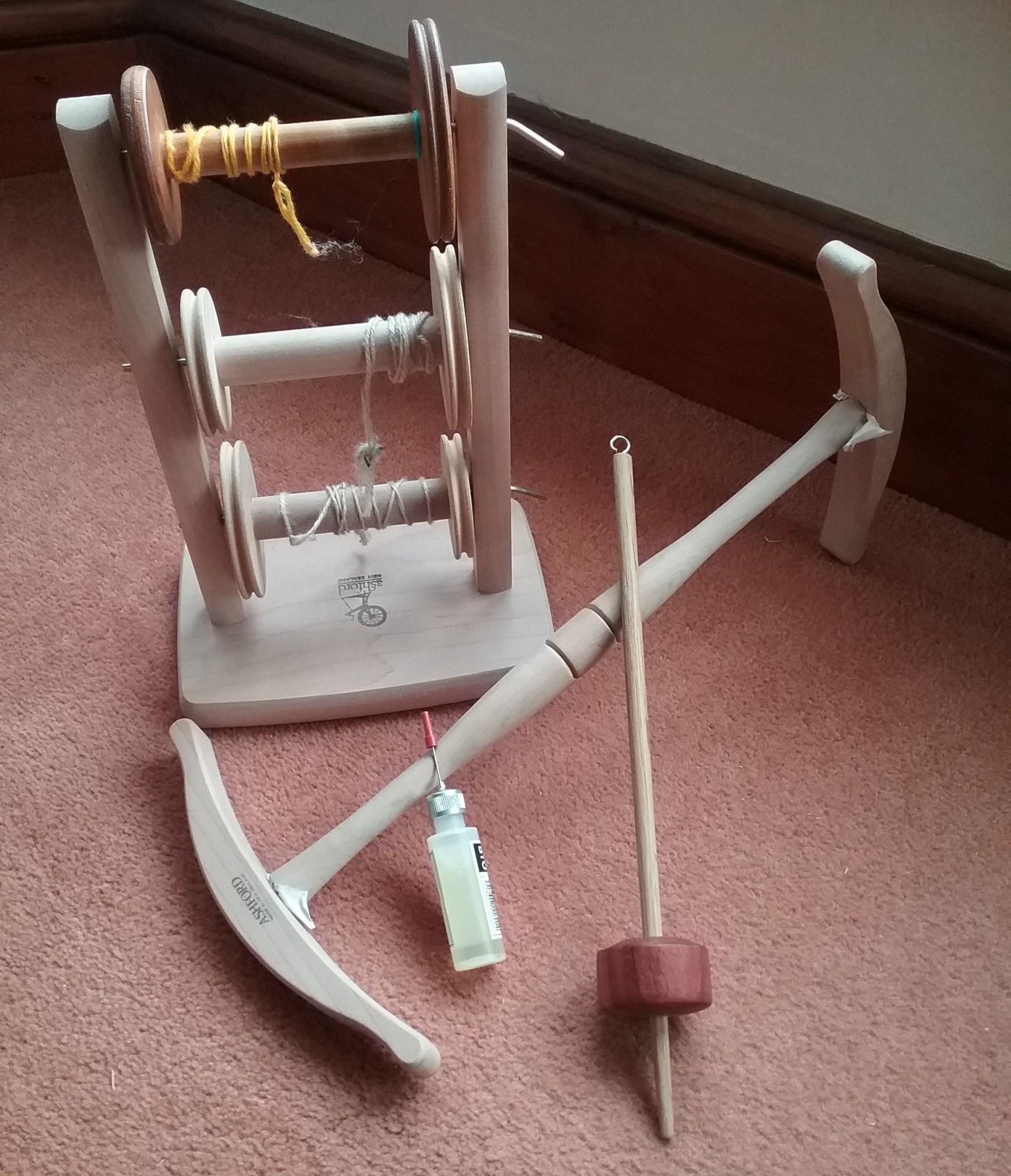
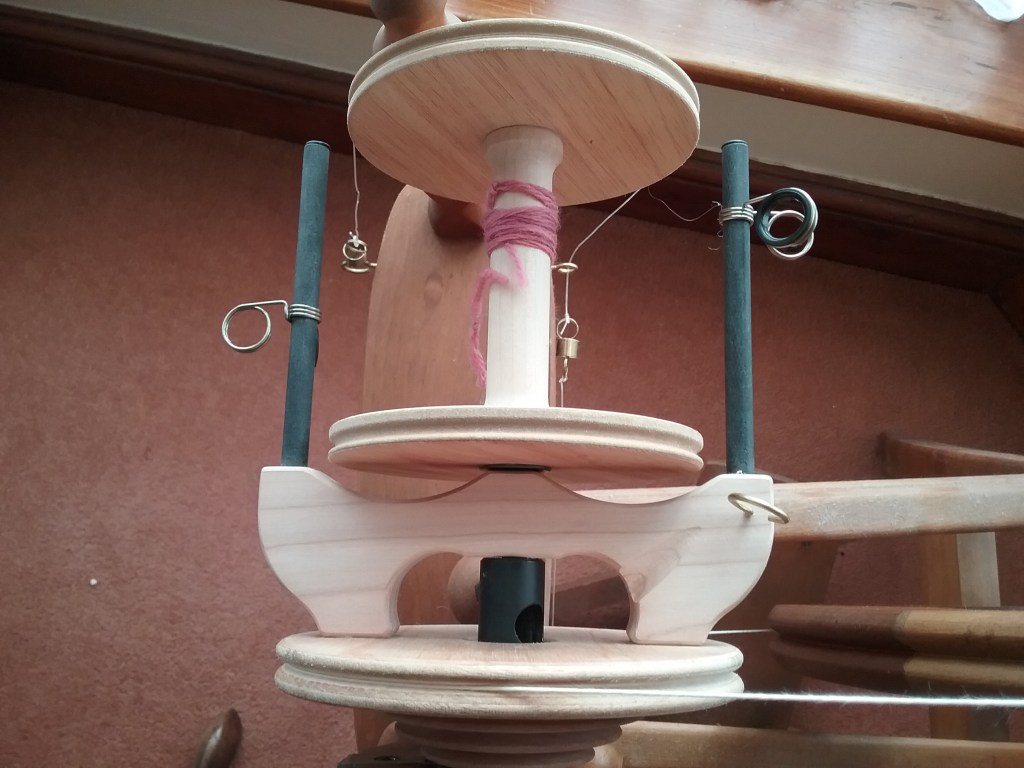
My trusty Ashford Traditional has been with me for three years now. It’s a very reliable wheel and spins beautifully, but the orifice size limits the size and type of yarn I can spin. Luckily Ashford make a jumbo flyer which has a larger orifice and can be fitted to their wheels (other spinning wheel manufacturers usually offer similar upgrades too). A family member treated me to a jumbo flyer for Christmas the year before last, but I wanted to use my old flyer to finish a project before I fitted the jumbo.
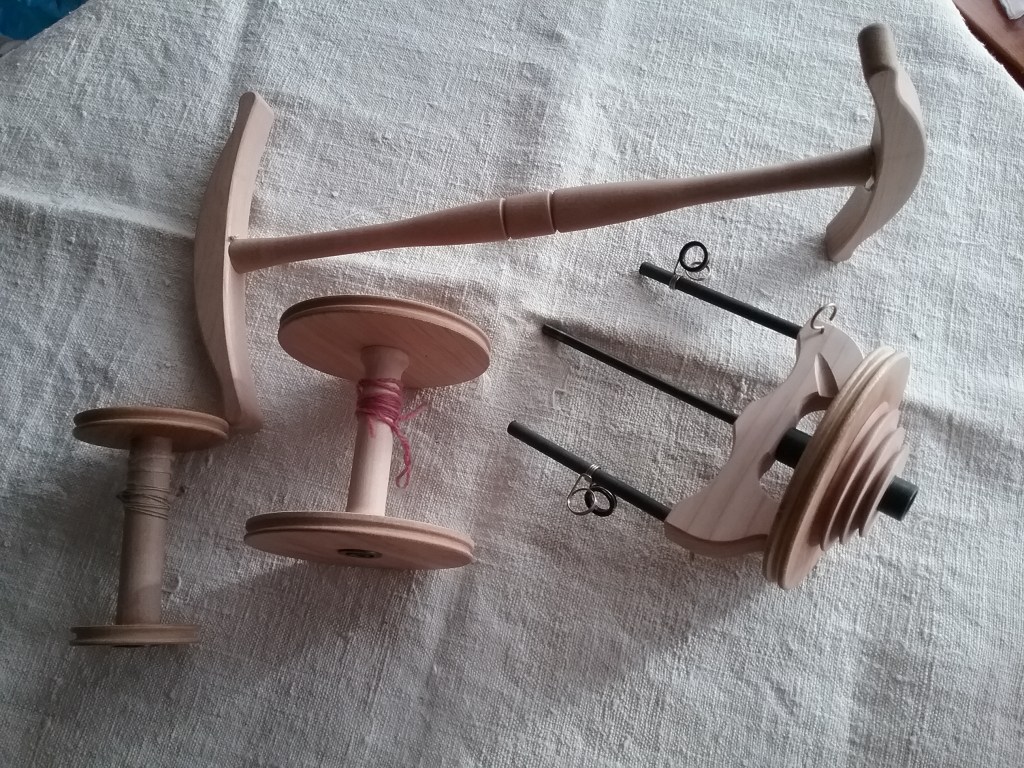
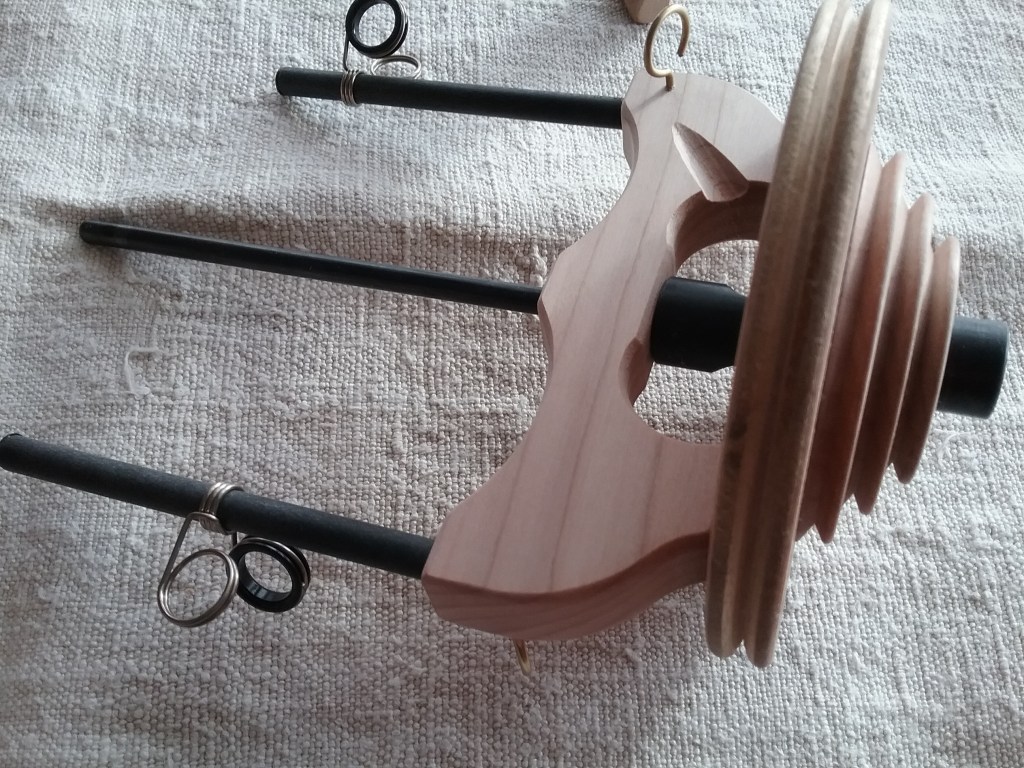
There are two styles of jumbo flyer; the standard which has individual hooks to fill the bobbin and the sliding hook (above). I opted for the sliding hook flyer as I wanted to spin textured art yarns and with the sliding hook there are fewer places for stray wool to get caught on as it winds onto the bobbin. The standard size Ashford bobbins can still be used on a jumbo flyer and it comes with an orifice reducer that you can clip into the orifice when spinning thinner yarns.
Fitting the Flyer
The flyer comes with very easy to follow fitting instructions, but there was the odd thing I did differently. I did also get carried away and fitted the flyer before having added a finish, so the order below is how it should be done, not how I did it!
My flyer was purchased unfinished, so the first job was adding a couple of coats of wax to the wooden parts of the flyer and bobbin. I also took this opportunity to wax my niddy noddy and one of my standard bobbins that were still unfinished. You could use an oil or lacquer finish instead, but I had wax to hand, it doesn’t have a strong smell and is easy to apply. After polishing the wood you can then slide the hooks onto the rods and screw the guide hooks into the pre-positioned holes.
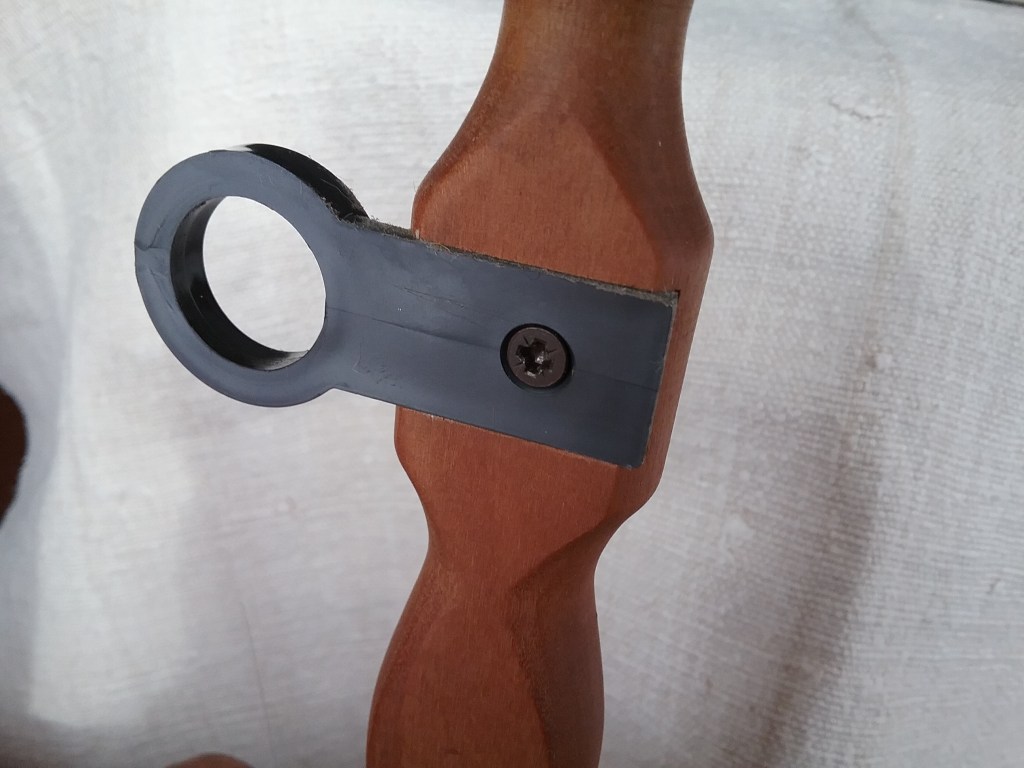
The next job was to replace the flyer bearings. The front bearing is the only one that needs to be replaced, but as my spinning wheel is from the 70’s I had previously replaced my back bearing with the newer style that lets the flyer clip in and out. Something that isn’t mentioned in the instructions is that new bearings can be slightly too large to fit the gap. Ashford send sandpaper in the pack to gently sand down the bearing edges, but it does need to be a tight fit, so gradually sanding and trying the fit is advised. It’s also a good idea to make sure the bearings are fitted in the correct direction with the entirely flat side facing in towards the flyer (see above).
After that the flyer can be slotted into place between the maidens and the new drive band fitted. I used my original break band and loosened it a little. Before using the flyer you then need to oil the usual points and tie on a leader.
I’ve had a little experiment with the new flyer and am very excited by the possibilities it presents. I like to spin wool in a way that preserves it’s character, rather than making it uniform, so this flyer gives me the freedom to spin thicker, looser, neppy and lockspun yarns and means I can finally work with some of the more textured fleece in my stash.
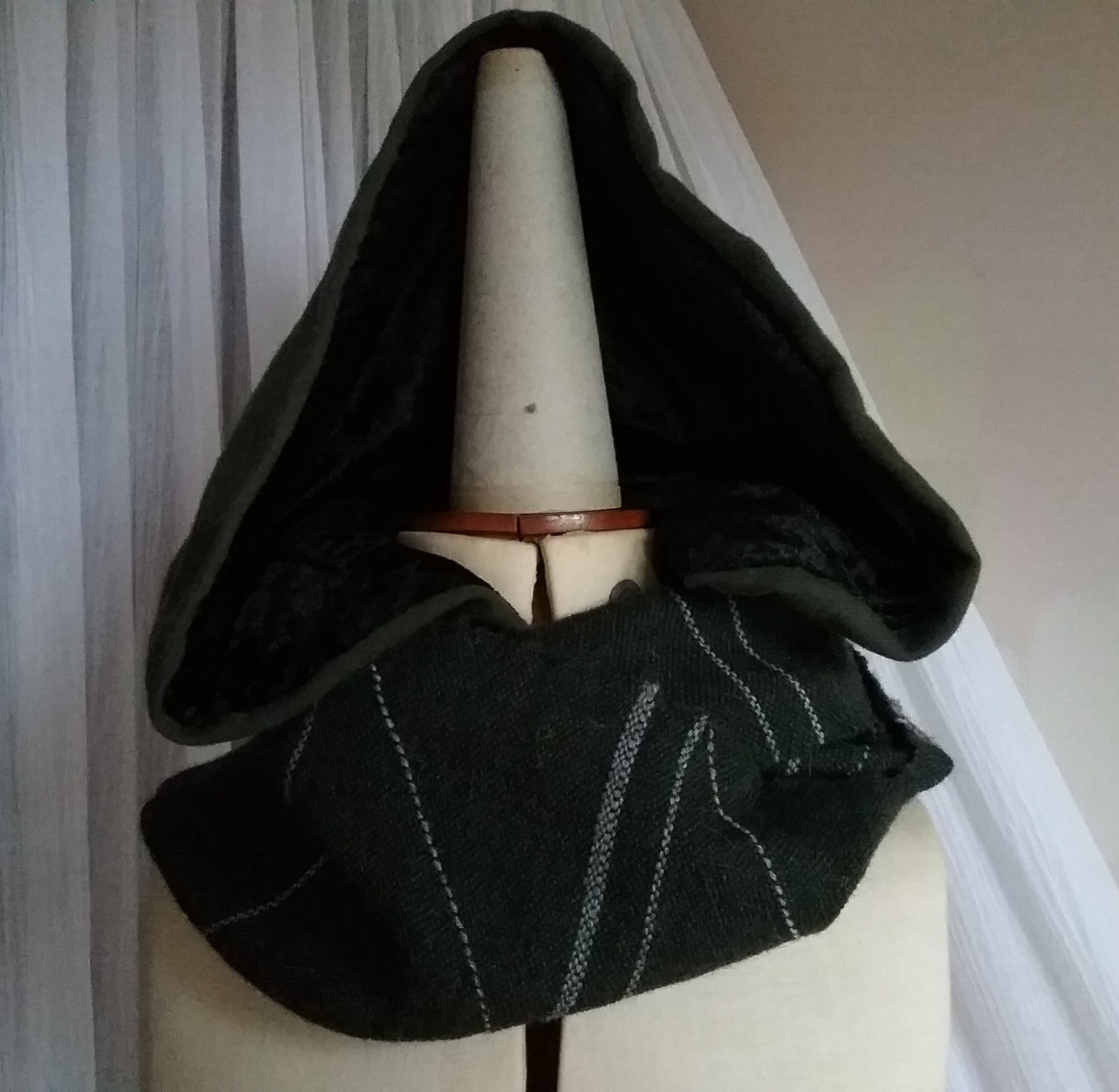
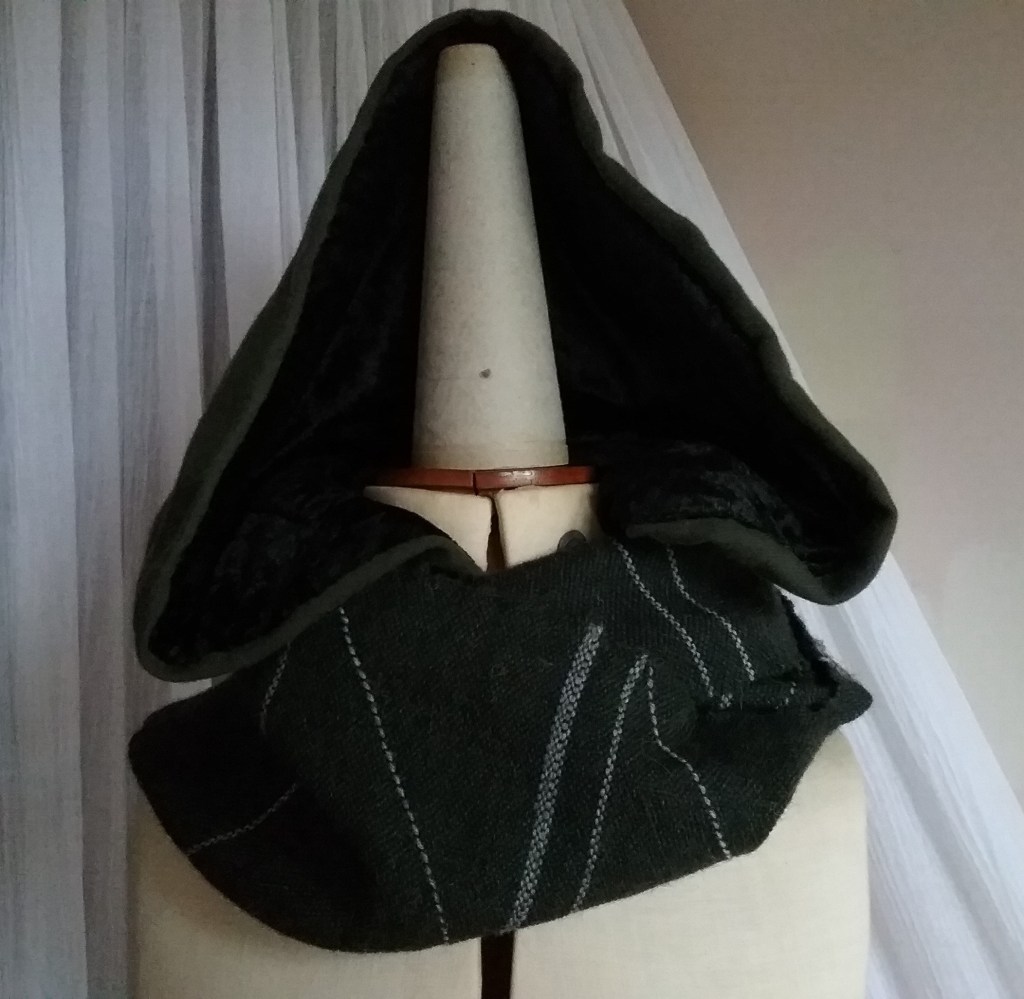
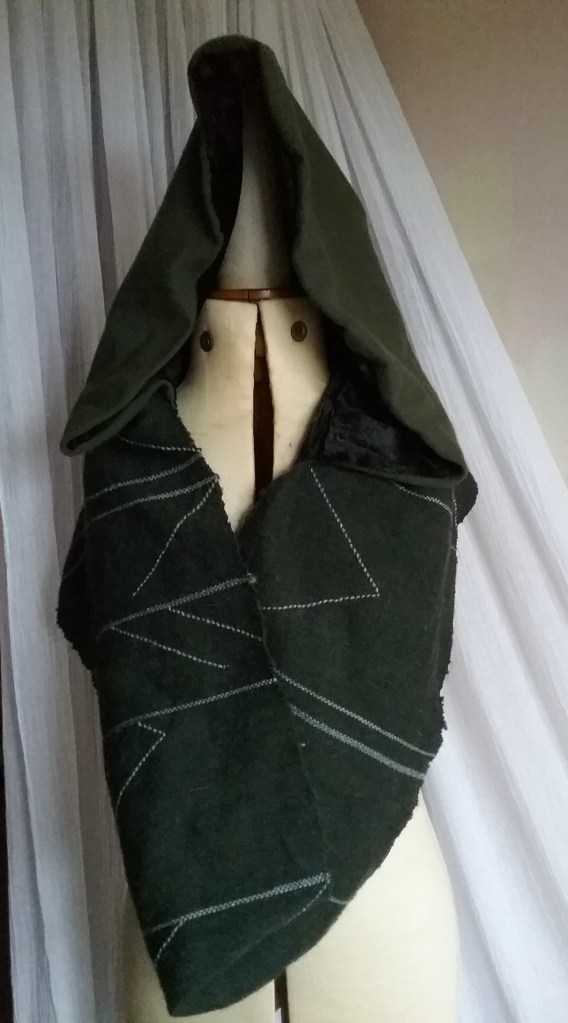
A final fibre related gift I made last year was this Lord of the Rings inspired hooded scarf. I was trying to think of a way of incorporating the medieval/fantasy style hood into something that could be worn every day and this was the result.
My Saori loom had a narrow thin black cotton warp currently on it that I wanted to use up ready to put another warp on and this was a perfect width for a scarf. I selected a forest green for the weft and a contrasting grey to weave patterns. I had originally intended to weave a pattern of curved lines evocative of elvish patterns, but whilst experimenting realised that my lines had turned into half of a dwarvish rune (seen in the front of The Hobbit book and on Thorin’s map) and I spiralled down a rabbit hole of weaving a message into the cloth. A Saori loom only has two shafts for a plain weave, so a different method might work better on a multi shaft loom.
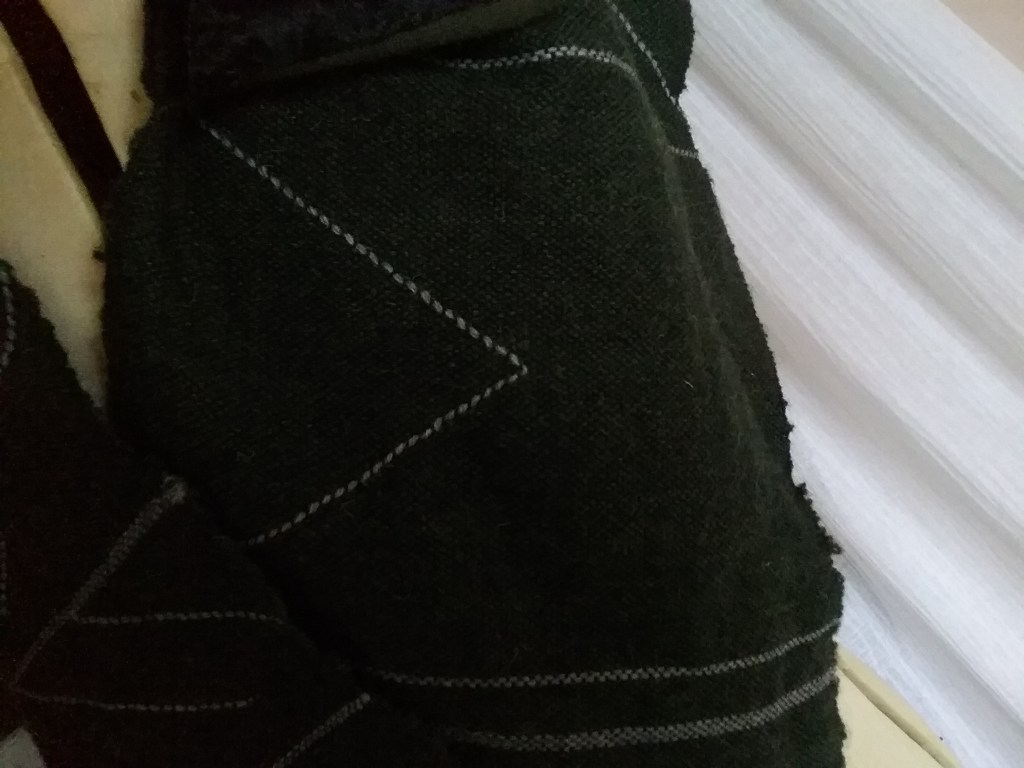
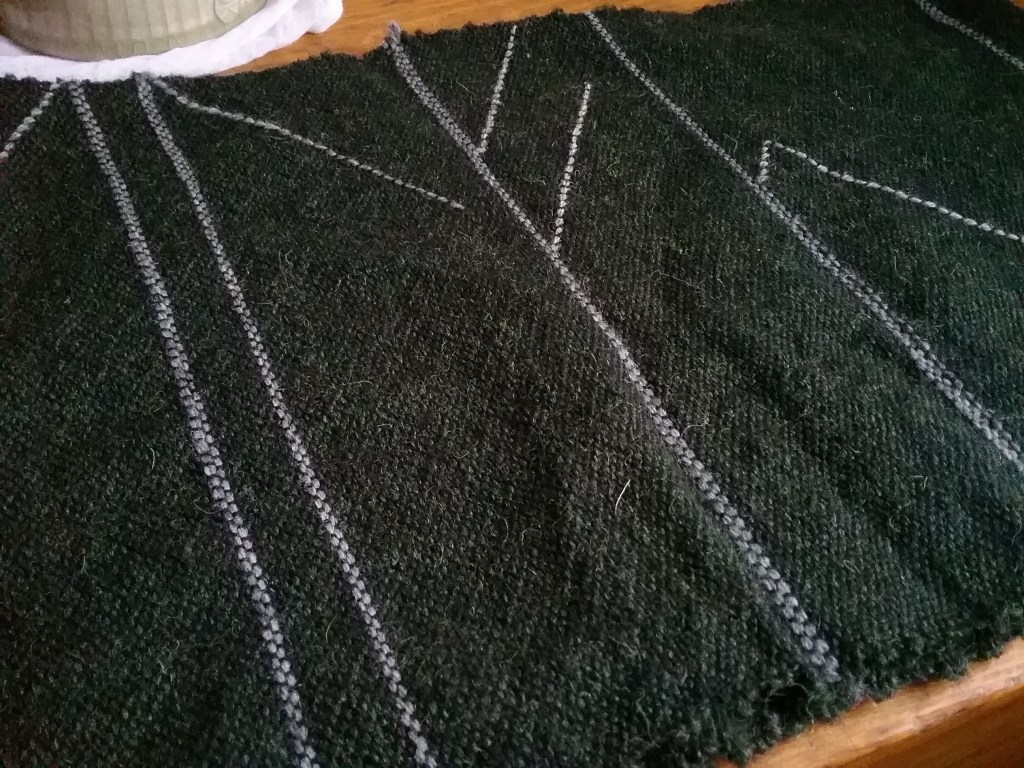
All the runes had to be woven sideways (as above) so I found a reference sheet was useful here. I also counted in from either side for the centre thread and made a note of this as it was useful for lining up where diagonal lines met. I had 1 boat shuttle threaded with green for the background and 1-2 bobbins threaded with grey depending on the rune. These bobbins were ‘free’ and I rested them atop the weaving as I worked. I began by weaving some plain green for seam allowance later on, before moving onto the runes. Straight lines were created by weaving 2-3 lines of grey thread instead of green. The diagonal lines were created by moving a grey bobbin under one warp thread at a time every other row in the direction required, whilst the green weft continued in a two row repeat i.e.
Row 1: Grey thread under 1 warp thread (right or left), weave 1 row green
Change shed as usual
Row 2: Weave back with 1 row green changing shed as usual
Depending on the letter, more than one grey bobbin may need to be moved at the same time.
Close up of straight and diagonal lines
After I had woven the length I required, I cut the weaving from the loom and knotted it before washing. I tidied up any loose grey ends by weaving them as invisibly as I could into the back of the fabric. I then sewed both ends together creating an ‘infinity scarf’ loop.
Although I had planned on weaving the fabric for the hood as well, I was running short on time, so I opted to use a complementary green wool fabric for this with a velvet lining. I used the hood shape from pattern C of Simplicity 5794, but opted to hand sew the lining into the hood so I could set it back a bit to prevent it from turning to the outside. After assembling the hood and hemming the bottom to prevent fraying I attached it to the top edge of the scarf, making sure both hood and scarf seams were aligned.
This was a very enjoyable project, most of it was experimenting and lots of pinning to get the positions right. The scarf can be worn either wrapped around as an infinity scarf or draping down (and who knew an empty yarn cone would make such as good hood prop!)
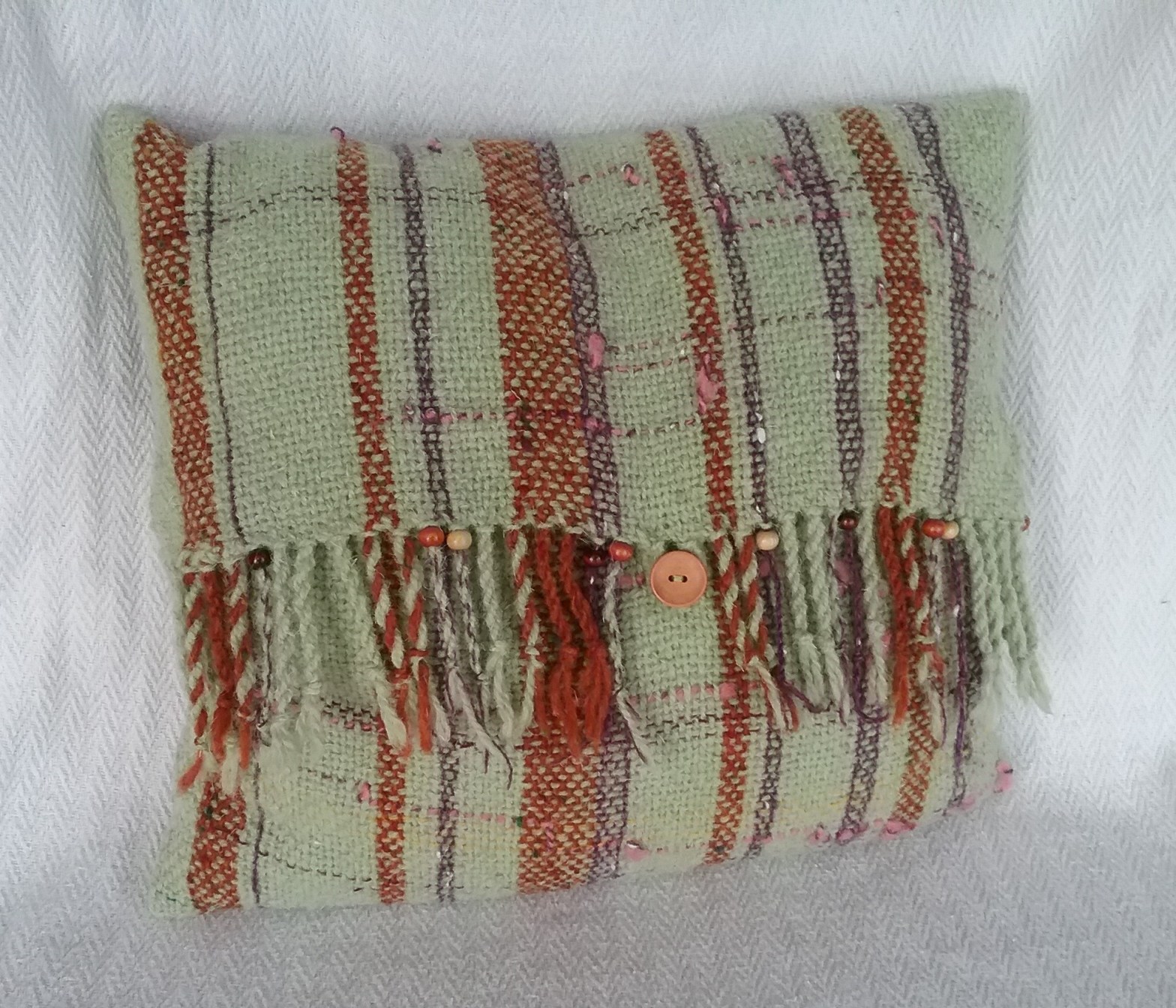
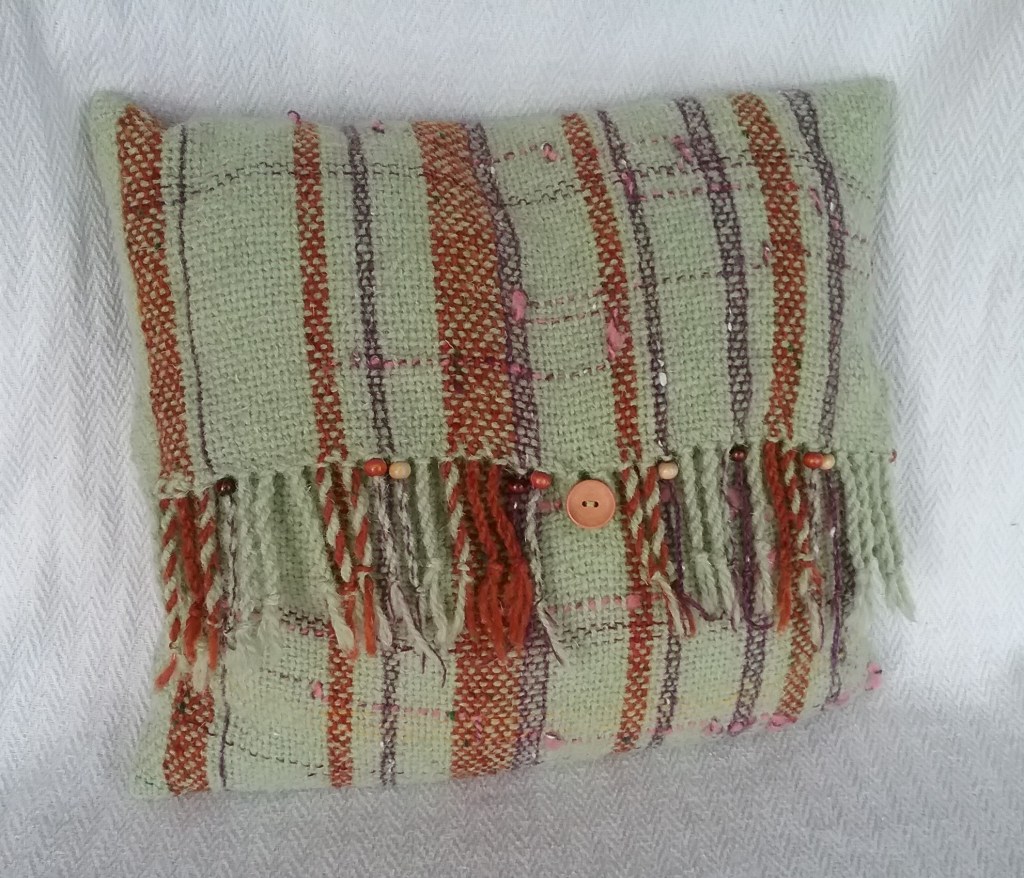
The next project that I thought I would share is a woven cushion cover I made for a friend. It had to have a modern art feel and pastel colours, which differs from my usual style, but it gave me an opportunity to explore some new techniques.
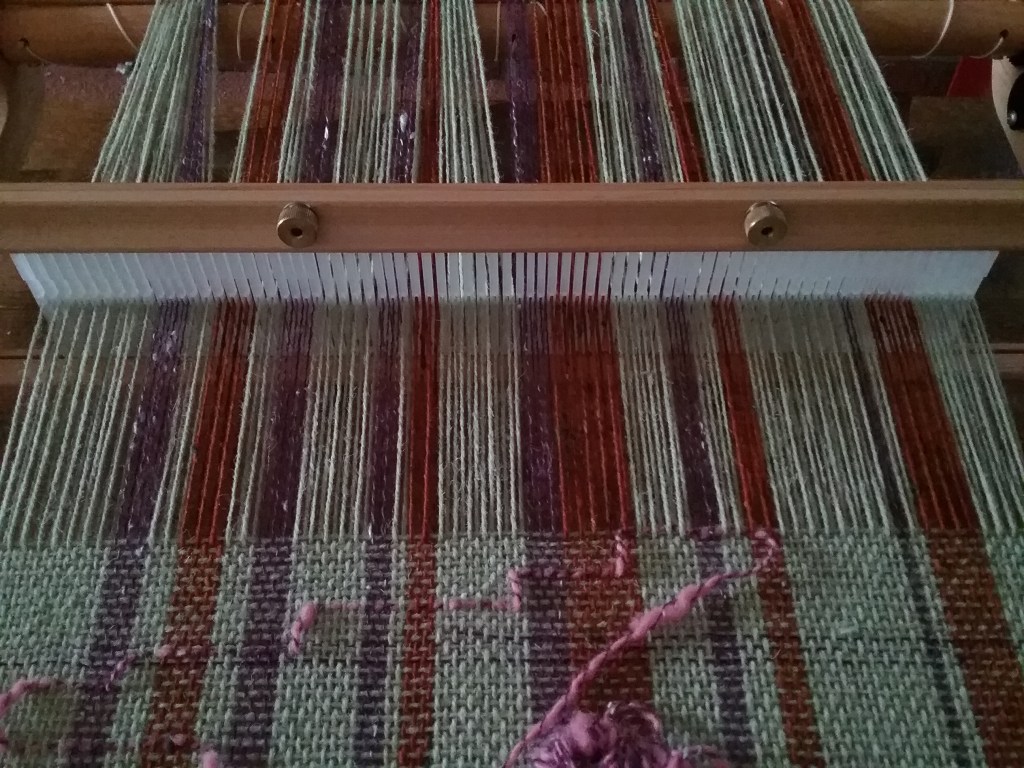
I first measured the size of the cushion the cover would need to fit. The length of the warp needed to be twice the height of the cushion, some extra for the fold over, plus an allowance for shrinkage (these measurements depend on the size of cushion and the amount of shrinkage in the yarn used). Whilst my Saori loom was engaged in another project and I only needed a small warp, I decided to use my rigid heddle with the weavers choice heddle set up in a random dent configuration. Instead of overcomplicating the mathematics for the warp width, I took the width measurement of the cushion, plus extra for shrinkage/seams and clipped my heddles together until they reached that measurement. I then picked some colours out and warped up my loom using the direct warping method.
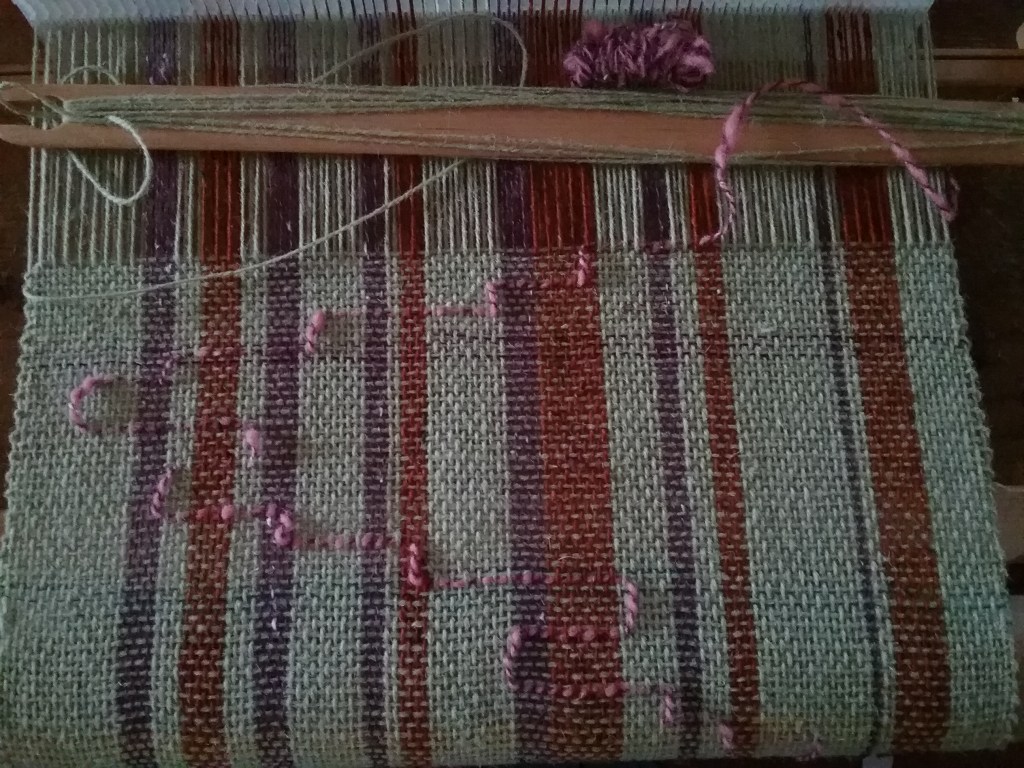
Start of weaving
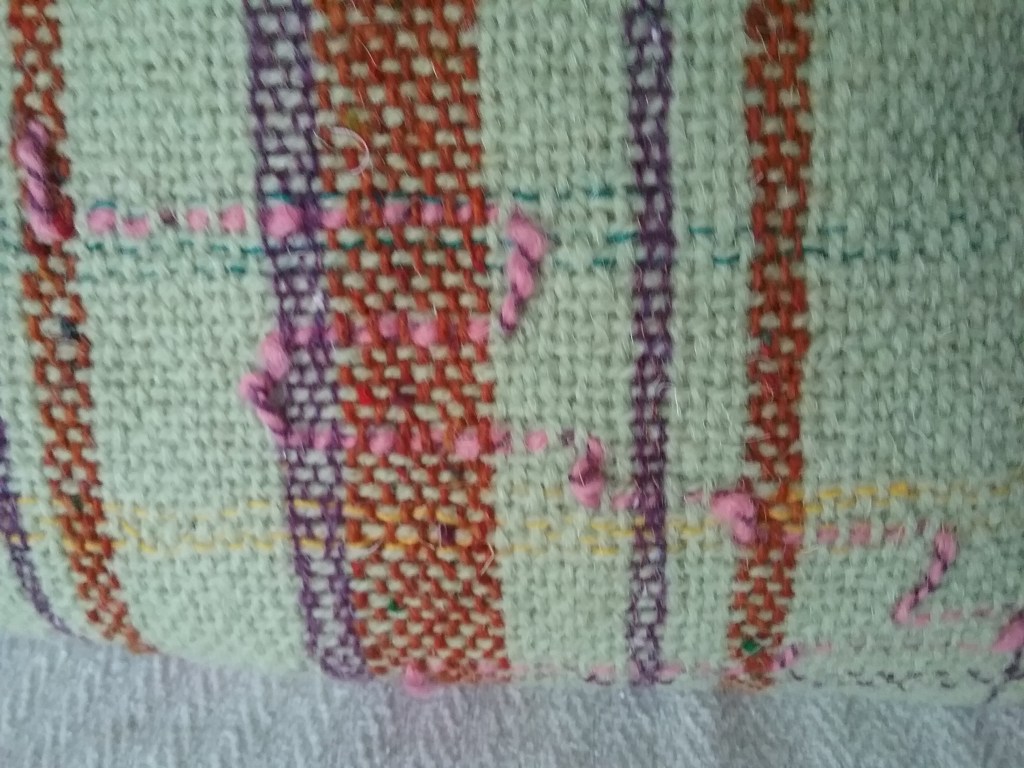
After warping and winding on I began weaving. The cushion is a plain weave using the mint green as the main weft thread to contrast the warp stripes and the pink ‘wandering weft’ hand spun yarn (this was the first yarn I tried spinning on my drop spindle). Ashford have a good tutorial on using art yarn in weaving here. I also added some contrasting weft threads in at random intervals.
When I’d finished weaving I hemstitched both ends (I have a habit of forgetting to hemstitch the start of the weaving and having to do it at the end!) and then cut it off the loom before washing it to allow the threads to properly move into place. To save having to weave in loose ends, I like to use the Saori method and weave them into the fabric as I go.
Although I omitted to take any pictures, sewing was completed on a vintage Singer hand crank machine – I have found that vintage machines sew handwoven fabric very well. The cushion is a simple folded construction. Firstly one of the edge widths is ‘hemmed’ and the excess fringe cut off – this will be the end that sits under the fringed fold. The fabric is then folded around the cushion (you can choose any configuration) and pinned right sides together at the seams. The cushion is then removed and the seams sewn. I find it is easiest to pin and sew the bottom seams first and then pin and sew the seams at the folding top. The cushion then slides into the cover.
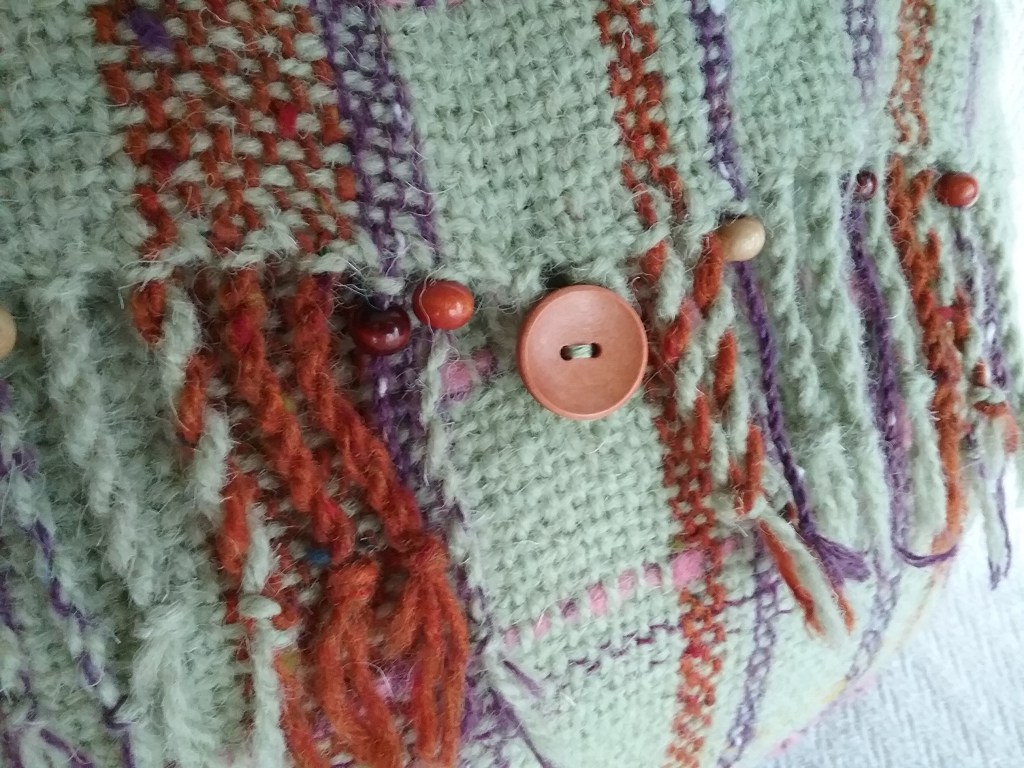
I added a twisted fringe with wooden beads (good Youtube video showing twisted fringe here). To close the cushion I encircled two of the twisted fringes around each other and sewed them to create a button loop, before sewing on a button.
Close up of button and fringe
This was quite a quick weave and gave me an excuse to try out new techniques I’d wanted to do for a long time. As always, let me know in the comments below if you’ve attempted something similar.
Happy New Year everyone, the end of last year saw me knitting, weaving and sewing Christmas gifts for friends, which I can now share. A friend gifted me the Harry Potter Knitting Magic book by Tanis Gray the year before, so I thought it only fitting to try out some of the patterns this year.
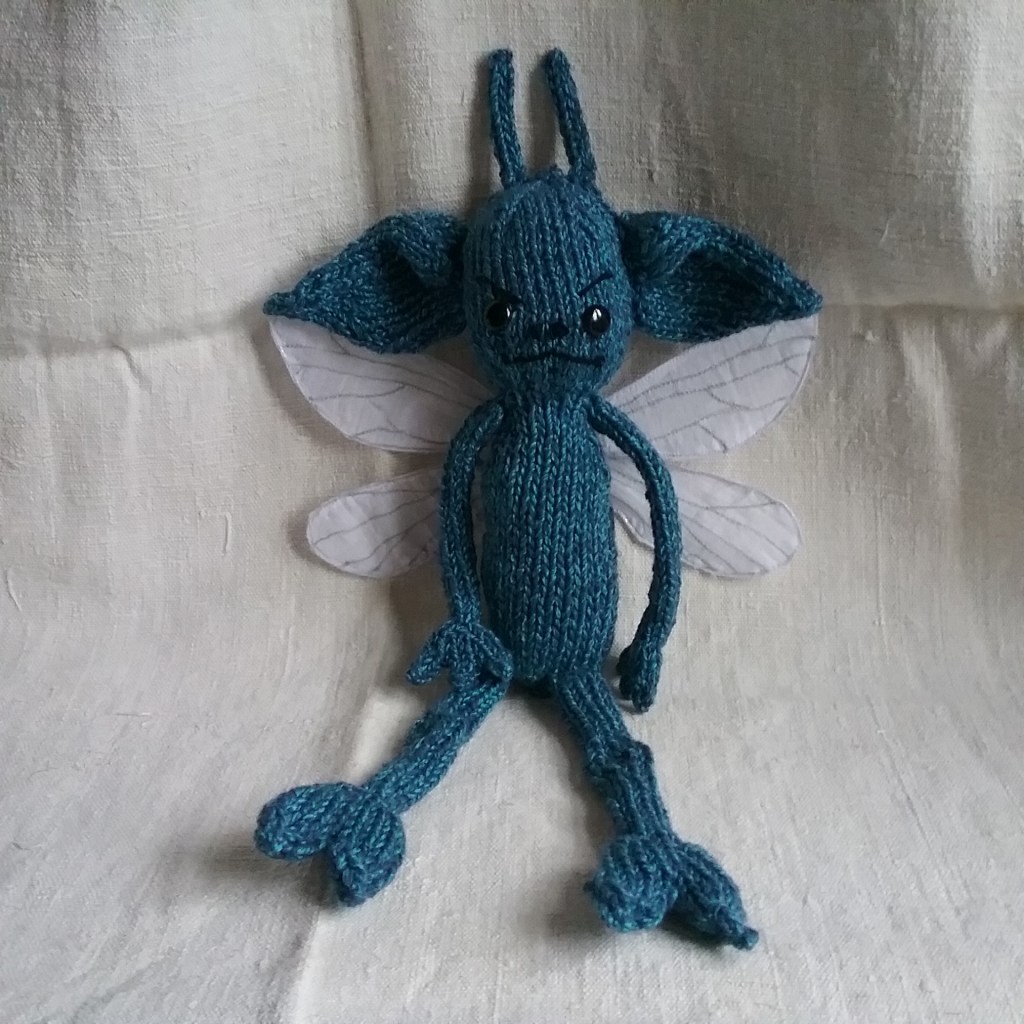
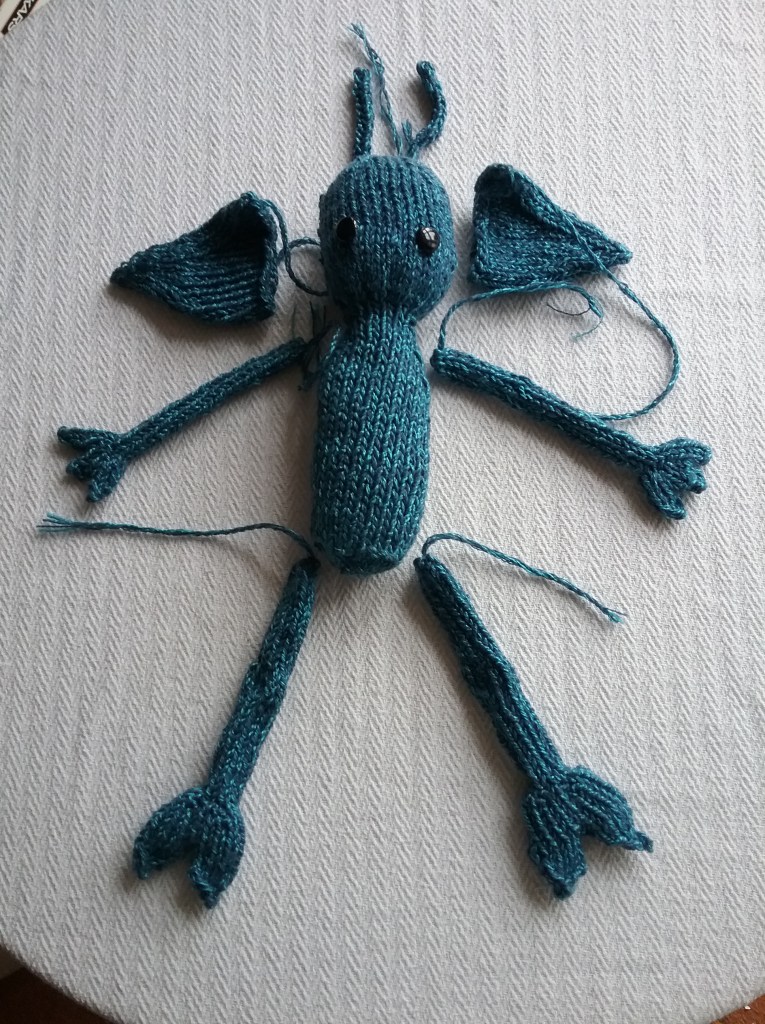
I began with a Cornish pixie. Most patterns in this book are knitted in the round, and since this was something I did not have much experience of, I decided to give it a go. I plied wool from two cones in my stash together on my wheel and then chain plied the resulting yarn to make it slightly thicker. I followed the pattern apart from the wings which I decided to make myself as I didn’t like how they looked in the book.
Cornish Pixie before assembly
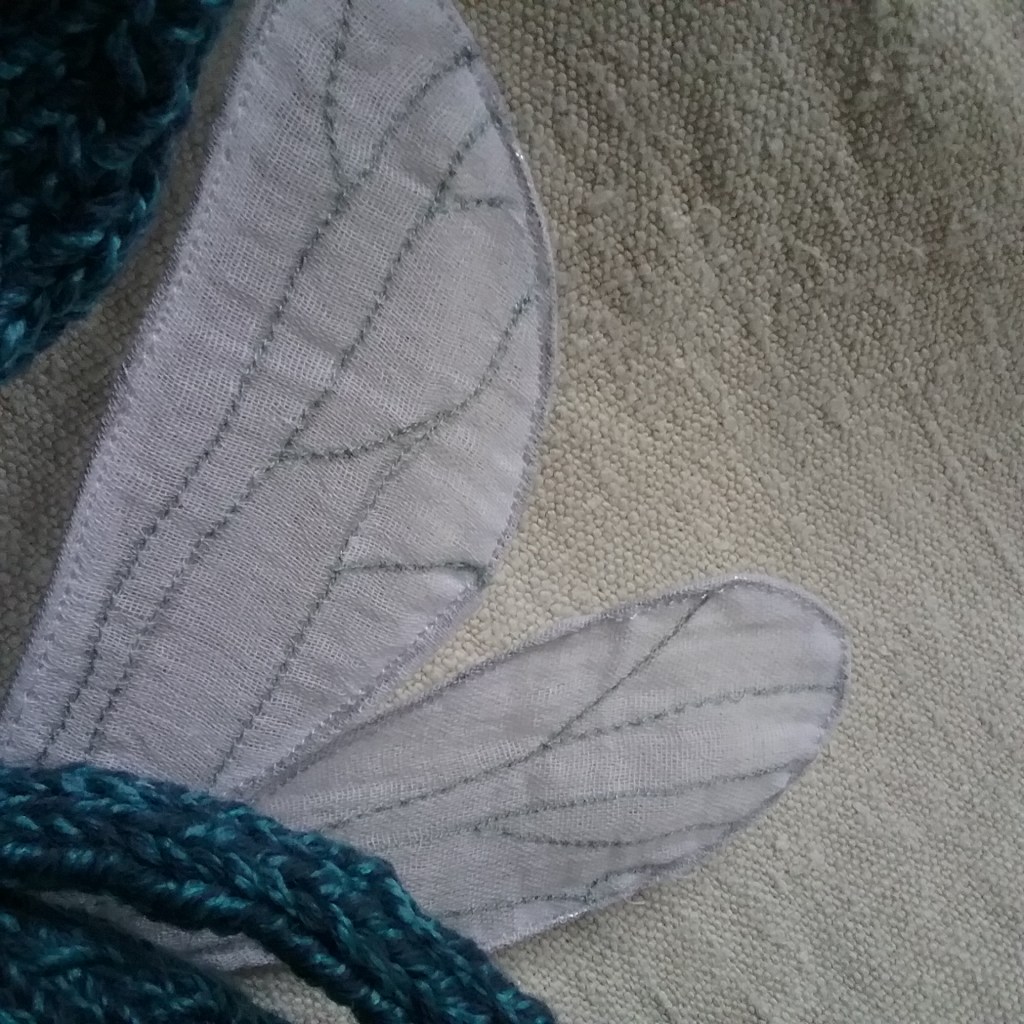
I made the wings by printing a wing template from Google and bending some wire to its shape. I then traced the wire wings onto some scraps of cotton muslin and cut them out. Using a sewing machine (vintage hand crank) I stitched the veins onto the muslin and then stitched the muslin to the wire frames. This proved to be difficult on a sewing machine as the presser foot and feed dogs are in the way. After struggling for a while and catching my finger with the needle, I ended up purchasing a feed cover plate add on (Singer part number 32622) that covers the feed dogs so when you remove the presser foot you can freemotion.
Close up of wing detail
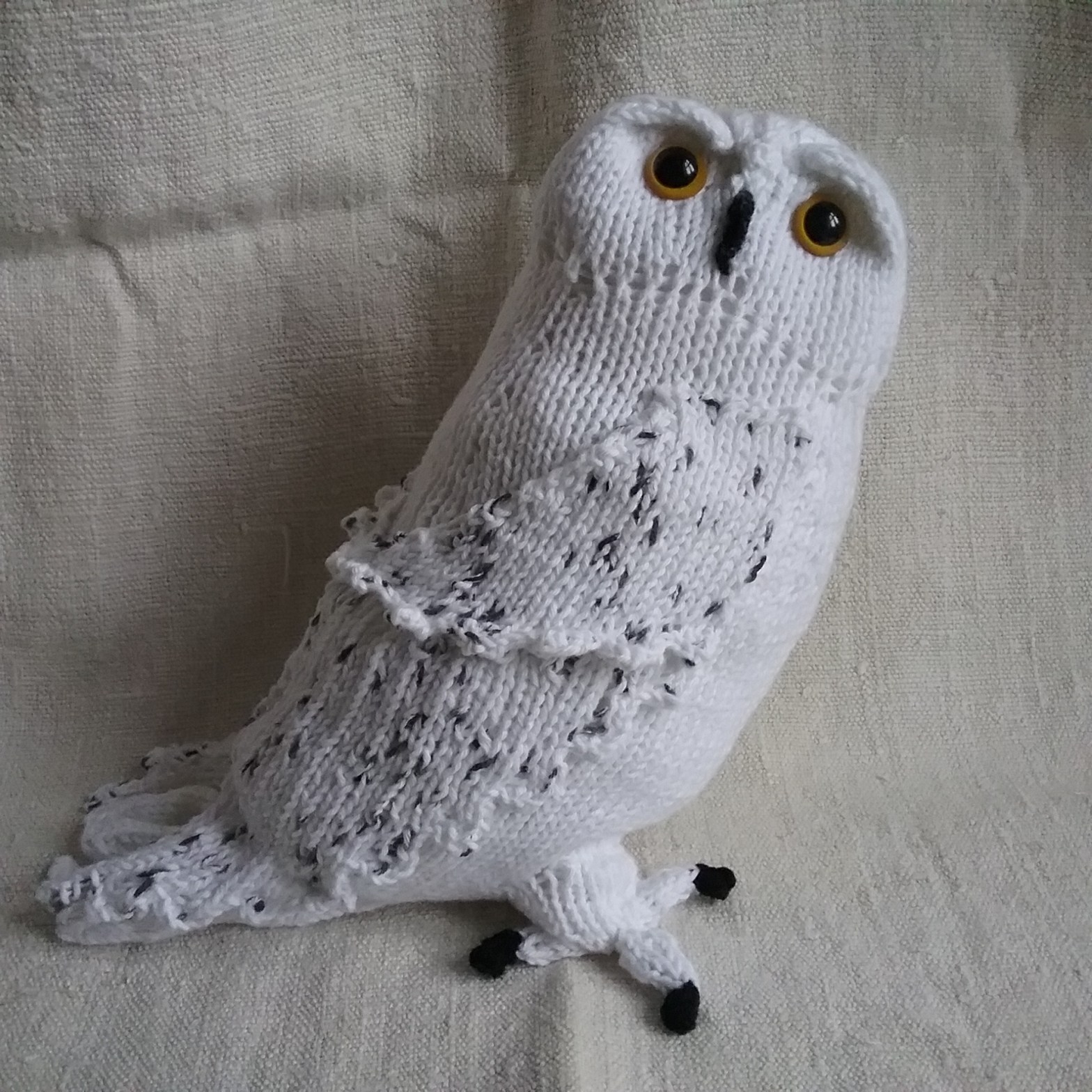
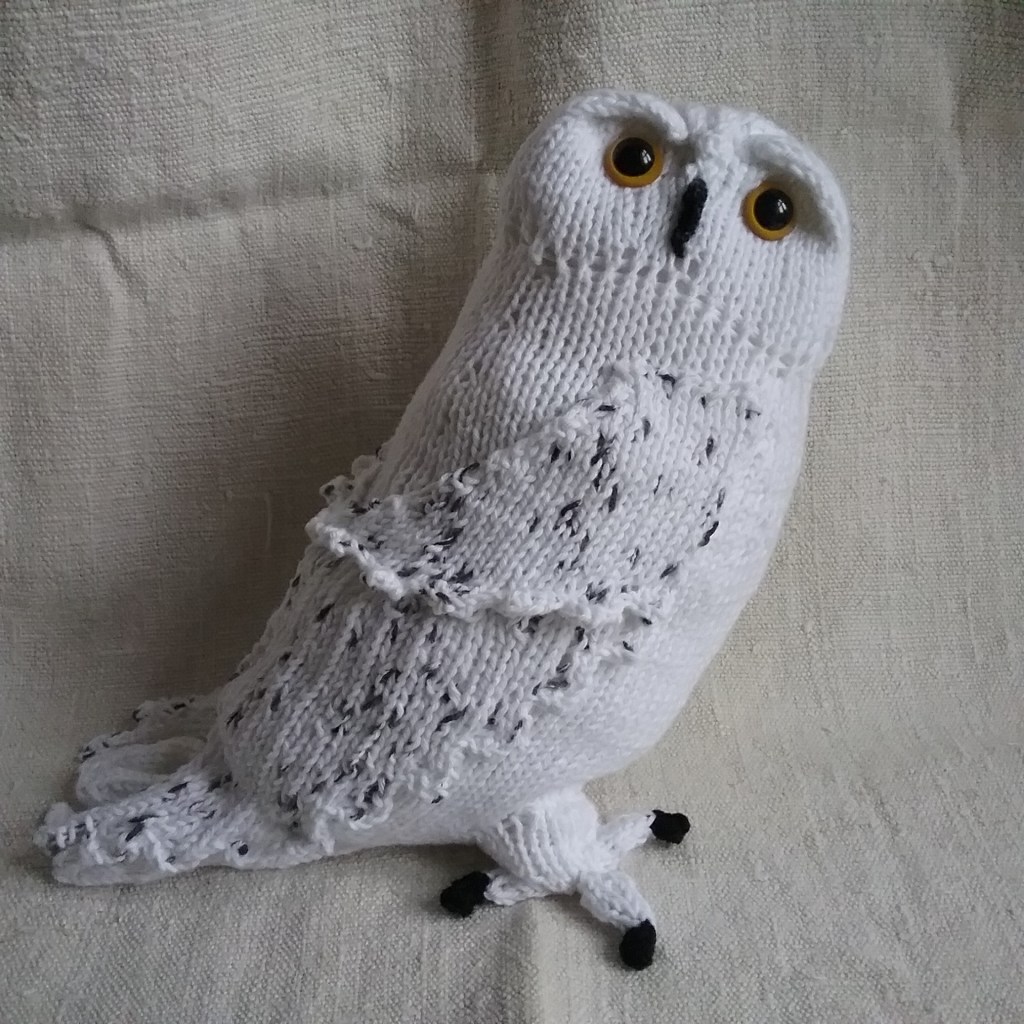
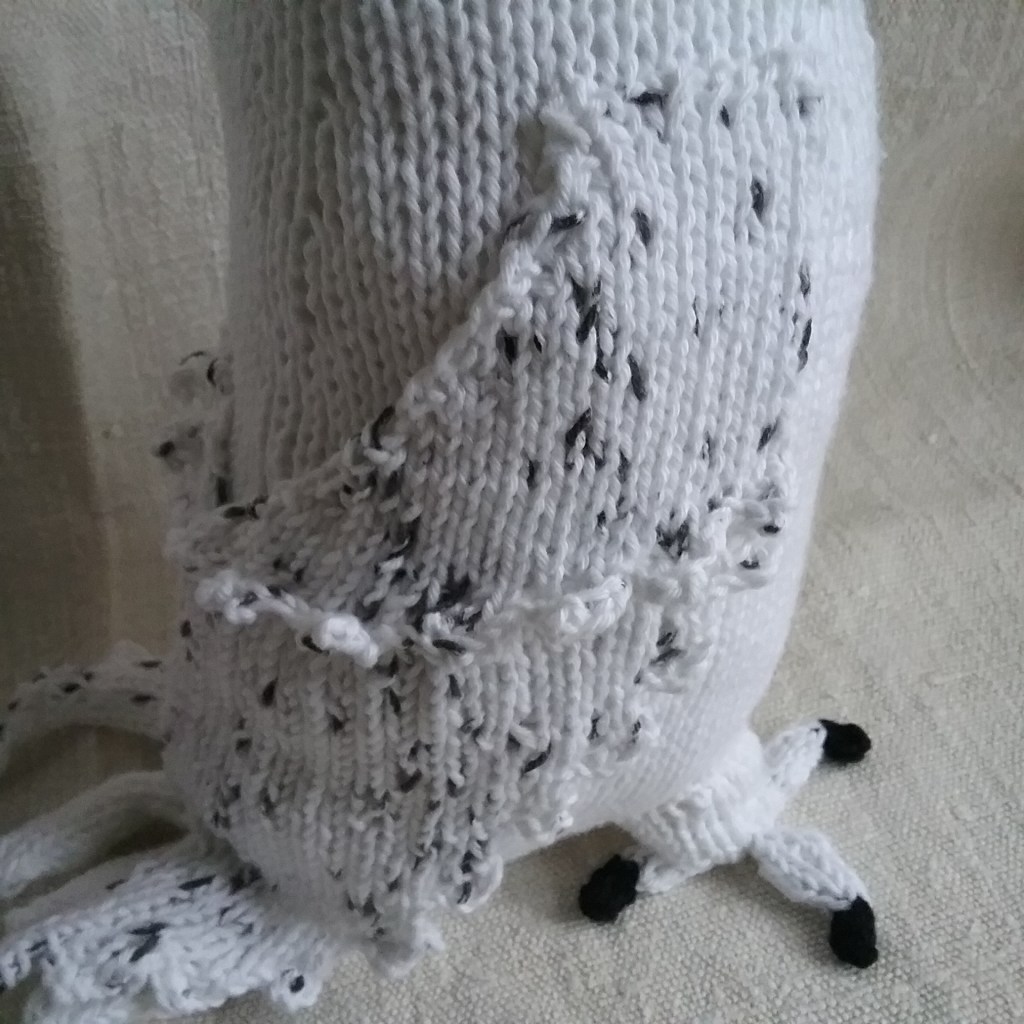
After getting on well with the Cornish pixie I decided to have a go at knitting Hedwig. I had some white cotton in my stash so decided to use this. I didn’t have any speckled black for the wings, but as the figure shouldn’t need to be washed, I watered down some black all-purpose acrylic paint to create the speckles. Otherwise, Hedwig was knitted according to the pattern.
Close up of wing detail
I enjoyed the challenge of kitting on DPN’s and was certainly much improved by the time I’d finished. The patterns also gave me an opportunity to learn some new techniques and I now have a much greater appreciation of how fiddly toys are to knit!

 Loose Ends