A Little About: Romney

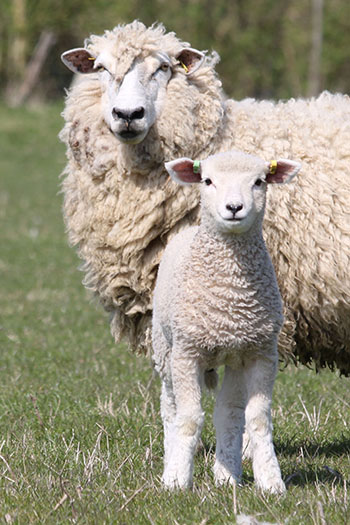
 A Pair of Romney Sheep
Photo Via romneysuk.com

History

Romney Sheep were established on Romney Marsh, a wetland between Kent & East Sussex, in the 13th Century and their fleeces were highly desirable to the British wool trade at its peak. Romney sheep are quite a good example of natural selection in action; the first sheep to inhabit the marsh suffered from many health conditions caused by the wet, damp conditions, but over the centuries the sheep adapted, and became less susceptible to parasites and foot rot. To further improve wool quality, shepherds on the marsh began selectively breeding sheep until the Romney breed could produce high quality wool in unfavourable conditions. These characteristics were highly desirable to farmers and led to the breeds export over time.

In the Medieval era taxes were imposed on wool being exported and these exports were only permitted to take place from designated ports. During the 15th Century however, the domestic price and demand for Romney wool declined, leading to an increase in smuggling wool abroad for higher profit. Romney Marsh was considered the perfect place for smuggling, due to its close proximity to the English Channel and the vast numbers of sheep that lived there. Those smuggling wool on Romney Marsh earned themselves the nickname ‘owlers’ due to using owl calls to communicate with one another. Despite many years of government policies that aimed to prevent smuggling, Romney Marsh was notorious with ruthless gangs and even inspired a series of books Doctor Syn: A Smuggler Tale of Romney Marsh in 1915. Smuggling had become such a problem that in 1816 a Coast Blockade was set up to patrol the waters between Kent and Sussex.

Fleece Research

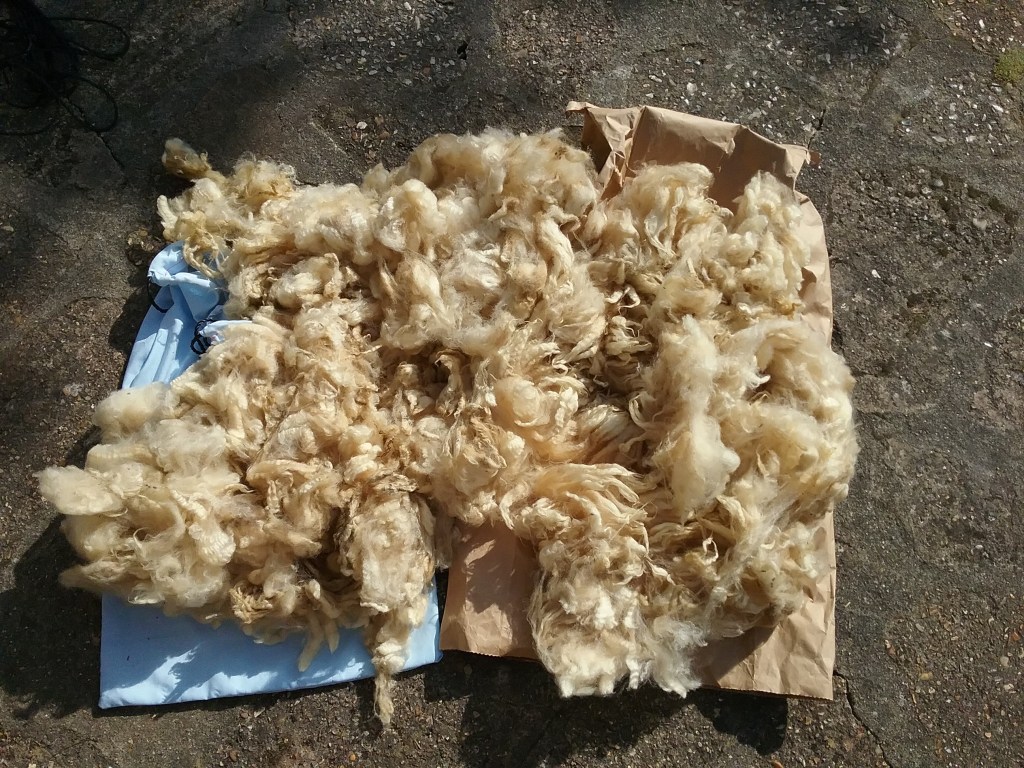
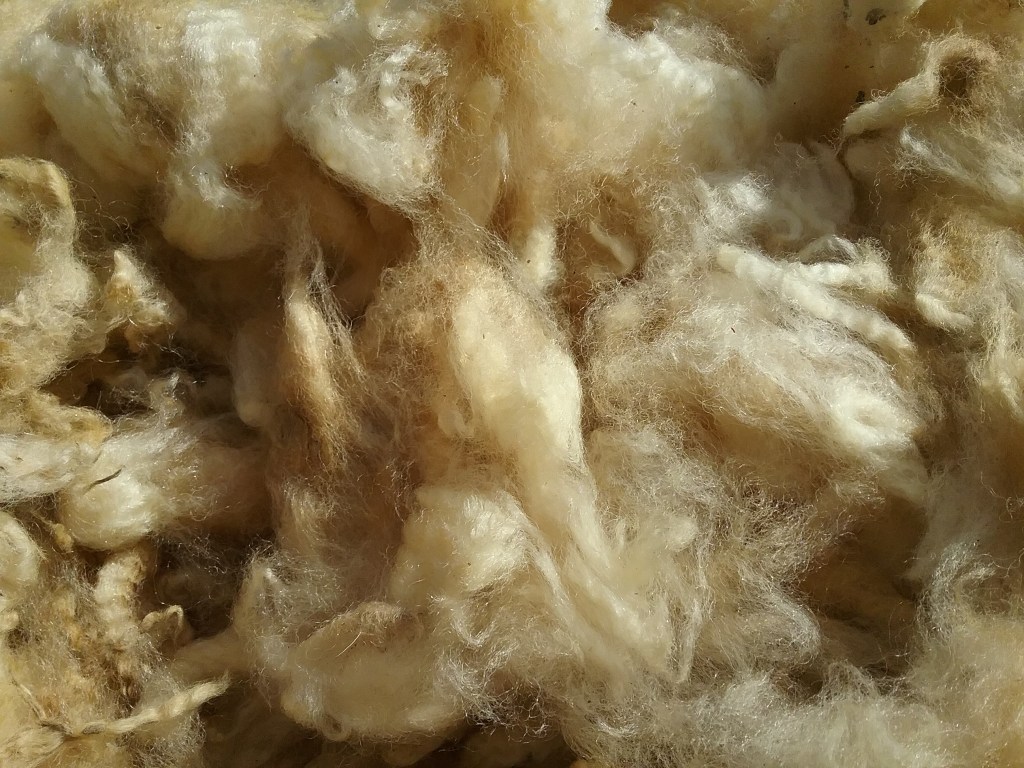
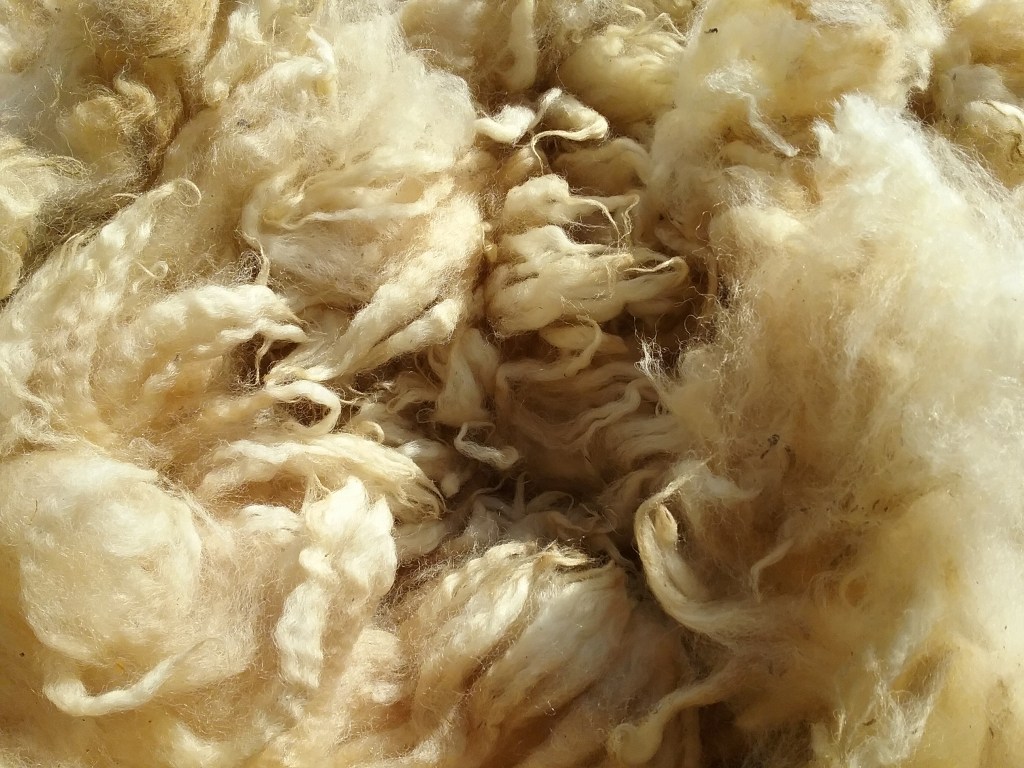
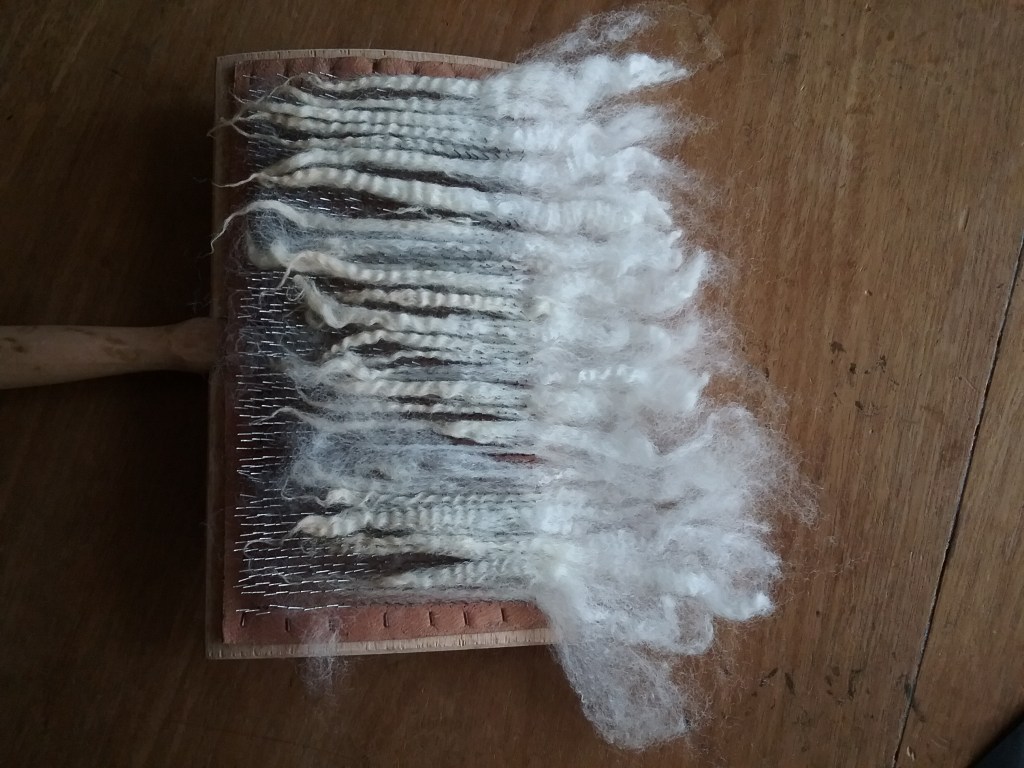
Romney sheep are classed by the British Wool Board as having a medium fleece with a 10-17cm staple length. Each fleece weighs around 3-5 kg. Romney wool is versatile; having both crimp and natural lustre so is highly desirable for use in textiles. According to my research, the fleece has a low grease content so can be spun ‘in the grease’ if desired. The medium staple length means the fleece can either be carded, combed or spun from the lock; and its durability means it can be used for anything from clothing to carpets – a good all-rounder.

I read with interest that some Romney sheep are carriers of ‘hairy’ genes, the first of which was isolated by Professor FW Dry of New Zealand in 1929. Sheep with these genes produced coarser wool and were selectively bred to produce wool for carpets. In New Zealand these sheep were called Drysdale, whilst in Australia there are three different carpet wool breeds derived from ‘hairy’ Romneys.

As the Romney fleece is an all-rounder and can be prepped in many ways, I’m curious to see how the fleece naturally behaves – will it lend itself to woollen, worsted or something in-between? Romney, although fine, is reported to be quite resistant to felting so hopefully there should be less chance of felting whilst washing. There is some debate as to whether Romney fleece is too coarse to be worn next to the skin, this appears to vary between fleeces, but the general consensus seems to be that it is more suited to outerwear.

Further Reading

The following sources have been used for reference

  • Breed Society Website – romneysuk.com
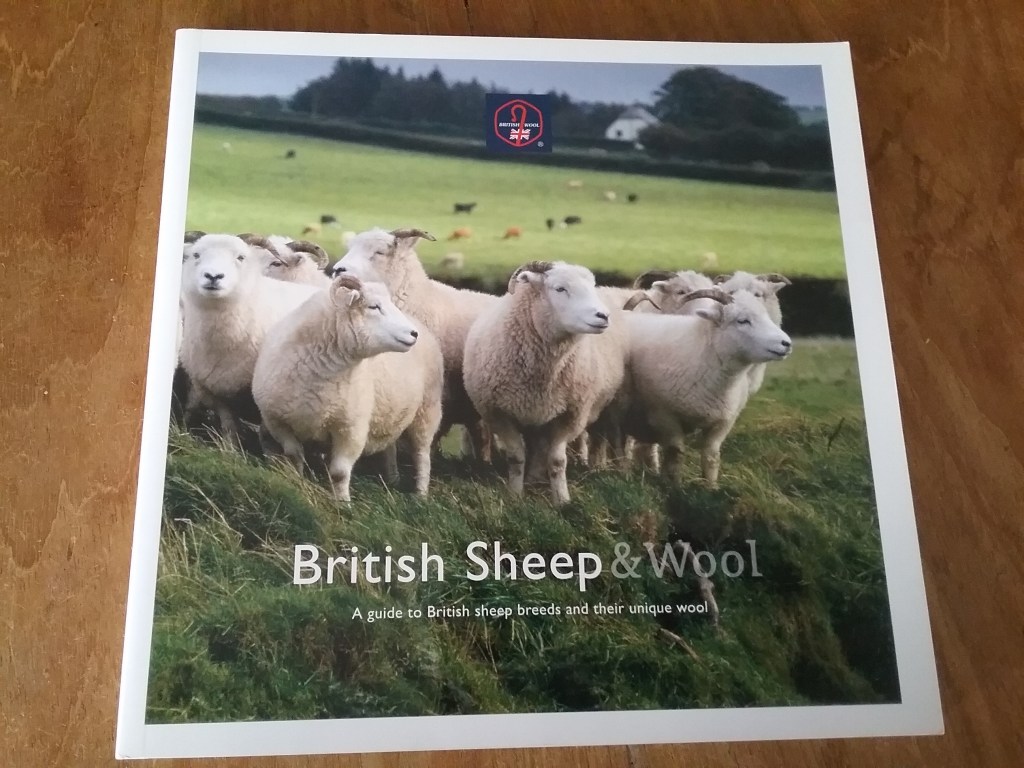
  • British Sheep & Wool by the British Wool Marketing Board – ISBN 9780904969108
  • The Field Guide to Fleece by Deborah Robson & Carol Ekarius – ISBN 9781612121789
  • The Fleece & Fiber Sourcebook by Deborah Robson & Carol Ekarius – ISBN 9781603427111
  • Romney Marsh Visitor website – theromneymarsh.net/sheep

Working Through the Stash

Hello everyone, it’s been a while since I put out a blog post. Over the past few months I have been steadily working through my wool stash and as usual I am working on several projects at once that are all at various stages of completion. I will be doing a full write up on each project when it is complete, but I thought I would share some progress pictures to give a more ‘real time’ insight into how a project comes together.

Ryeland

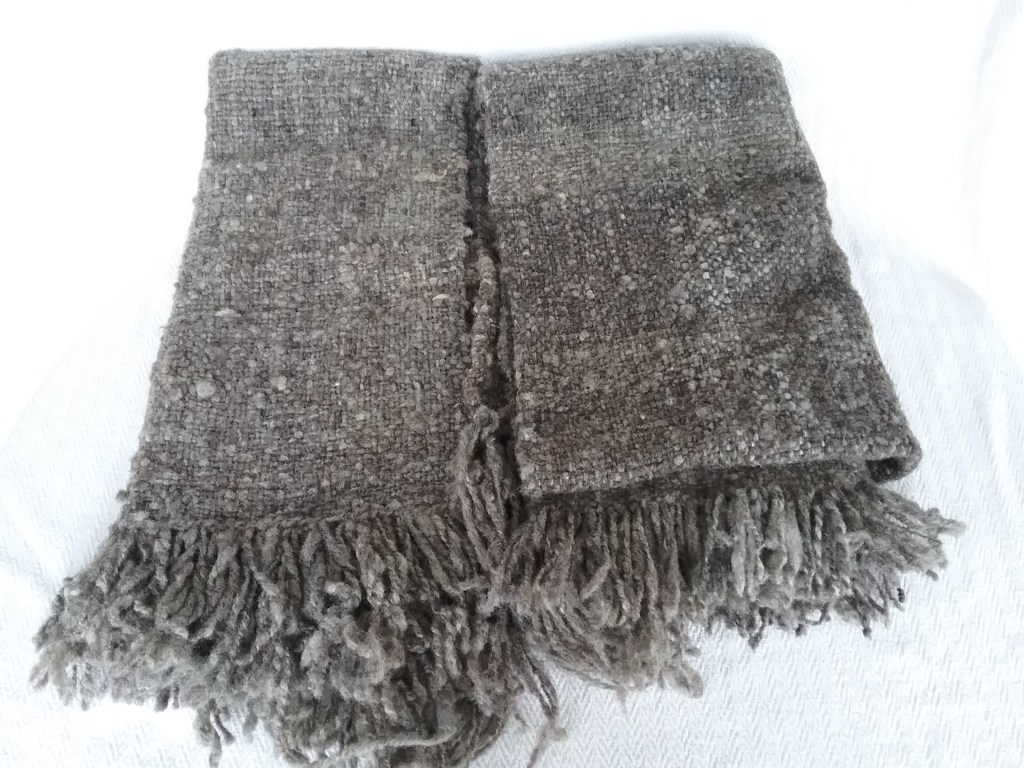
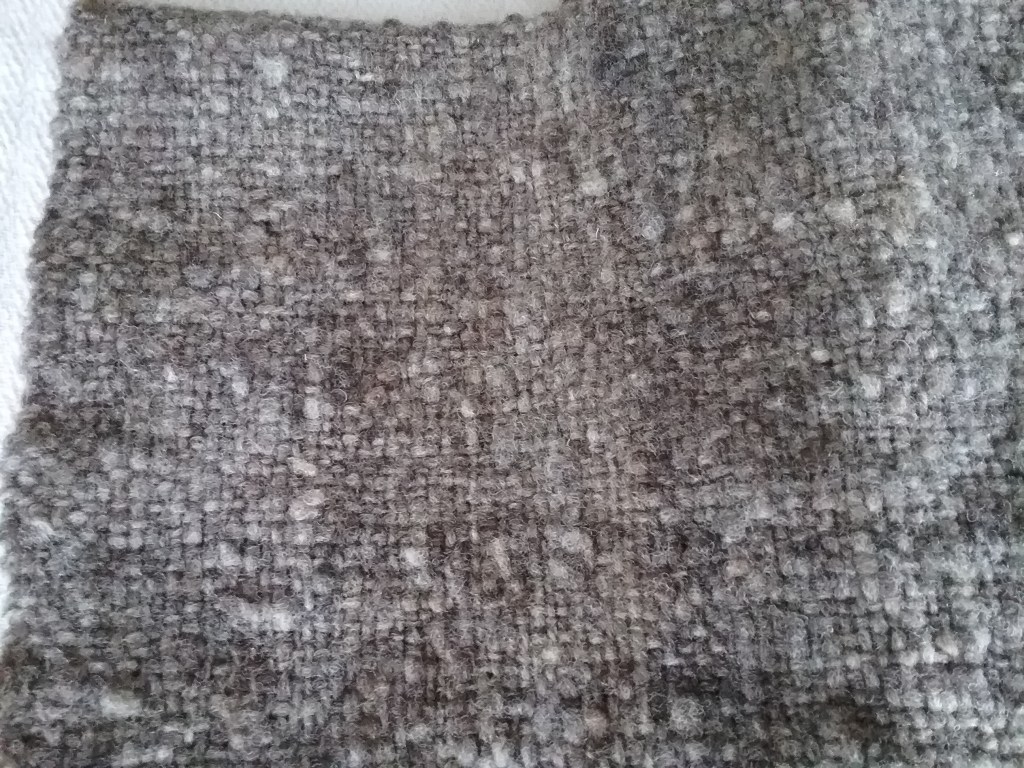
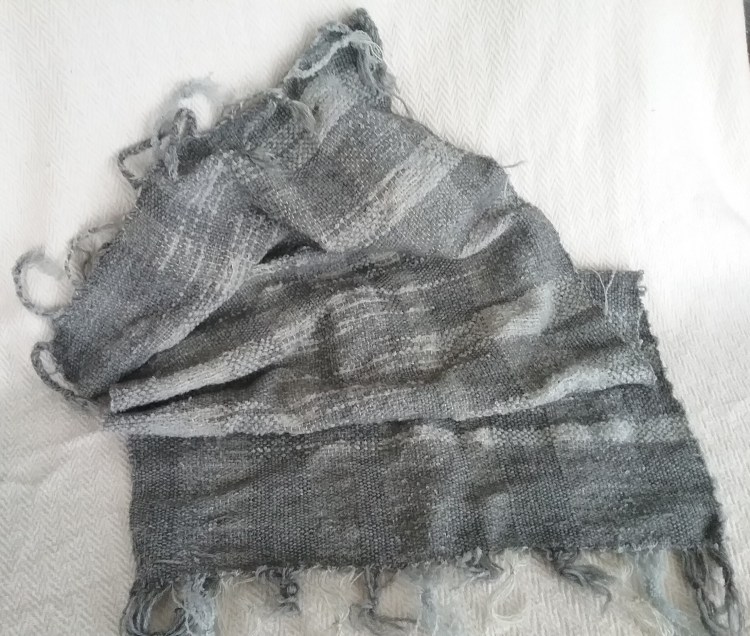
I still had a lot of Ryeland wool after knitting the gloves and cowl and wanted to turn this into a jumper. Although I do enjoy knitting, I’m not a very fast knitter and don’t have much patience when it comes to large projects, so I decided to weave it instead with the intention of using a basic jumper pattern from my Saori weaving book. I still have another length of fabric to weave before I can sew it together, but I was very happy with how the fabric turned out – it is incredibly soft and has a very natural look.

Folded Ryeland Fabric
Close up of woven Ryeland fabric

Romney

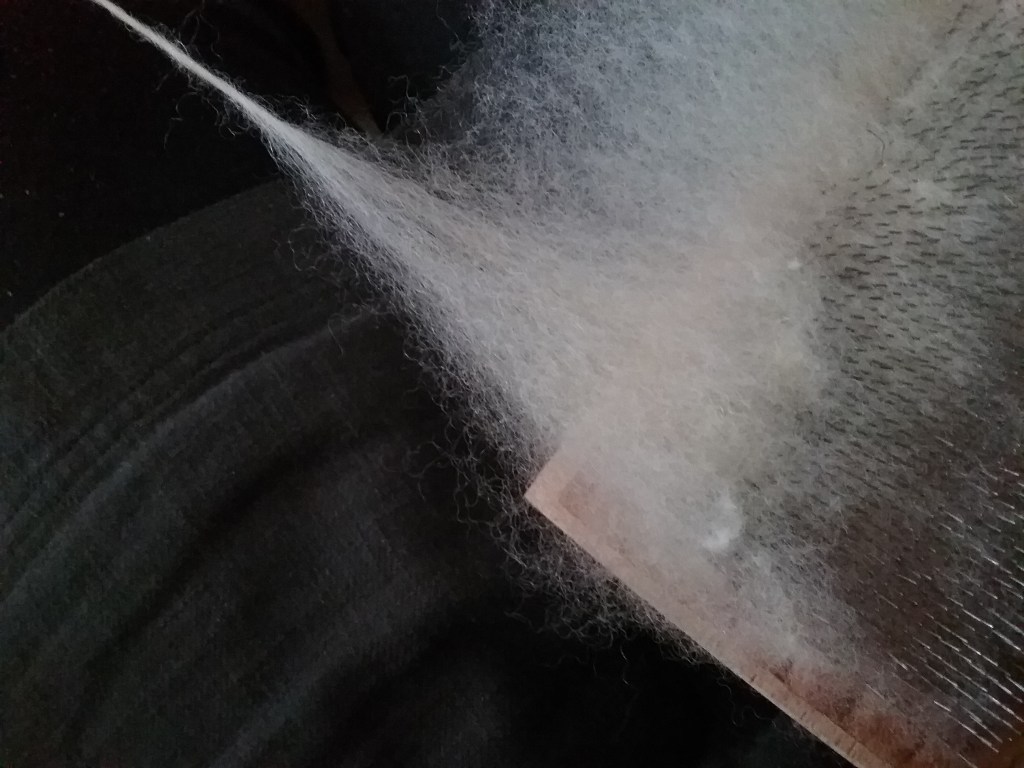
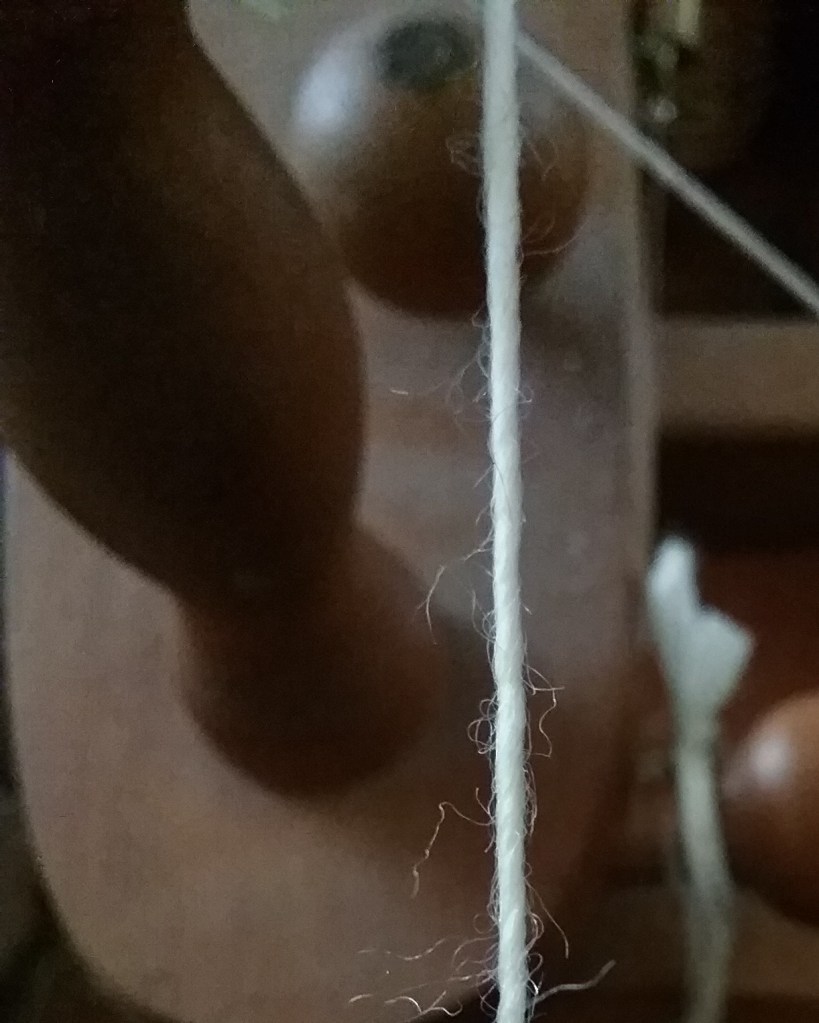
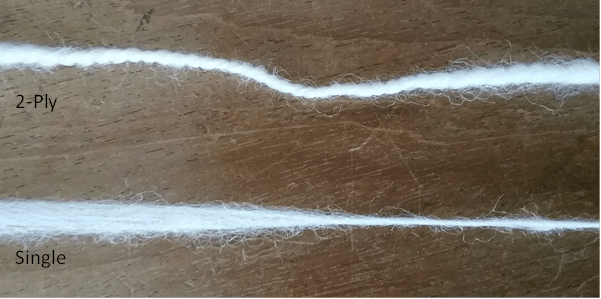
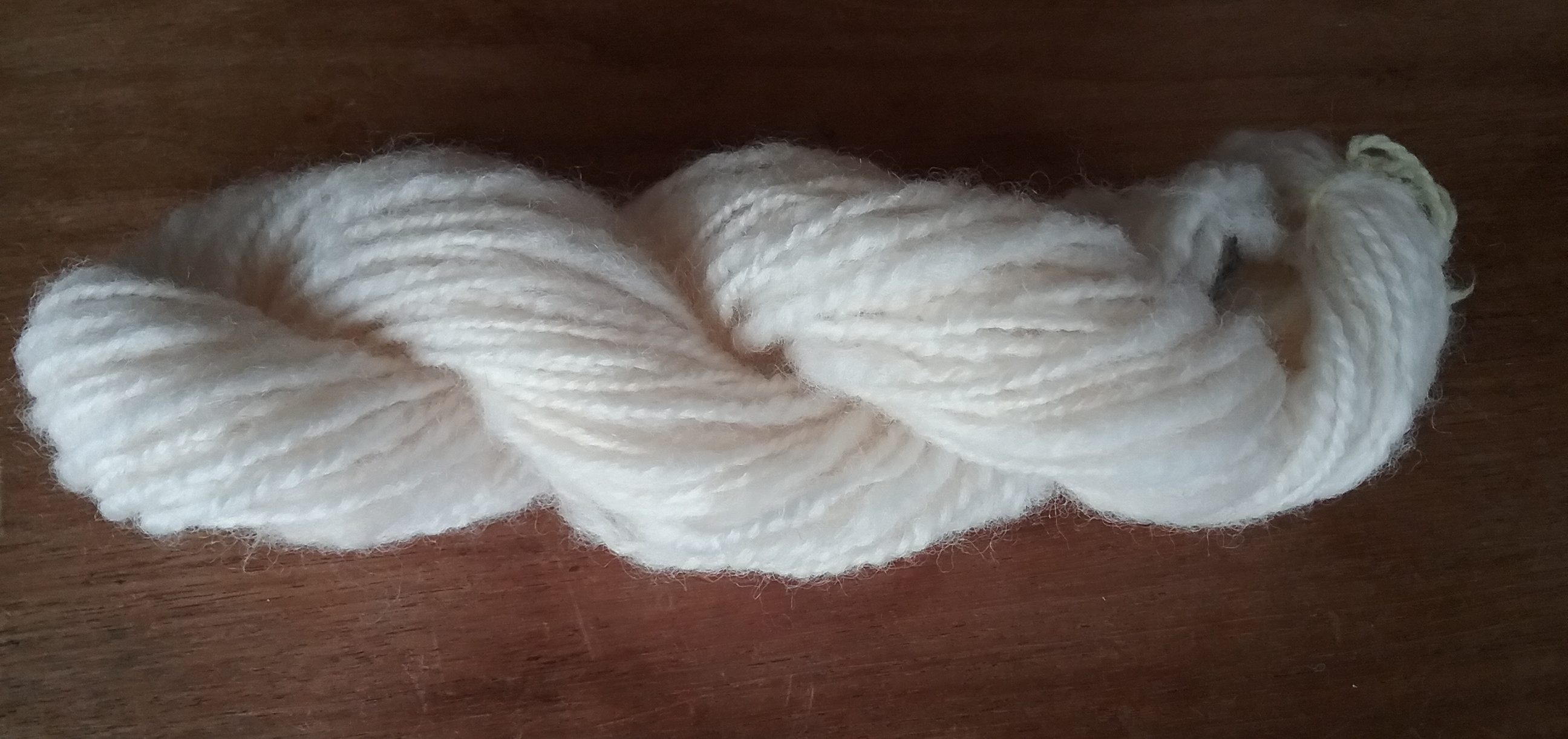
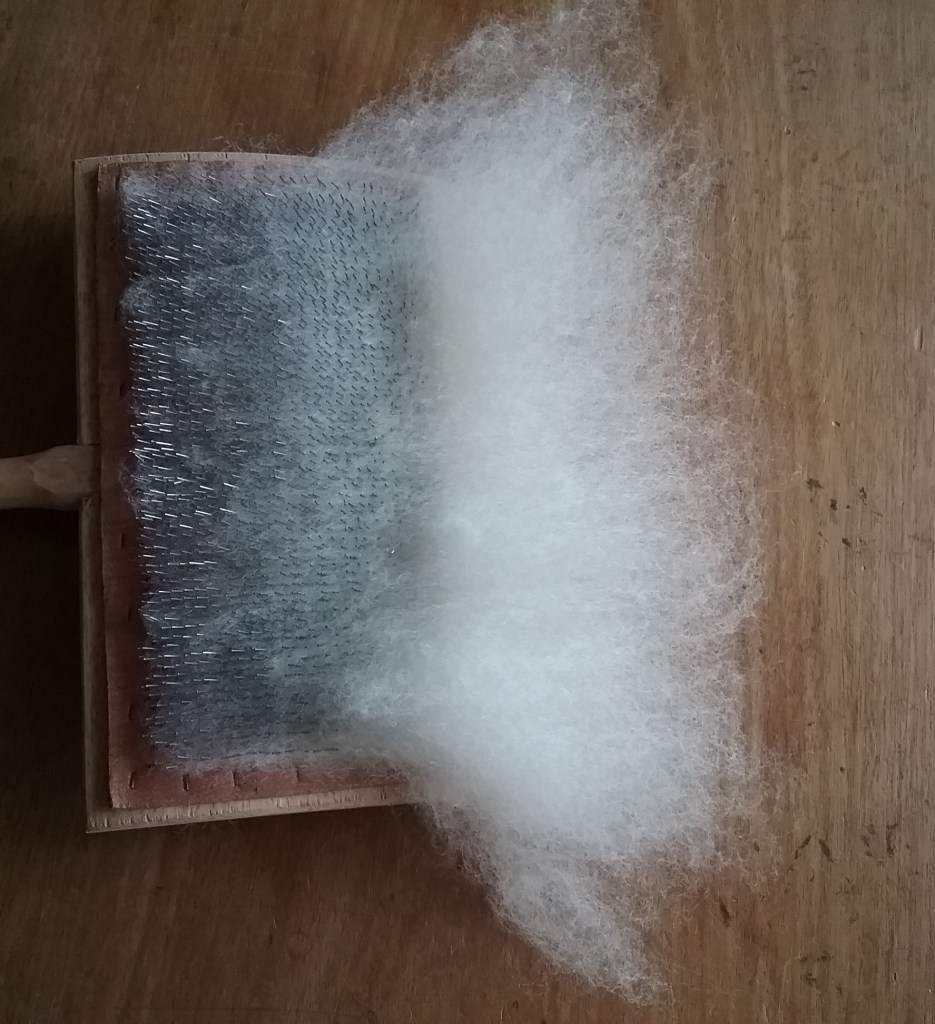
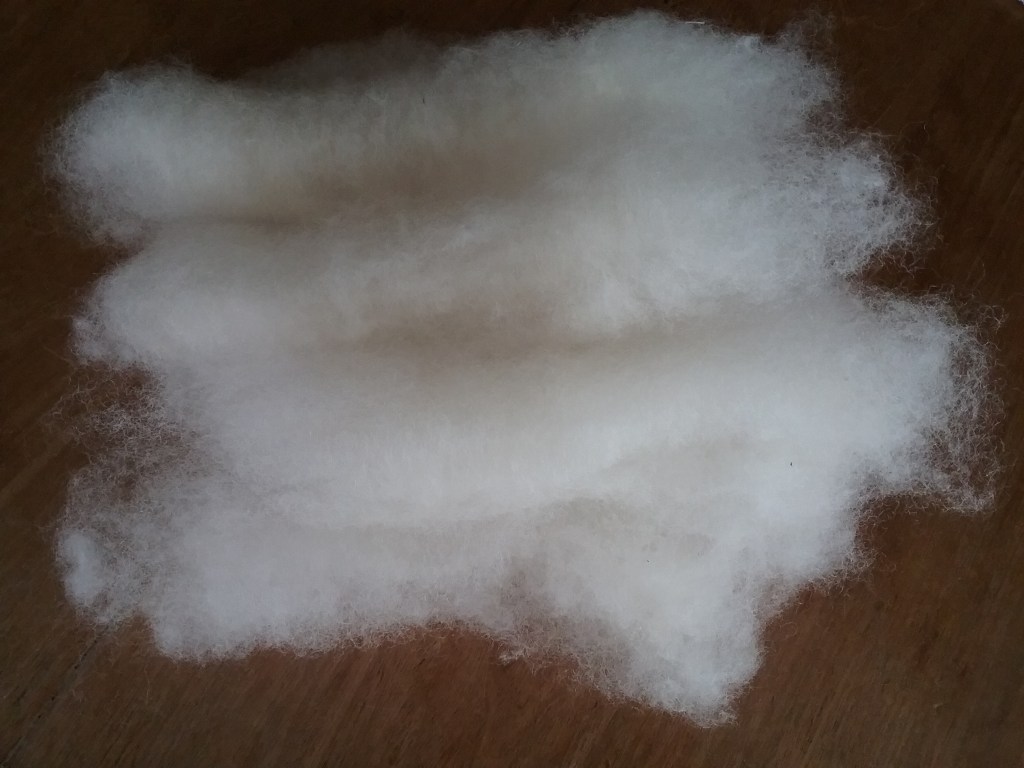
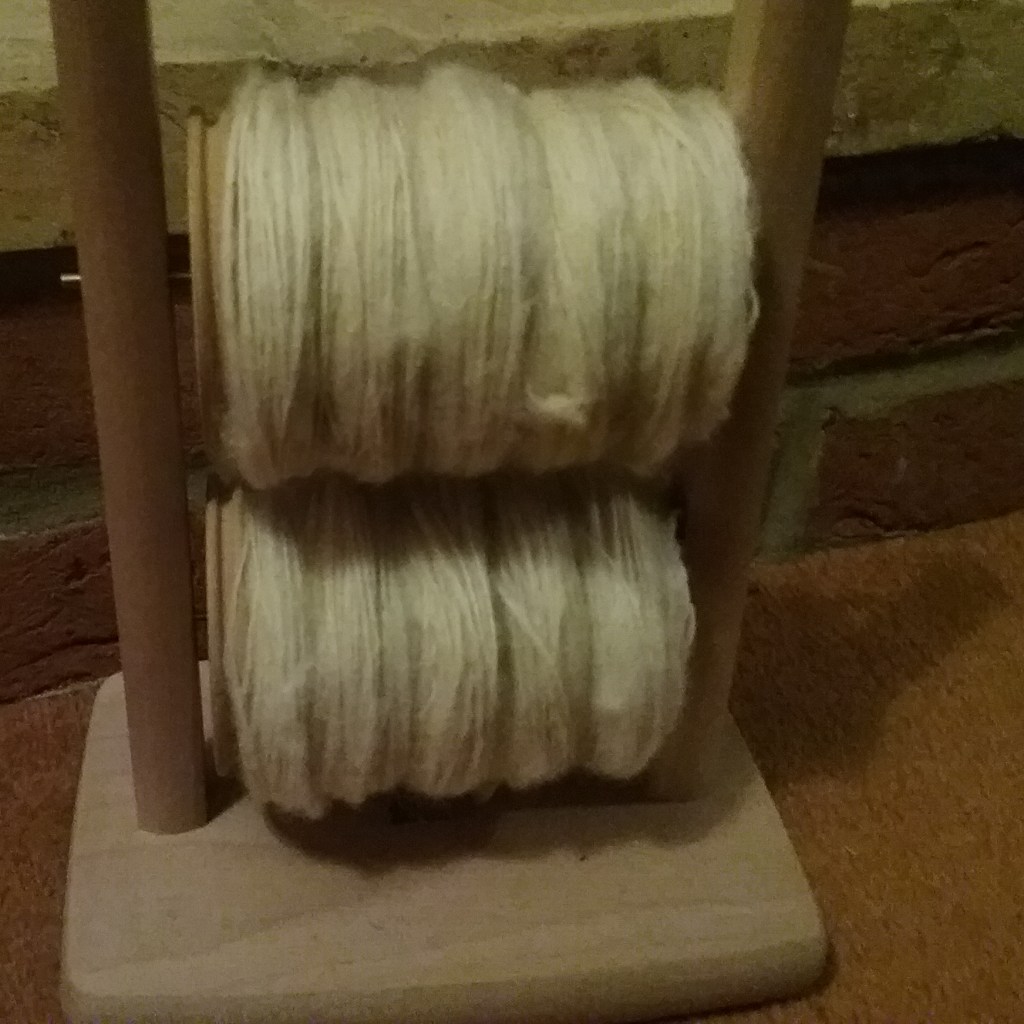
Last year I washed the Romney wool I purchased from Fibre East before storing it until I had the time to prep it. I have now begun the process of carding and spinning it (I will publish a proper fibre prep post soon). All my carding is done using hand carders which is slow (but quite relaxing) work and rather than carding a whole fleece in one go, I work by carding a bagful of rolags and then spinning them before returning to carding again.

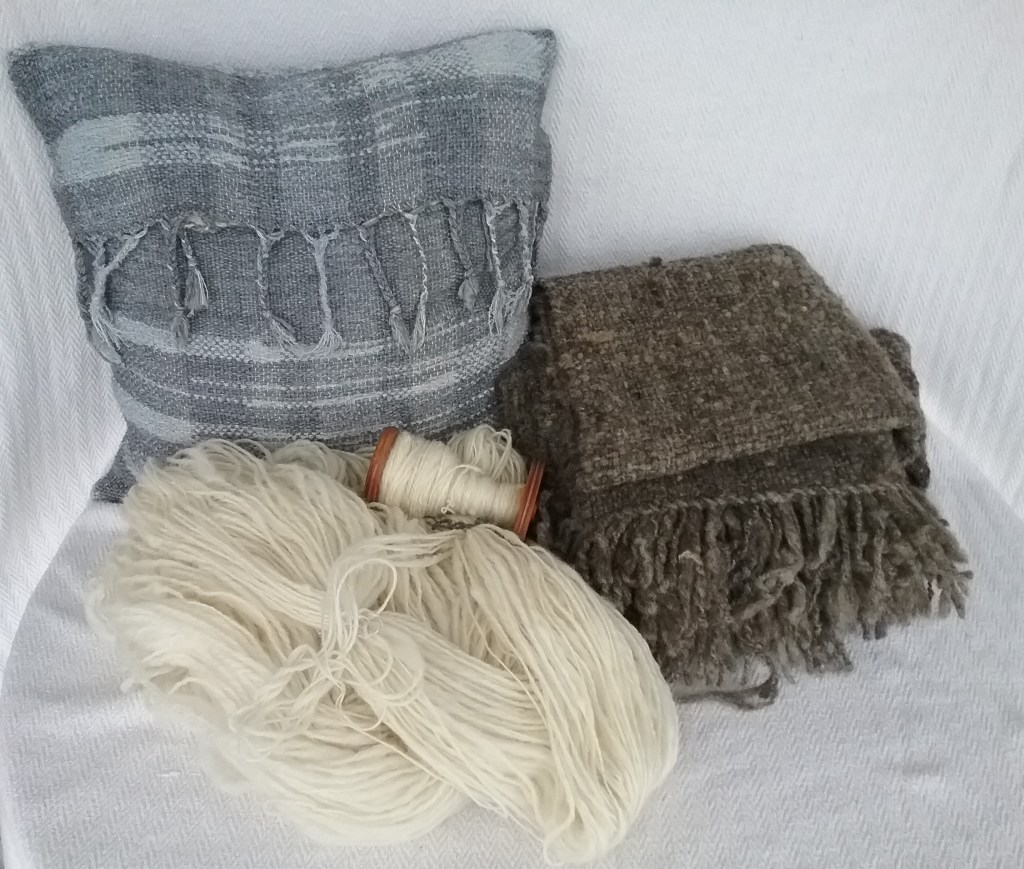
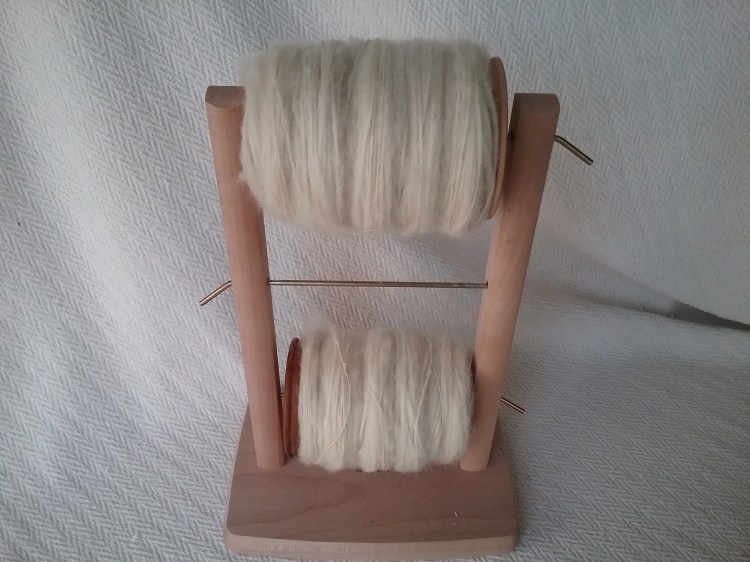
2 Bobbins of Romney singles ready to be plied

Woven Cushion Cover

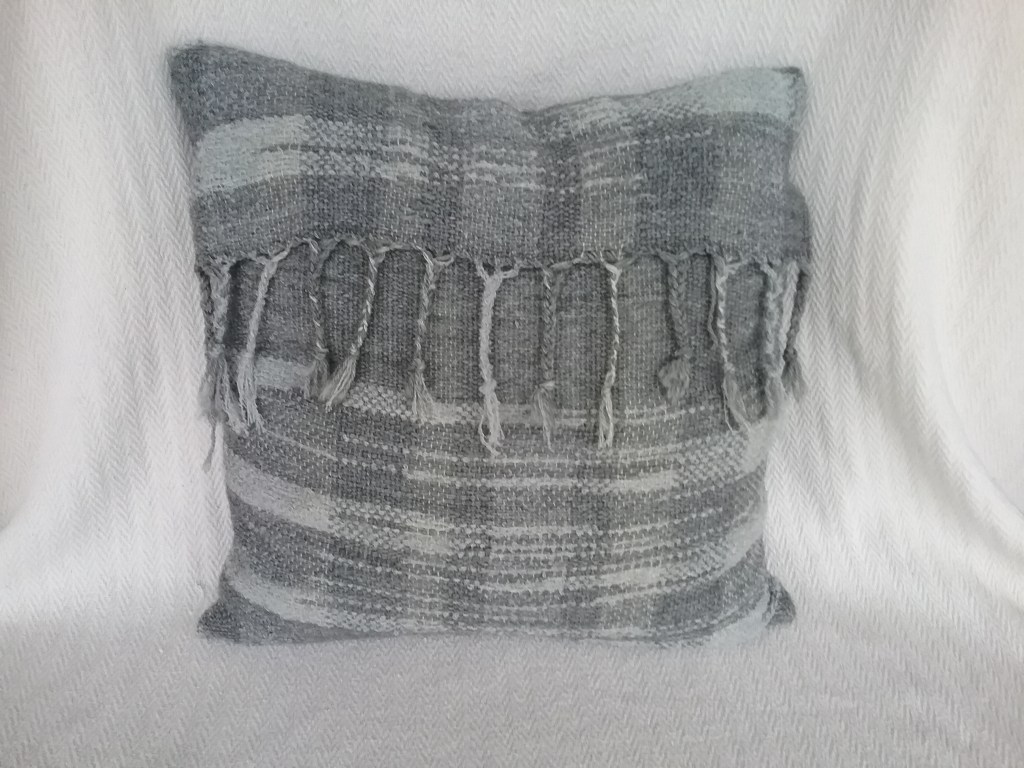
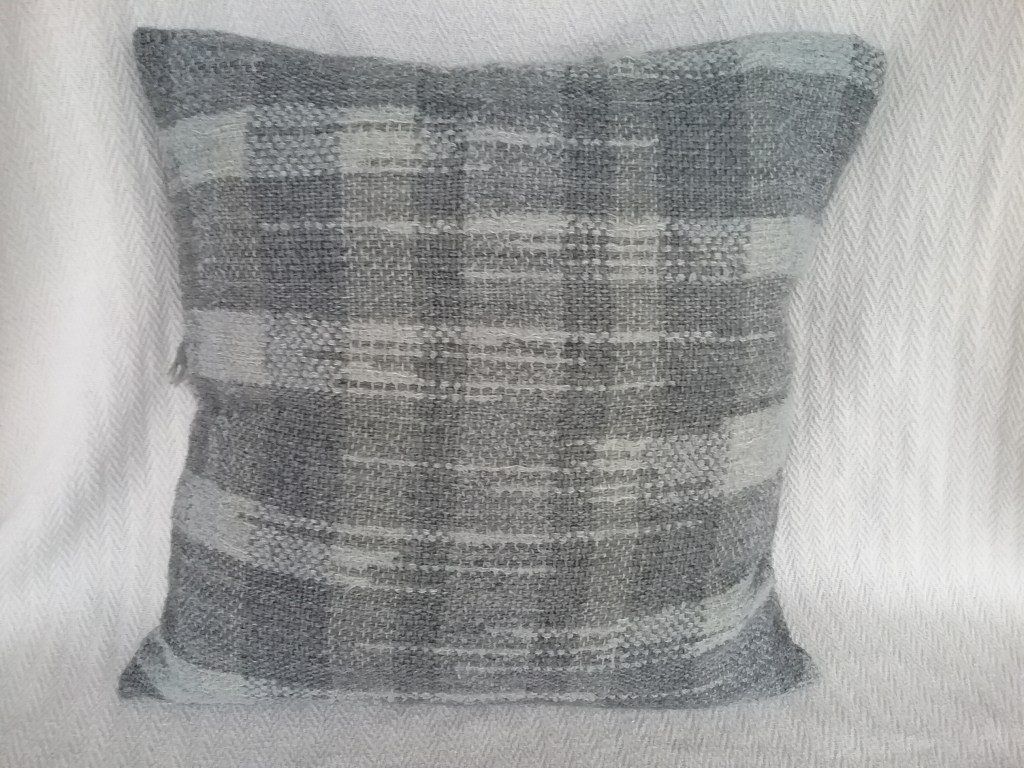
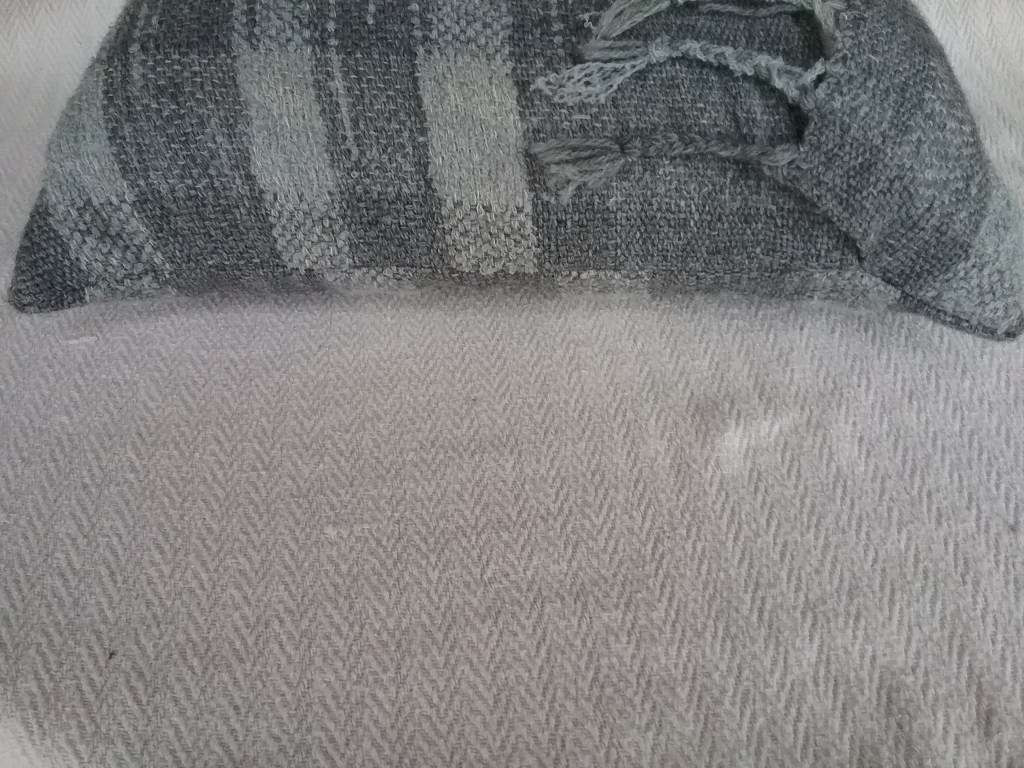
Back in October 2020 I shared photos of a sample of weaving I had made with the intent of turning it into a cushion cover, but I never took the time to sew it up. I have challenged myself this year to finish off any UFO’s (unfinished objects), so I wrangled it under the sewing machine and fashioned it into a cushion cover. It is constructed by folding the fabric twice right sides together and sewing along the selvedge’s leaving enough space at the opening fold to insert the cushion. I used a straight stitch with a short stitch length as I sew on a vintage hand crank machine (I don’t like electric machines) and the seams are very secure. I had intended to cut off and hem the braided ends, as it was just the way I had kept the warp ends from tangling during washing, but I decided they looked quite nice, so left them be.

That concludes my little project update post – I am also working on calculating a warp length for my Dorset Horn wool and am of course writing up more blog posts (coming soon!). Let me know in the comments if you have any UFO’sI definitely do!

Happy Crafting!

🎄A Festive Message🎄

I would like to thank all my wonderful readers and followers for making my first year of blogging so enjoyable. The past couple of months have been very busy with little time to play with wool, but I hope to start working through my stash in the coming weeks.

I wish you all a relaxing festive season and here’s to another year of crafting & blogging!

Loose Ends

Wovember: Fibre Library Part 2

A continuation of Fibre Library Part 1.

Disclaimer: I am not affiliated with any of the publishers, authors etc. in any books mentioned in this post. All books mentioned are my personal copies which have been purchased either new or secondhand. This list is not exhaustive, so if a book isn’t listed here it doesn’t mean it’s bad – I just haven’t discovered it yet.

British Sheep & Wool

Author/s: British Wool Board

ISBN: 9780904969108

This book focuses on British sheep breeds and their fleece. It has snapshot information for each breed including their history, wool characteristics, uses and facts/figures. The book is more strongly focused on the breeds and their characteristics than working with their wool, so contains little information on fibre prep etc.

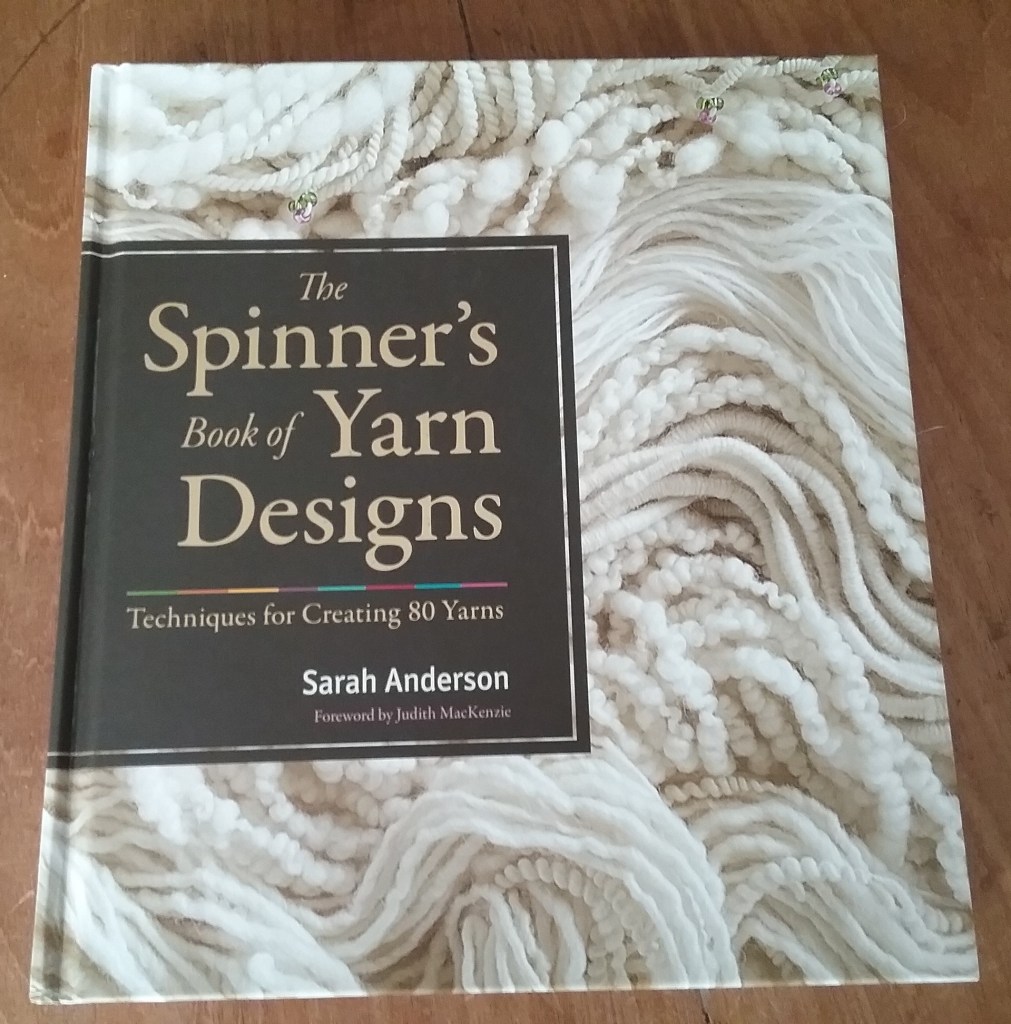
The Spinners Book of Yarn Designs

Author/s: Sarah Anderson

ISBN: 9781603427388

This book is quite art yarn centred, although it does have a section on spinning basics and fibre prep. The bulk of the book teaches you how to spin custom art yarns and also how to work with them; in knitting for example. It also comes with abbreviated reference cards in the back that can be kept by the wheel during spinning.

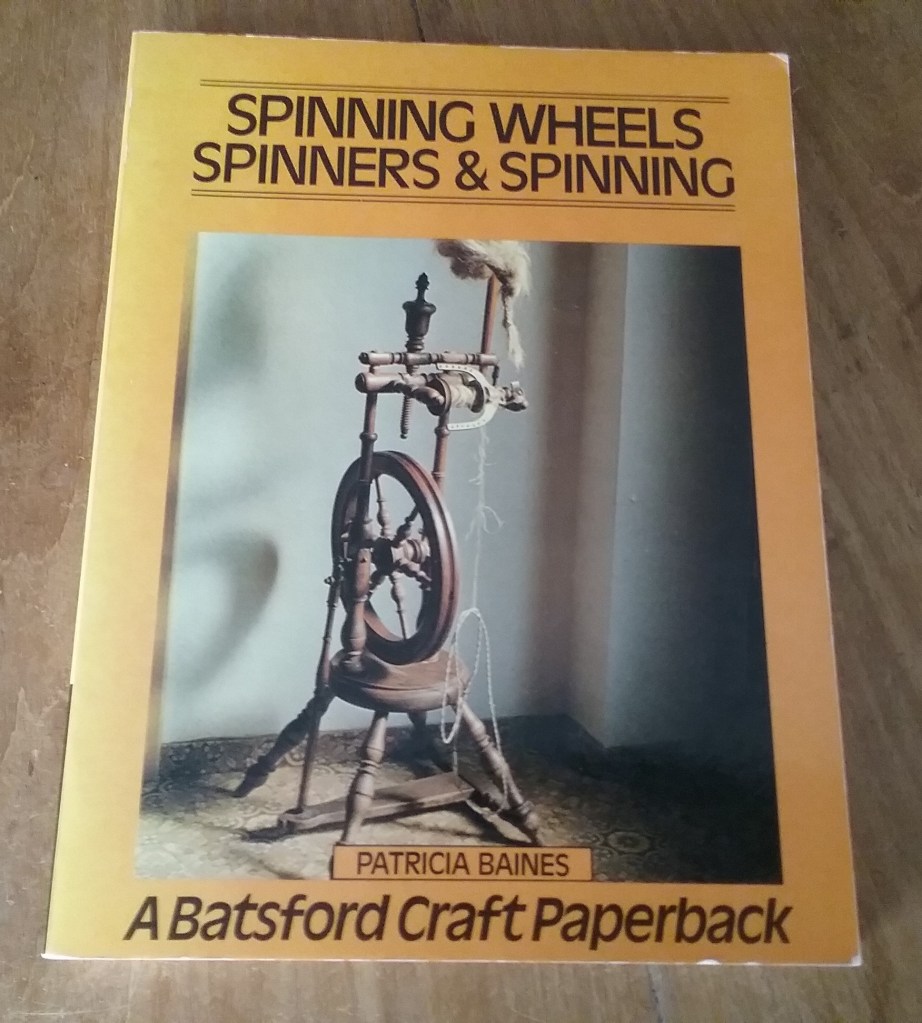
Spinning Wheels, Spinners & Spinning

Author/s: Patricia Baines

ISBN: 0713408227

The good thing about fibre books is that they rarely date, as the process has been virtually the same throughout history. I purchased this book from a charity shop about two years ago, it was first published in the 1970’s, but contains so much useful information. Although lacking in colourful photographs, it contains an overwhelming amount of information on the history of spinning around the world, spinning wheels through the ages, wheel mechanics and the preparation of all types of fibres.

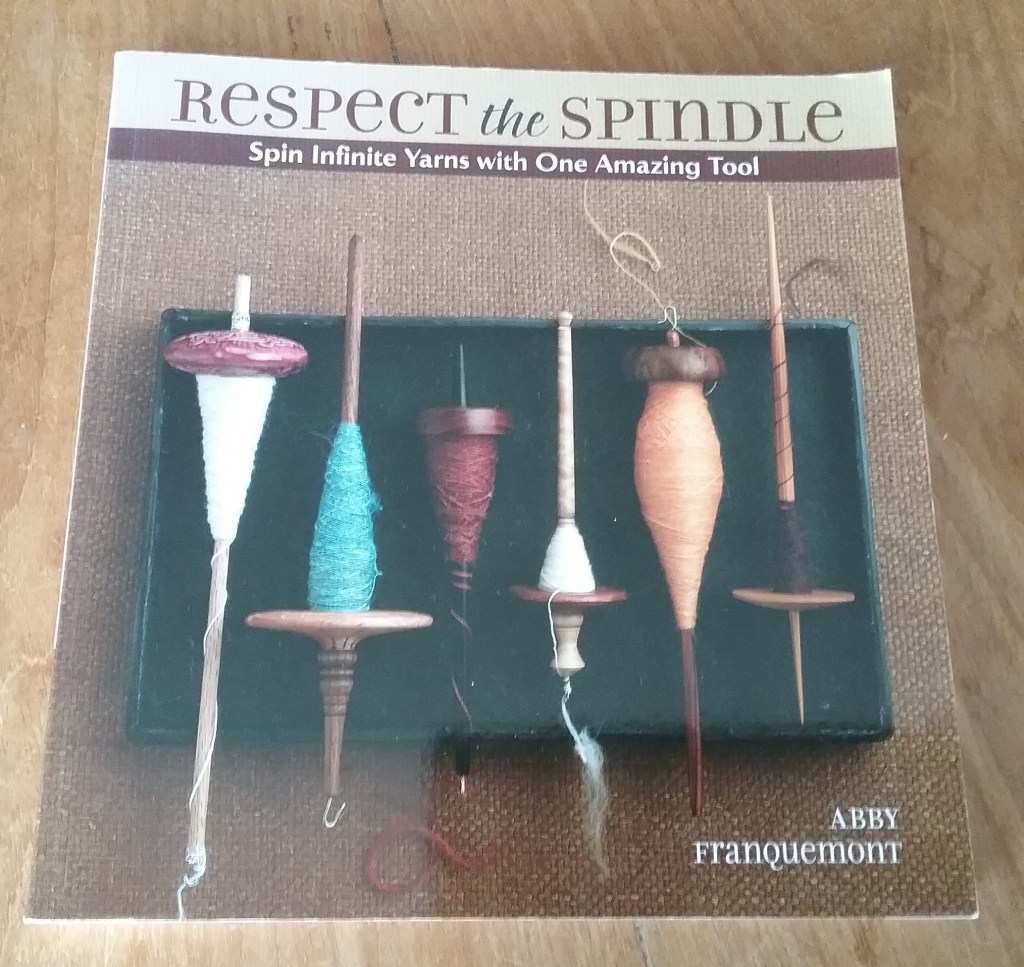
Respect the Spindle

Author/s: Abby Franquemont

ISBN: 9781596681552

This is probably the ultimate spindle spinning book. Often spinning books tend to focus more on spinning wheels than on spindles. This book however, covers the history of spindles, including their cultural significance and relevancy today. It contains basic tutorials, alongside more advanced spindle work and also provides information on selecting the best type of spindle for spinning certain fibres. It also has a chapter on the science of the spindle and ways to optimise the process of spindle spinning.

If you are looking to purchase a fibre book, then please do consider supporting an independent bookshop or craft store. I’ve recently heard of a website called Bookshop (I’m not affiliated – this isn’t an ad) that lets you order books online, but supports the indie bookshop of your choice.

I would love to know if there are any fibre books that should be on my reading list, please leave me any sugestions in the comments below. For Fibre Library Part 1 click here

Happy Crafting!

Fibre Prep: Lincoln Longwool

The Fleece

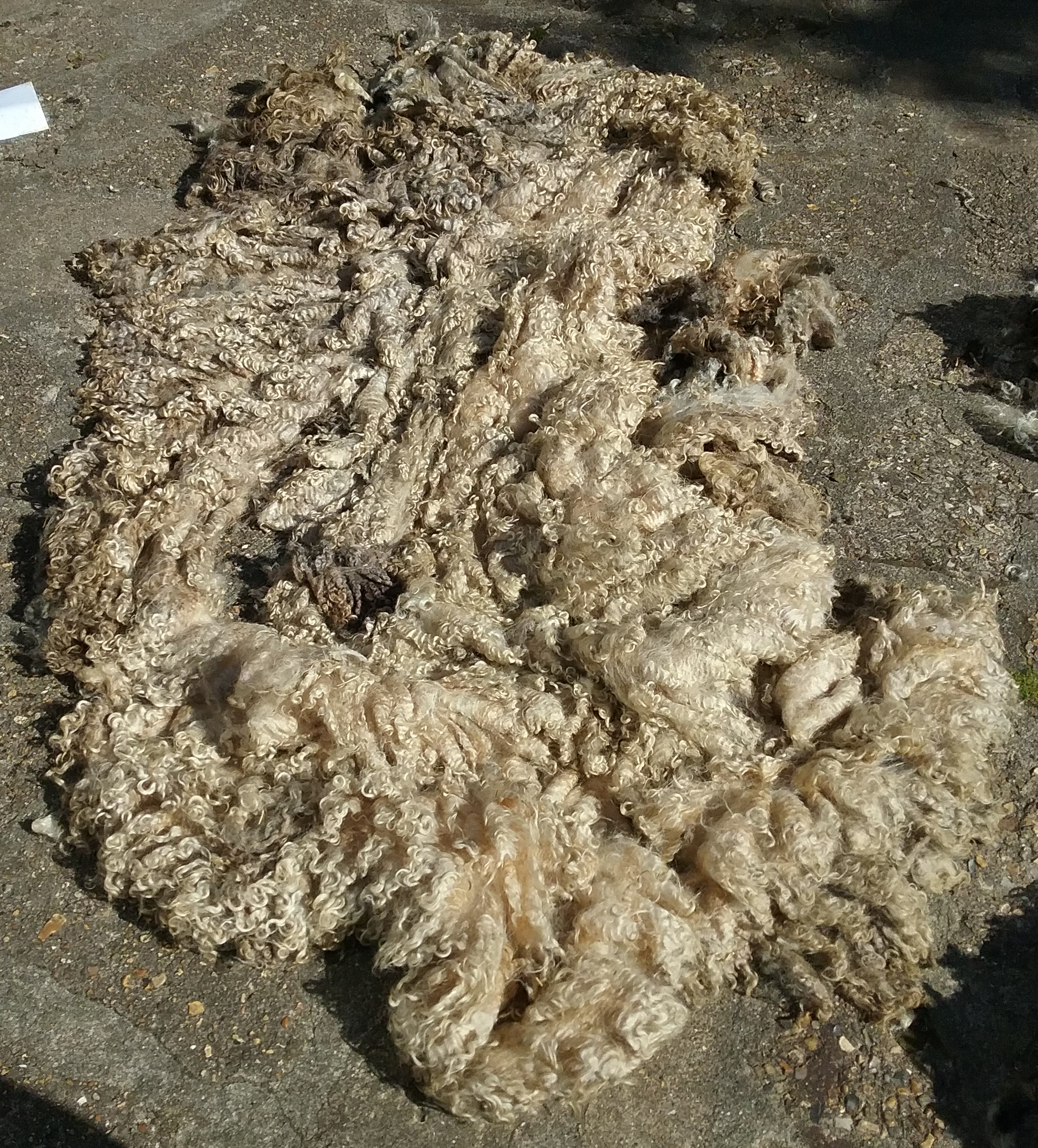
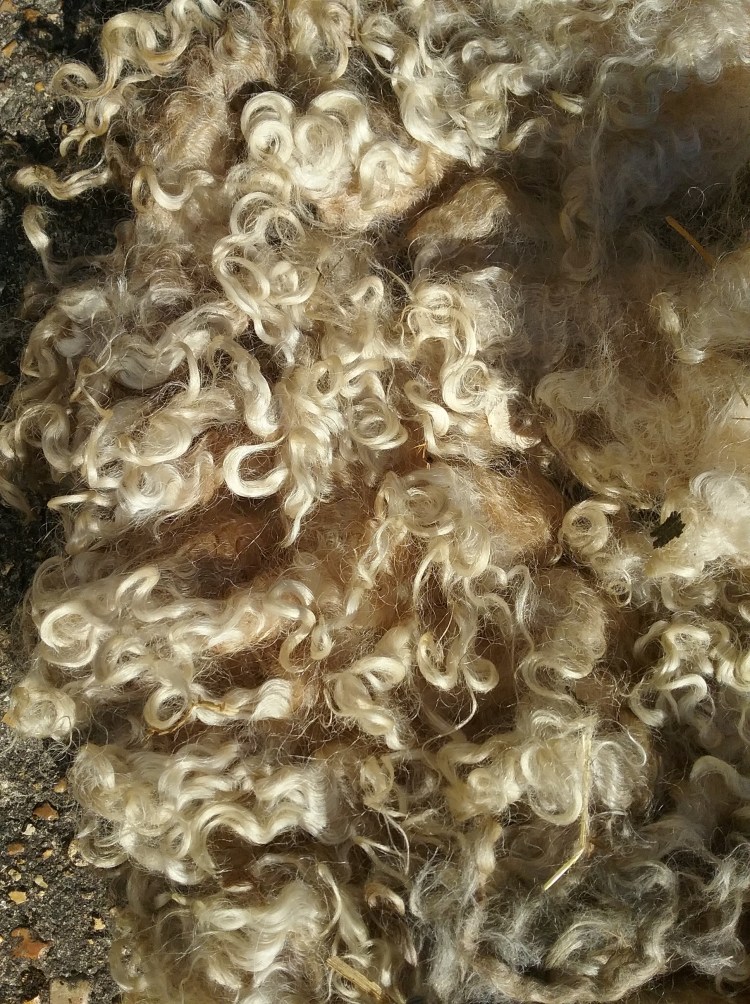
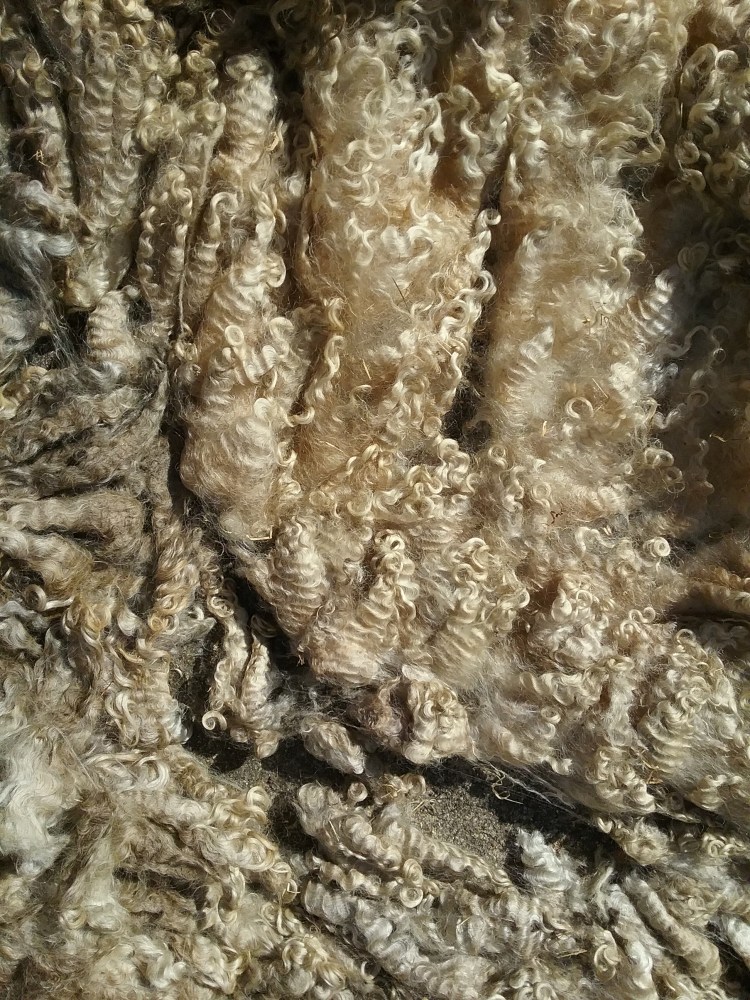
I was surprised by the weight of this fleece when it arrived (some Longwool fleeces can weigh up to 8kg) and by how much there was of it (it isn’t fully spread out in the photo). The fleece was, as my research suggested very greasy, but overall it was reasonably clean without much VM. As expected, there were some dirty sections around the rear, but these were very easy to separate and compost as the fleece is arranged in individual locks. The colours in the fleece were beautiful – areas of grey blended with the white. I had wondered if the grey areas were kemp hairs, however they are the same length as the rest of the fleece and don’t feel any coarser, so as far as I can tell, it is just the natural colouring of the sheep.

Washing

I’ve been doing lots of experiments with suint fermentation over the summer and have been optimising my process a little. One of the changes I made was to sew some sacks from old cotton sheets to put fleeces in before submerging them in the suint bath (this saves me from scooping around in the suint bath trying to fish out all the small pieces of fleece). I had read that historically, fleeces would often be put into sacks and left in streams or rivers to clean, so thought it might work in a suint bath too.

I put the whole Lincoln fleece into a sack and left it in the suint bath for just over a week. When I went to remove the fleece, I realised that in hindsight I should have split it in half to wash, as wool absorbs lots of water, so it was a two person job to lift it out of the suint bath, hold the sack while it drained and then put it into some rinse rainwater. After rinsing I put it out to dry so the suint smell would go, but as the locks were close together and it was a large fleece, it took several days to fully dry (thankfully there was still some sunshine).

Close up of Lincoln Longwool fleece before washing

The suint bath brought out the white colour of the fleece and definitely made a difference to the amount of grease left, but it was still too greasy for me to store indoors until I have time to spin it up, so I decided to do another wash using washing powder. Heading into winter, good drying days are limited, so I’m working my way through, washing a bowlful of fleece at a time in good weather. So far it’s taken 2-3 washes with the washing powder and 1 rinse for the grease to come out of each bowlful of fleece. The advantage of using a suint bath first is that it does seem to ‘loosen’ up the lanolin so that it comes off even the greasiest fleeces with fewer washes and somehow it stops the washing powder from stiffening the end of the locks.


The final step in preparing a long stapled fleece would usually be combing. However, I plan to spin this fleece from the lock as it comes, so I don’t need to comb after I finish washing. My final ‘prep step’ will be gently teasing apart the locks with my hands and picking out any bits of VM I missed during skirting.

As always, let me know if you have any tips/advice in the comments below.

Happy Crafting!
Further Reading about Lincoln Longwool:

Wovember: Fibre Library Part 1

When I started my fibre journey, I began looking for the relevant books. I like to look through reference books before committing to buy, to check that the information is useful, but as fibre books are quite niche, they aren’t often found in local libraries (although guilds are sometimes happy to loan books) and some craft shops won’t stock them if there isn’t much demand. There are lots of fibre books out there, so I thought I would share some of the books on my shelf and give a very brief rundown of what content they include, should it be useful to anyone else.

Fibre Library Part 2 will be coming later in Wovember.

Disclaimer: I am not affiliated with any of the publishers, authors etc. in any books mentioned in this post. All books mentioned are my personal copies which have been purchased either new or second hand. This list is not exhaustive, so if a book isn’t listed here it doesn’t mean it’s bad – I probably just haven’t discovered it yet.

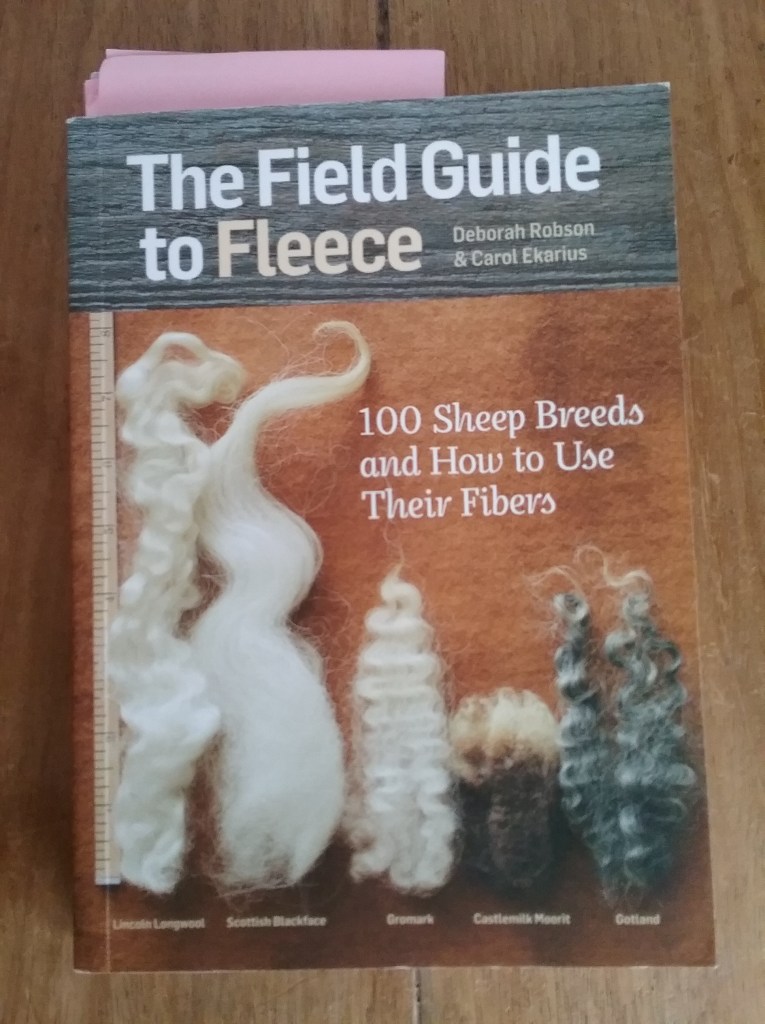
The Field Guide to Fleece

Author/s: Deborah Robson & Carol Ekarius

ISBN: 9781612121789

This is my go to book when I’m choosing which raw fleece to work with next (please ignore my pink paper bookmarks in the photo!). Its small (designed to be taken to wool fairs for reference) and has two pages on each breed. It gives a short background and snippets of information on each breed from best fibre prep, to staple length and best uses (although it is not a ‘how to’ guide). Each breed is arranged alphabetically, so it’s very easy to navigate.

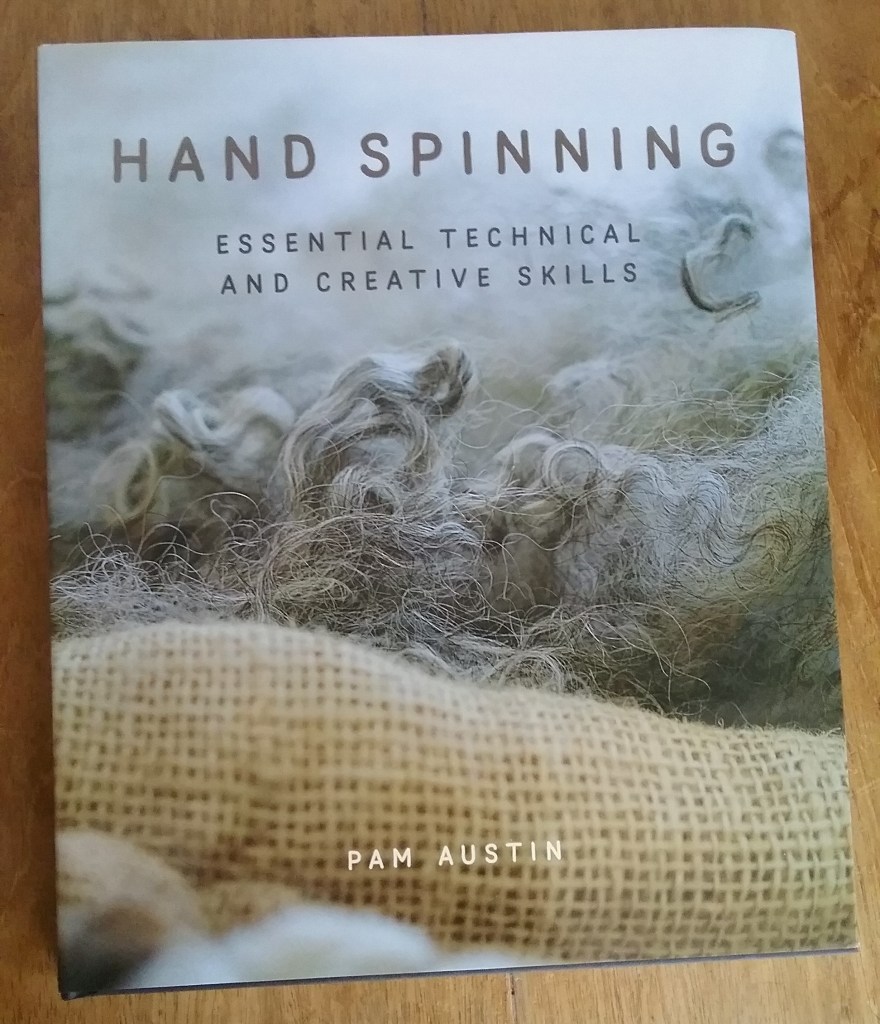
Hand Spinning

Author/s: Pam Austin

ISBN: 9781785003738

This book has lots of information and goes from beginner to advanced. It’s written in a chatty style, so it has the feel of a supportive spinning teacher guiding you. It has information on using both spindles & wheels, tensioning, troubleshooting, carding, choosing fleece, fibre prep, art yarn, dyeing (natural & synthetic) and working with other plant fibres i.e. flax & silk. It also has very clear diagrams and photos to support the text, so is good for ‘book learning’.

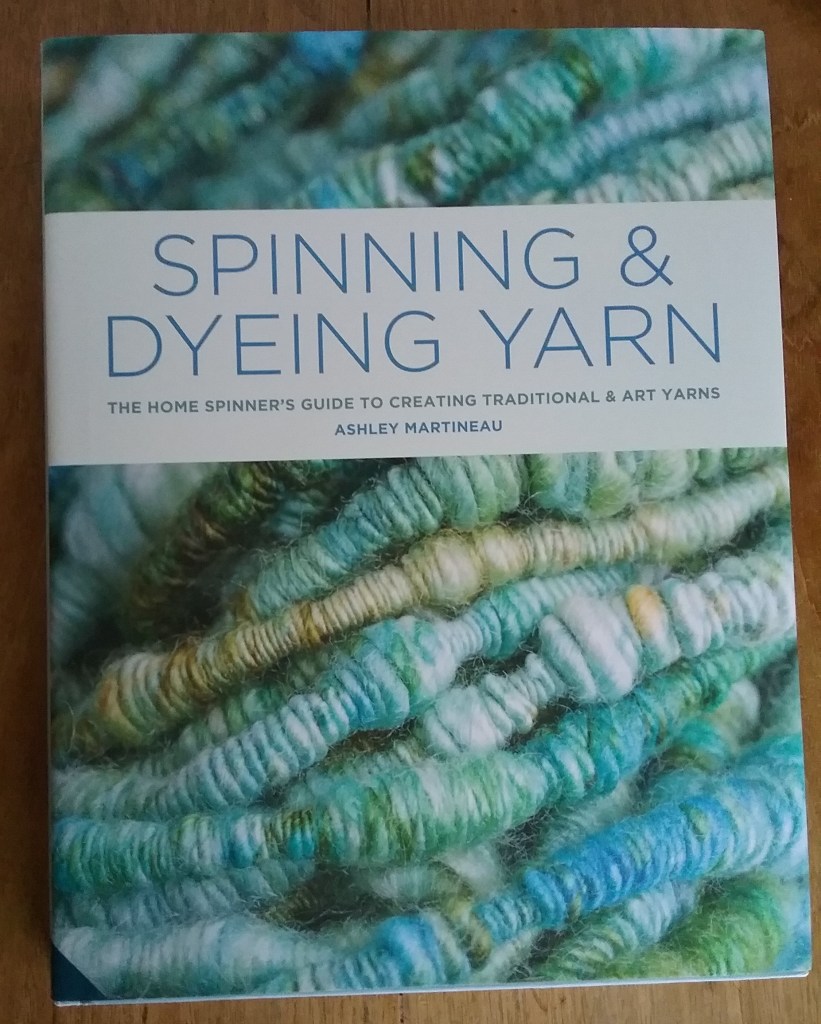
Spinning & Dyeing Yarn

Author/s: Ashley Martineau

ISBN: 9781909342460

The main focus of this book is art yarn, so it has lots of information about blending fibres on hackles and carders and lots of art yarn techniques, both on the wheel and the spindle. It has sections teaching you how to DIY equipment (including how to make a spinning wheel from pipe and a bicycle wheel) and lots of different techniques for dyeing with commercial dyes. It has a short fibre prep section along with some basic skills and also contains pages written by professional fibre artists giving several perspectives.

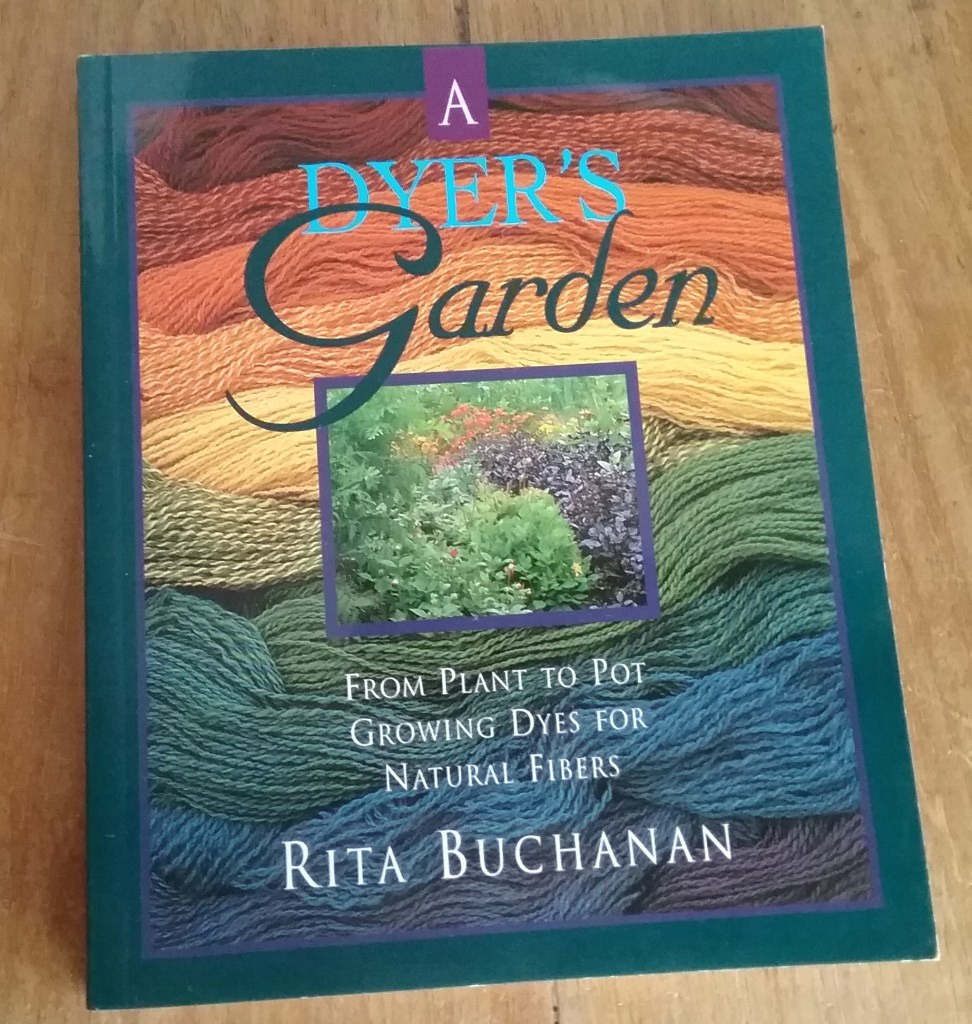
A Dyer’s Garden

Author/s: Rita Buchanan

ISBN: 9781883010072

This book is a short but detailed text that explores natural dyeing. Although I have read this book, I haven’t had a chance to try natural dyeing yet, so cannot vouch for how the methods turn out (and results would undoubtedly be reliant on skill). It contains sections on the basics of natural dyeing, alongside dye garden layouts and page edges showing photos of the colours produced from plants on different fibres and the effect of mordants and modifiers on these. It is an American book however, so although most plants could probably be grown in similar climates, it may not be relevant to every geographical area.

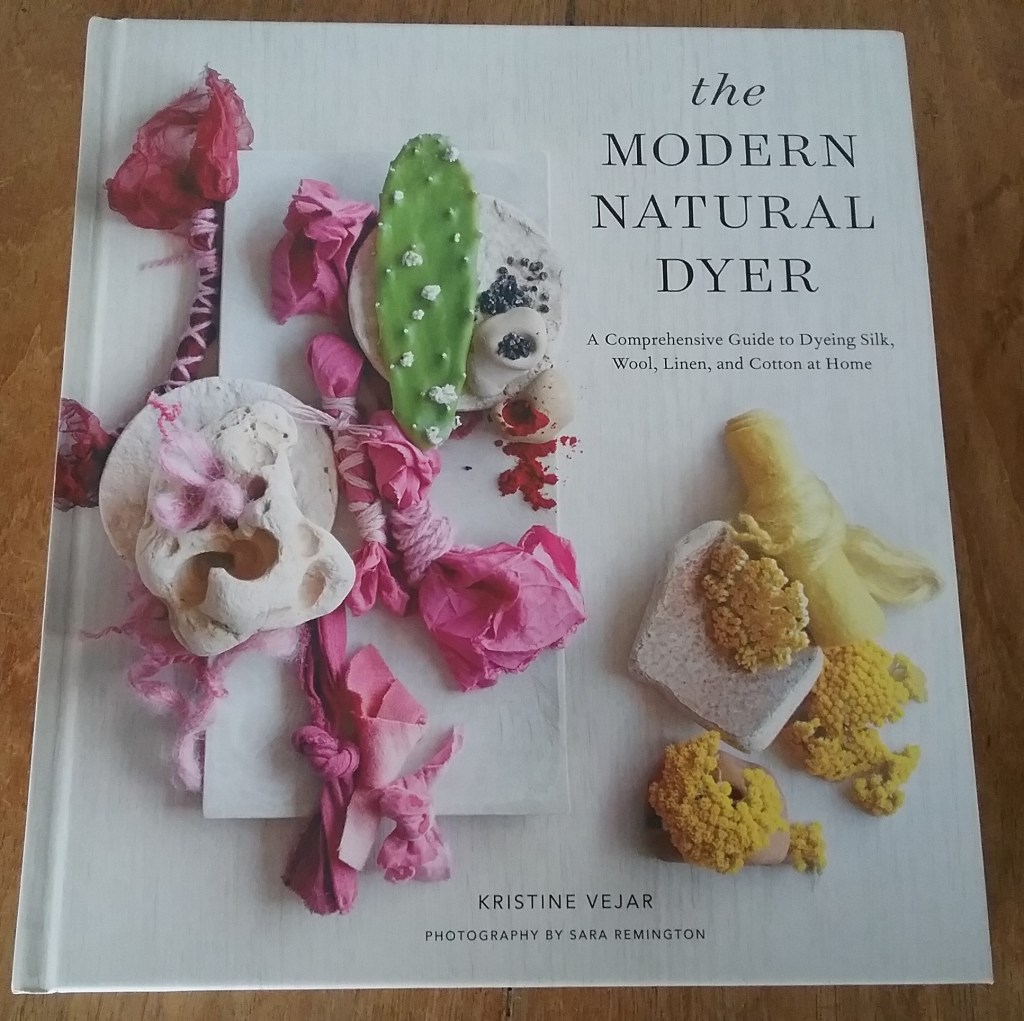
The Modern Natural Dyer

Author/s: Kristine Vejar

ISBN: 9781617691751

Again, I cannot vouch for how the methods in this book work, but it contains lots of information on dyeing both wool and non-wool fibres. It also has sections on record keeping and the book is set out with the basic method first followed by several project ideas including knitting and sewing patterns that incorporate the dyeing skills learnt on the pages before, which, as the title suggests, helps explore how natural dyes can be used in modern life.

I would love to know if there are any fibre books that should be on my reading list, please leave me any suggestions in the comments below.

If you are looking to purchase a fibre book, then please do consider supporting an independent bookshop or craft store. I’ve recently heard of a website called Bookshop (I’m not affiliated – this isn’t an ad) that lets you order books online, but supports the indie bookshop of your choice.

Happy Crafting!
A Little About: Lincoln Longwool

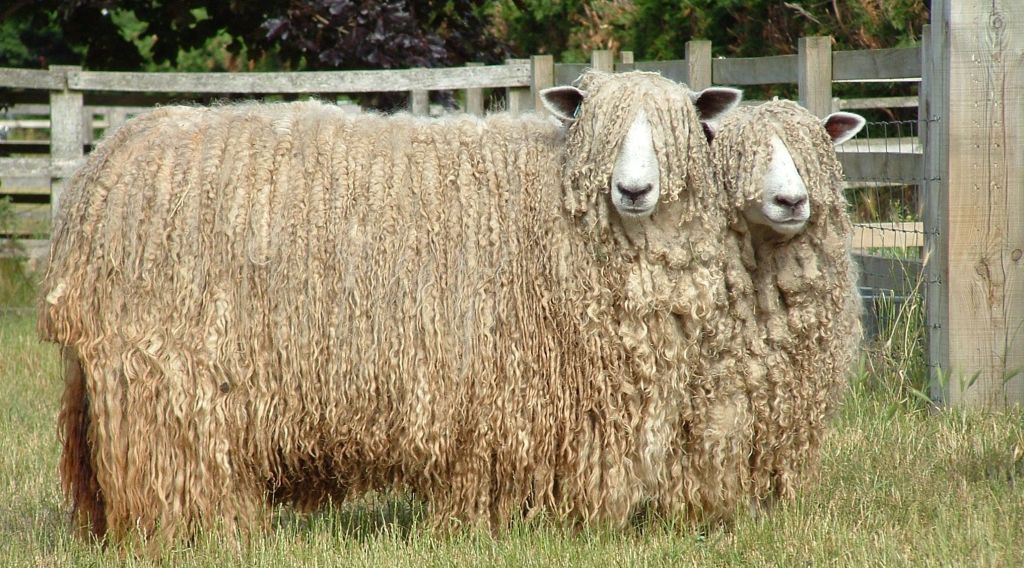
A Pair of Lincoln Longwool Sheep
Photo Via lincolnlongwools.co.uk

History

Lincoln Longwool sheep are one of the older British sheep breeds and were established in the English city of Lincoln in the Middle Ages, where their long, lustrous fleeces formed an important part of the wool trade. Lincoln sheep were later developed to provide both wool and meat and were exported across the world during the Victorian era. After WW2 the changing textile industry and reduced exporting of the breed led to a large decline in numbers. Today the breed is categorised by the RBST as ‘vulnerable’ (only 500-900 sheep), with most flocks still located in the Lincolnshire area.

Fleece Research

In 2020 the Rare Breeds Survival Trust launched a campaign called ‘Love a Longwool‘ aiming to draw awareness to the rare longwool breeds, many of which still have declining numbers, so of course I had to try and work with a longwool fleece before the year ended. Lincoln Longwool fleeces are large and have staple lengths of around 20-30cm. The fleece is reportedly high in Lanolin, but difficult to felt, so will hopefully clean up well in a suint bath. The fibres are too long for carding, so combing or spinning from the lock is recommended. It is not the softest of fleeces, often used commercially in carpets, so is probably not best used in clothing. This fleece does however, seem to be the quintessential candidate for lock spinning to make some art yarn and preserve the natural crimp.

Further Reading

The following sources have been used for reference

Celebrating Wovember: What is Wool?

Wovember was an annual blog campaign running from 2011-2017 centred around celebrating natural wool throughout the month of November. It was started to raise awareness of the importance of labelling commercial fabrics correctly (i.e. not using the term ‘made with wool’ for something made from a fluffy synthetic fibre). You can read more about Wovember and lots of other woolly information on the website.

To celebrate, throughout the month of ‘Wovember’, alongside some of my usual wool posts, I will also be sharing some information about wool and some resources & books I have found useful during my first couple of years starting in fibre, in the hope that it will encourage others to try crafting with natural wool in some way during November (and hopefully after).

What is Wool?

One does not need to be scientific to work with wool; it’s soft, fluffy and warm. However, I like to know a little wool biology to understand why it has these properties.

Wool is a protein fibre and like human hair, is part of the Keratin group. Each wool fibre is comprised of many different internal components surrounded by cuticles that cover the surface like scales (this site has a really good interactive diagram and more scientific explanations). The Woolmark Company also have a very short Youtube video showing the structure of wool here. These cuticles are surrounded by glands on the sheep that produce lanolin – the waxy substance that allows wool to repel water. Each of the components give wool its specific characteristics.

Why is wool so unique?

A very brief explanation of the properties of sheeps wool

Insulation: All wool has crimp. This is due to the arrangement of cells in the cortex and varies depending on the breed. Crimp gives wool natural elasticity and helps trap air between the individual fibres which reduces heat loss. This makes it useful for both clothing and house insulation.

Absorbent: The cuticle that surrounds each fibre has pores that allow moisture to travel through the fibres. This along with the air pockets created by the crimp, means that wool can efficiently absorb moisture from the body and transfer it into the atmosphere. Alternatively, it can also generate heat through absorbing moisture from the atmosphere (wool can absorb up to 30% its own weight in moisture before feeling wet). This means wool can help regulate body temperature when worn (and why its described as being able to keep you both cool and warm).

Flame Resistant: Keratin proteins contain high levels of nitrogen and due to wools high moisture absorption it requires much more oxygen than other materials in order to burn. This means that typically wool will not sustain a flame and instead, will smoulder for a short time before extinguishing itself.

Felting: The cuticle scales are arranged much like tiles on a roof – they are smooth in one direction, but cause friction in the other. For example; if you hold out hair from your head and run your finger along it from root to tip, your finger moves smoothly, if you move it from tip to root there is more resistance. Heat and agitation can lift the cuticles at their ‘open’ end causing them to interlock with other fibres aligned in the opposite direction. This process cannot be easily reversed, so makes a strong fabric without the need for chemical processes (although it is not as useful if felting is unintended!).

Renewable & Biodegradable: Sheep grow a new fleece every year and require a regular trim to prevent a multitude of health problems such as overheating and parasites (there are very few sheep breeds now that can naturally moult). While there are sheep, wool will never run out. Washing textiles made from natural wool does not release harmful microplastics into waterways and when it comes to the end of it’s useable life, it can be composted and biodegrades in a relatively short space of time (short video of a wool vs an acrylic jumper biodegrading on Youtube).

Websites for Further Reading:


I’ve given a very basic overview of all the wool science, so if you are looking for further explanations, then do visit the links in the post to websites with further information. A quick internet search will also bring up lots of results and I highly recommend having a look if you are so inclined.

Happy Crafting!
Britspin & British Wool Week

Today marks the end of both Britspin and British Wool Week. I’ve had to put my fibre play on hold while I try and get ahead making Christmas presents in my spare time. I’ve been very productive, but unfortunately I can’t show any completed gifts, as the people who will receive them follow this blog. However, in order to celebrate the fibre week I thought I would share a couple of recent projects.

Power Cut Spinning

A few weeks ago there was a long power cut in my area, so I decided to spin up the ‘underwater treasures’ and ‘forest treasures’ rovings I purchased from Yarns from the Plain during Fibre East.

It was the first time I’d spun roving (I’m used to spinning from rolags) and have never spun anything with silk in it, so I think they turned out rather well even though I couldn’t really see what I was doing in the dark!

I was initially going to use them in some weaving, but the skeins of the forest colourway have been sitting next to the rest of my Ryeland fleece and the colours go together so well, I may knit myself another pair of fingerless gloves with an arty cuff instead. Decisions, decisions!

Weaving

I recently finished weaving a length of fabric that will get turned into a cushion cover. This was a bit of an experiment as it was my first project on the rigid heddle loom I got myself over the summer – my Saori loom is great for big projects and long warps, but I can’t just put it in a bag and take it with me (plus I can now have 2 warps on the go at once!).

I’ve just got to tidy up the ends at the back and sew it together.

Happy Crafting!
Ryeland: Knitted Cowl & Gloves

Hello everyone, it’s been a while since I last wrote a blog post – I haven’t had much spare time to play with fibre and I’ve been trying to wash as many fleeces as possible while the weather is still dry (I have been optimising my suint method, but that’s a post for another time). Anyway, without further ado, onto a finished project!

Since this was my first attempt at knitting with my handspun yarn, I decided to use small simple patterns, but wanted to see how the wool behaved on different needle sizes. I’m certainly not a very experienced knitter and for some reason I find calculating tension gauges confusing, so unfortunately I have no such data for these projects, just my experiments. Happily, my handspun yarn doesn’t fall into any standard size/weight category as I spun it with the intention of making it uneven (some sections are about 3x the size of others). For both projects I decided to use moss stitch to accentuate the uneven squishy nature of the yarn, which I think it did perfectly.

The Cowl

This was the first of the two projects and my first time using circular needles. I cast on an uneven number of stitches onto 6mm circular needles (the only size I have) and just continued knitting rounds of moss stitch until it reached a length I was happy with. In my enthusiasm to use the circular needles, I confess I did forget the importance of checking the stitches don’t get twisted at the start and I knitted about 4 rows before noticing something was wrong!

The Fingerless Gloves

For the gloves I adapted a vintage pattern (pictured left) that I had used before to make a present for a family member. It uses size 11 & 9 needles. I didn’t change much, just knitted the cuff and finger tops in moss stitch instead of 1x1rib. I was surprised how versatile my handspun was as it was just as easy to knit on smaller 3mm needles as on the 6mm and didn’t distort the shape of the gloves.

I love the design of these gloves, they are very comfortable, the cuff goes well over your wrist and the fingers are a bit longer than standard.

I was very pleased with how these projects turned out; I only used about 3 balls/bobbins full of wool on both projects collectively. They are extremely warm, very soft and a beautiful colour (matt brown and grey tones with a subtle pearly lustre). They also have the added advantage of making me feel like I’m about to journey through Middle Earth when I put them on!

Happy Crafting!