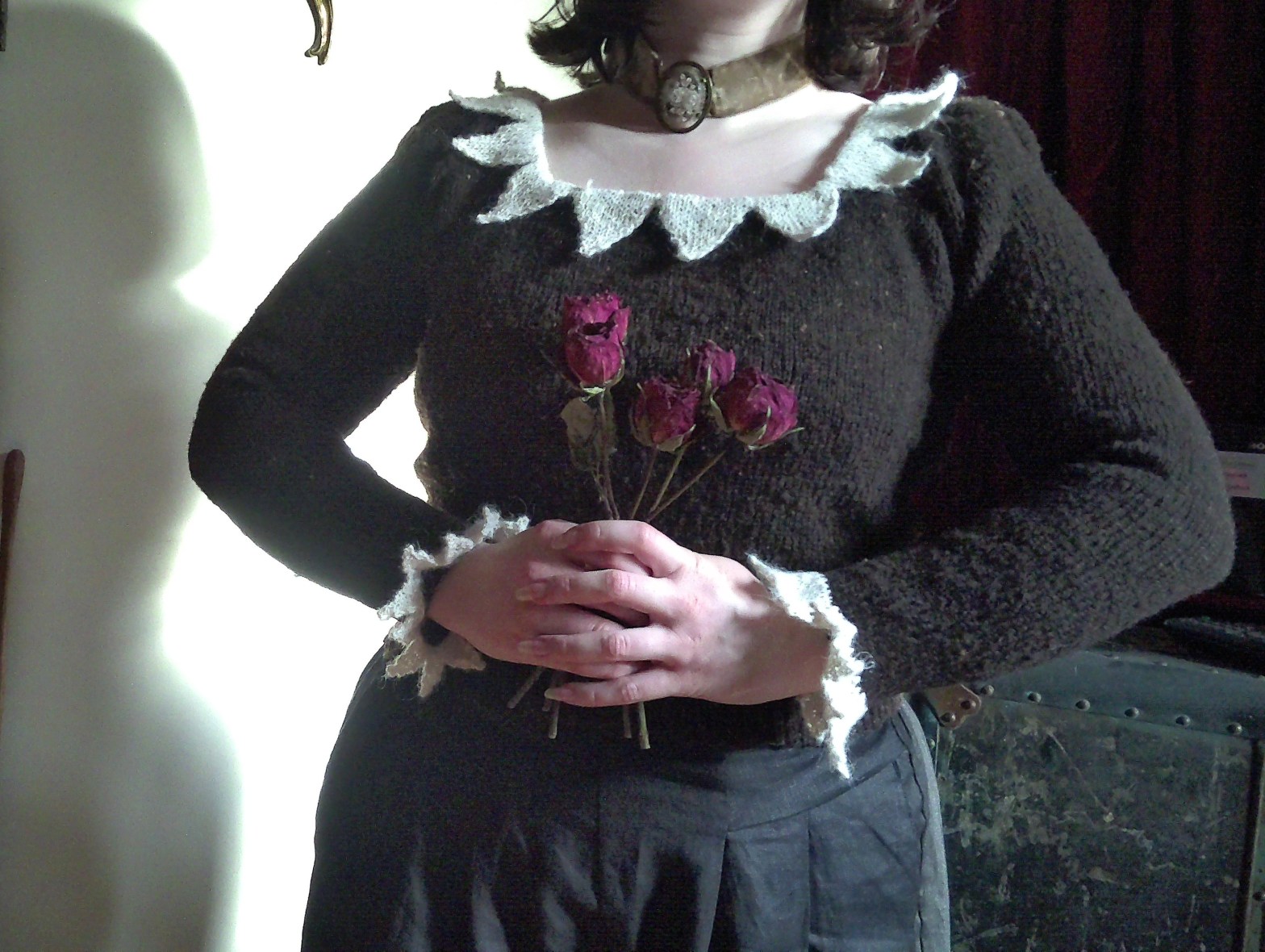
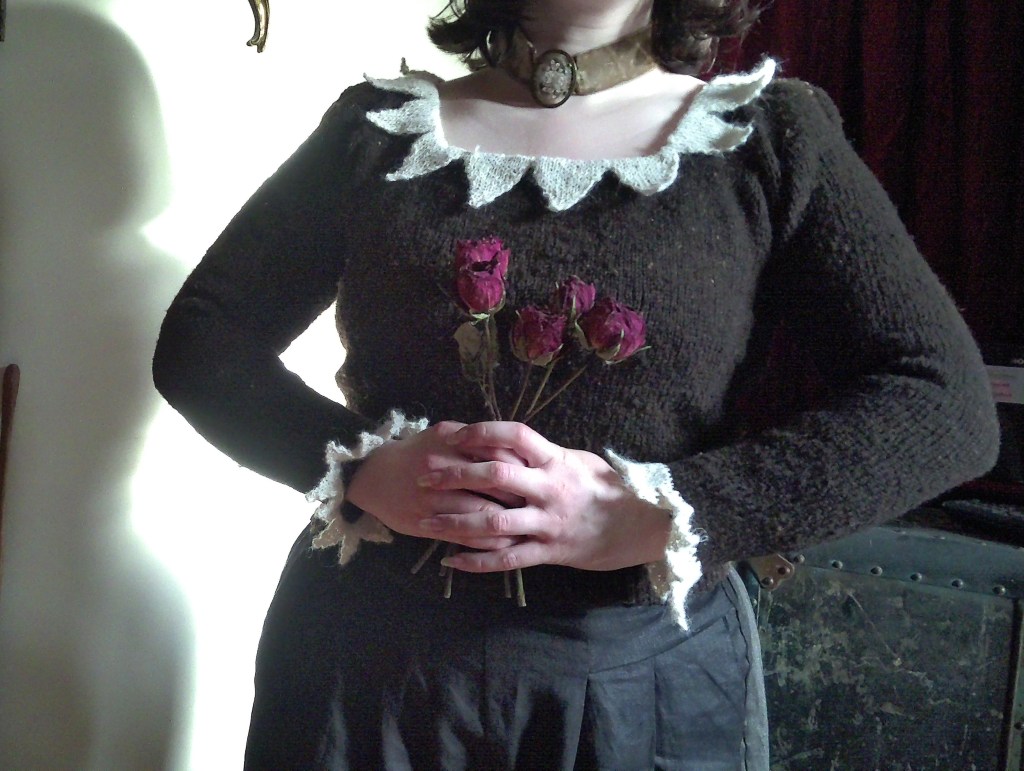
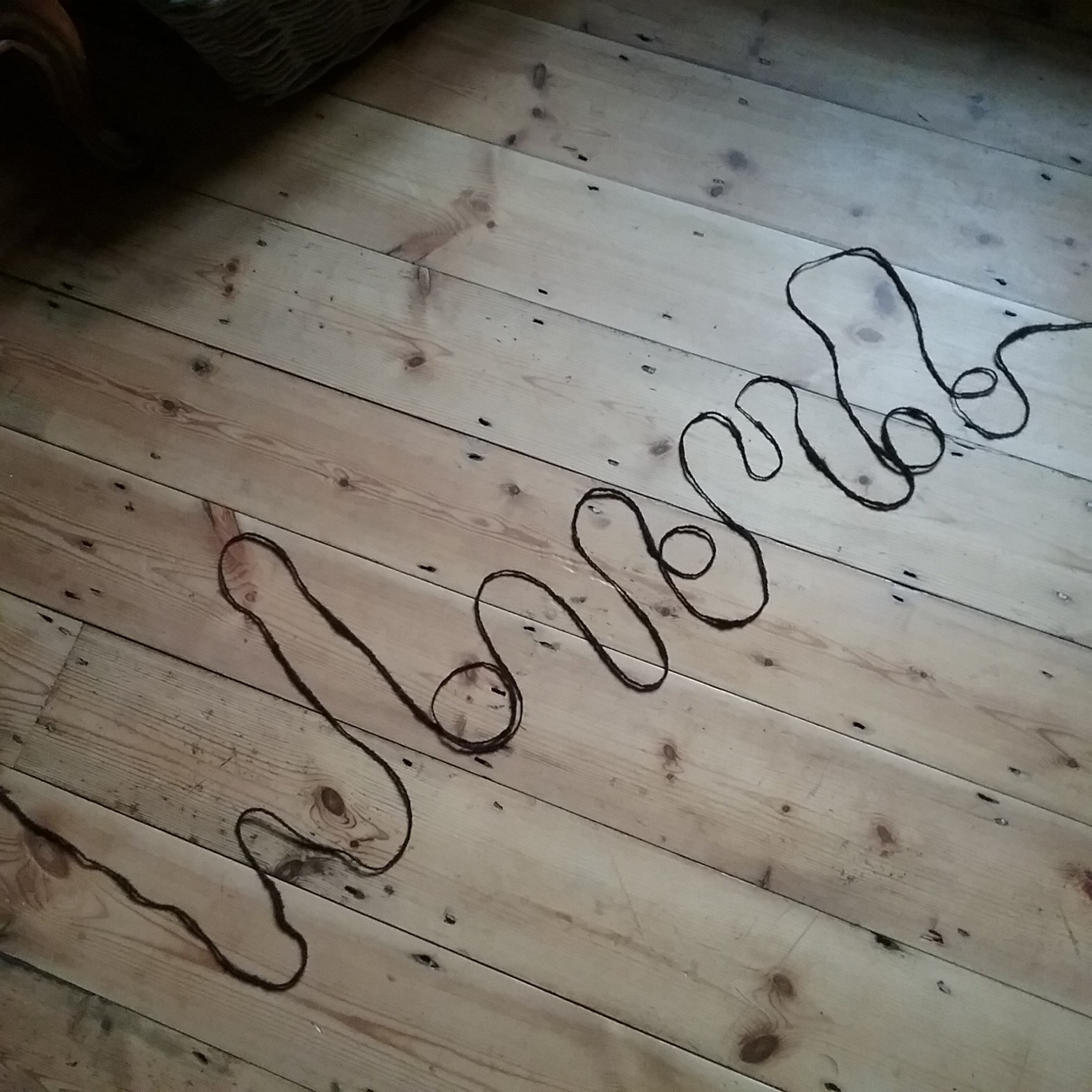
Black Welsh Mountain: Alice Starmore’s Raven Collar

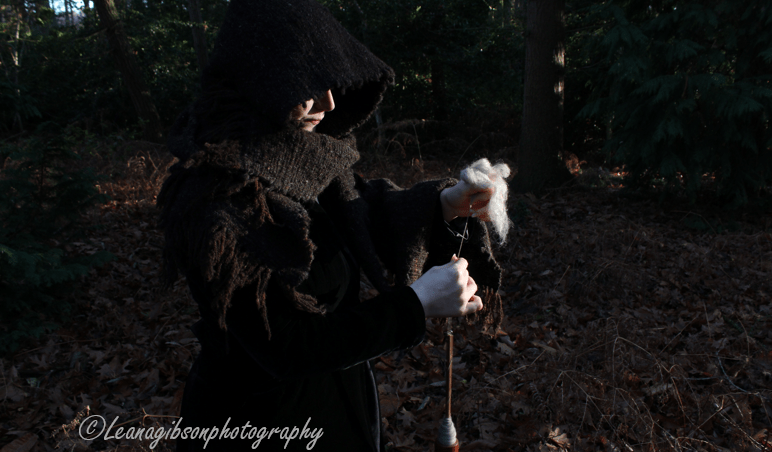
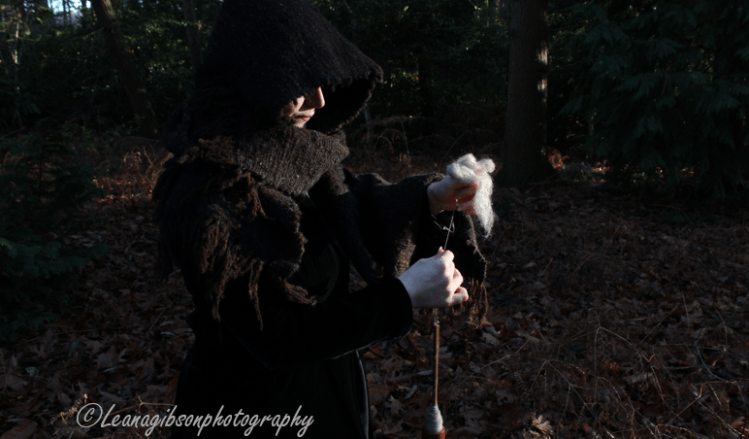
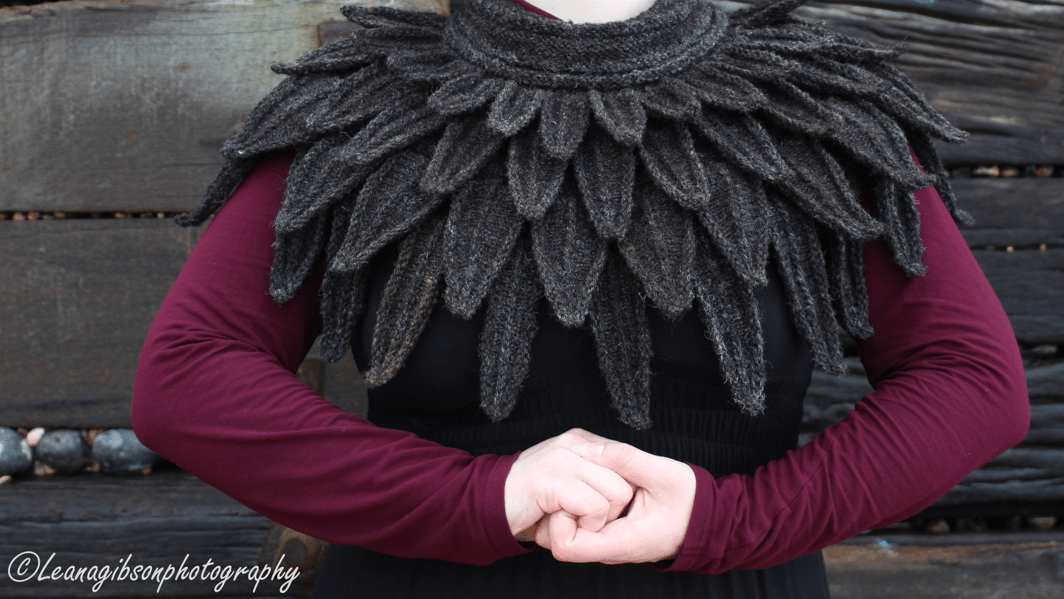
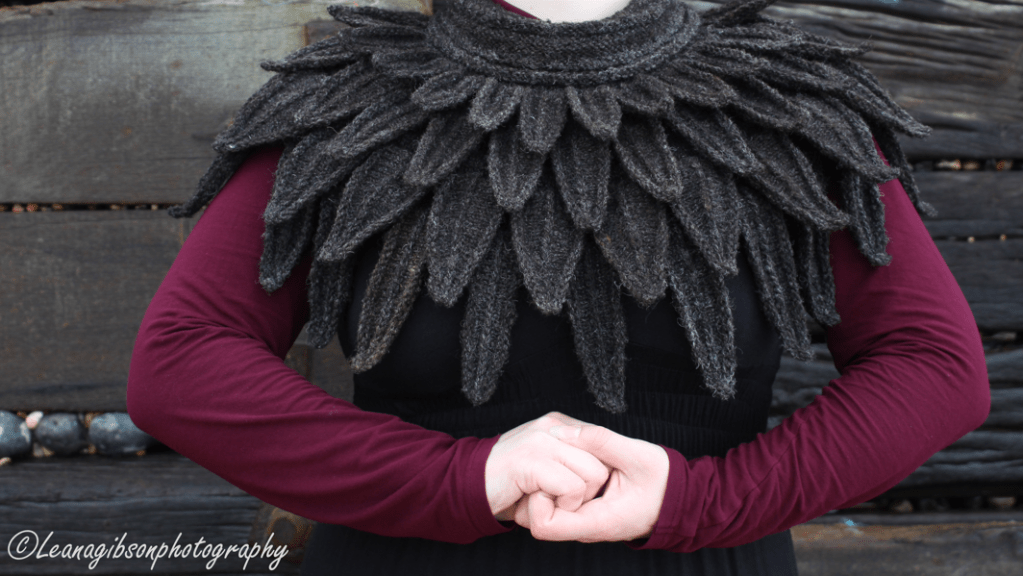
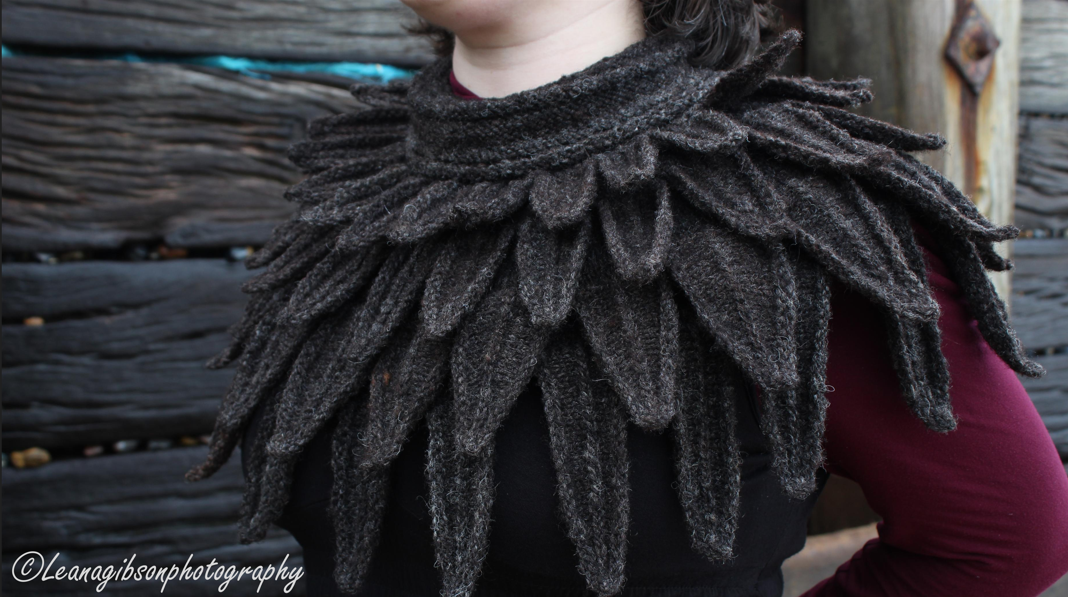
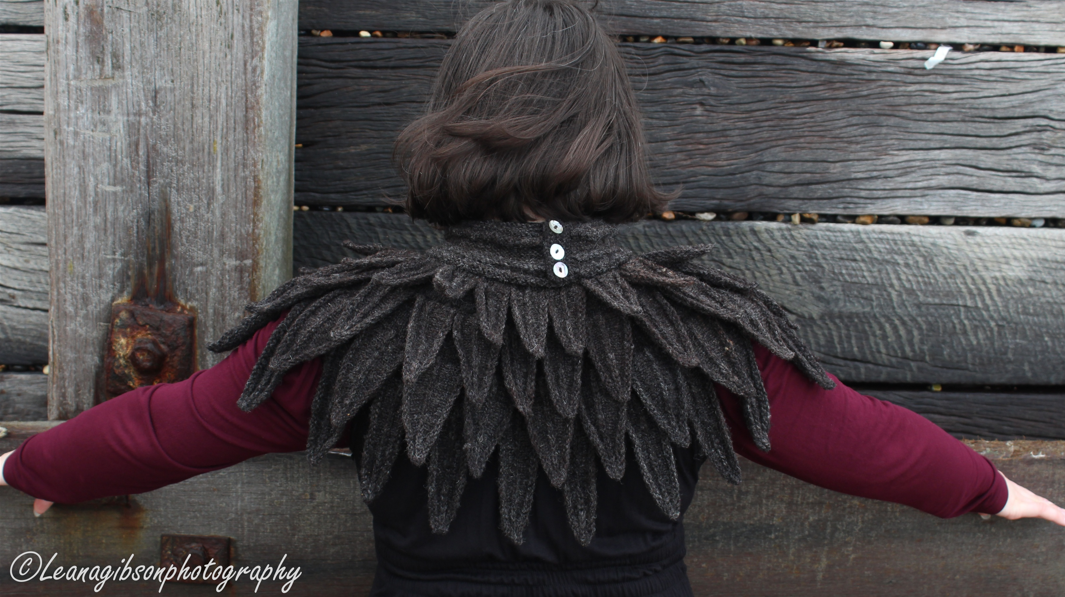
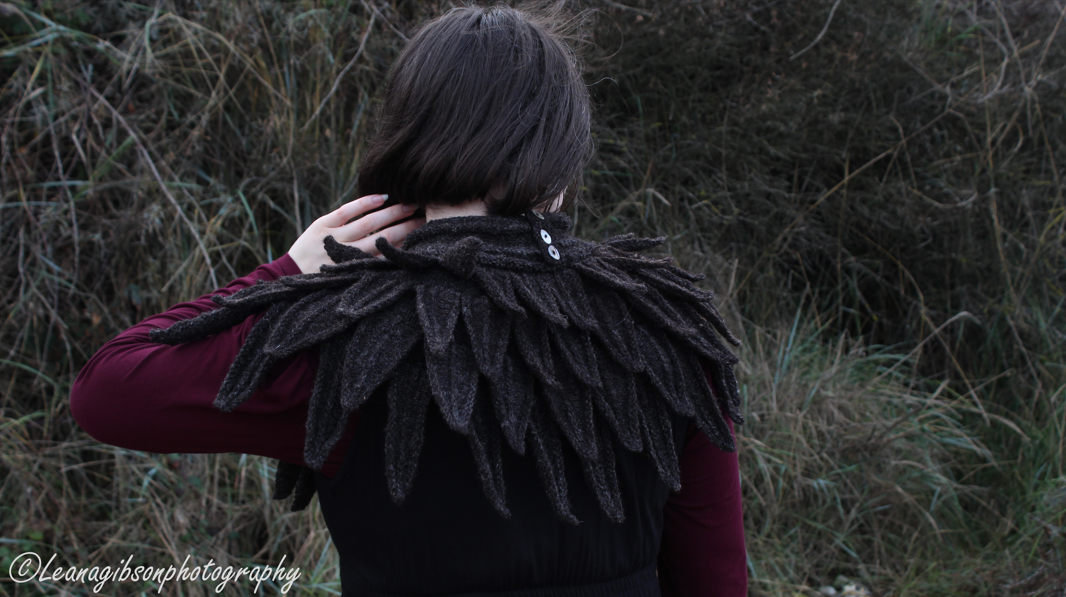
Earlier this year I knitted the Eagle wrap from Alice Starmore’s Glamourie and waxed lyrical about the other patterns in the book. The raven poncho was the design that first grabbed my attention as I thought it would be a perfect project for my Black Welsh Mountain. Though the poncho is beautiful, I was most interested in the feathered collar portion, so was very happy to discover that Starmore has created a version of this herself. Something I love about the Glamourie book is how you are encouraged to take the bare bones of the patterns to tweak and adapt what you make, with the beautifully intricate costumes serving as inspiration. For anyone wanting to make this there is a specific pattern available on Starmore’s site, however I knitted the 3 layers as per the Glamourie book and then improvised the fourth layer based on these.

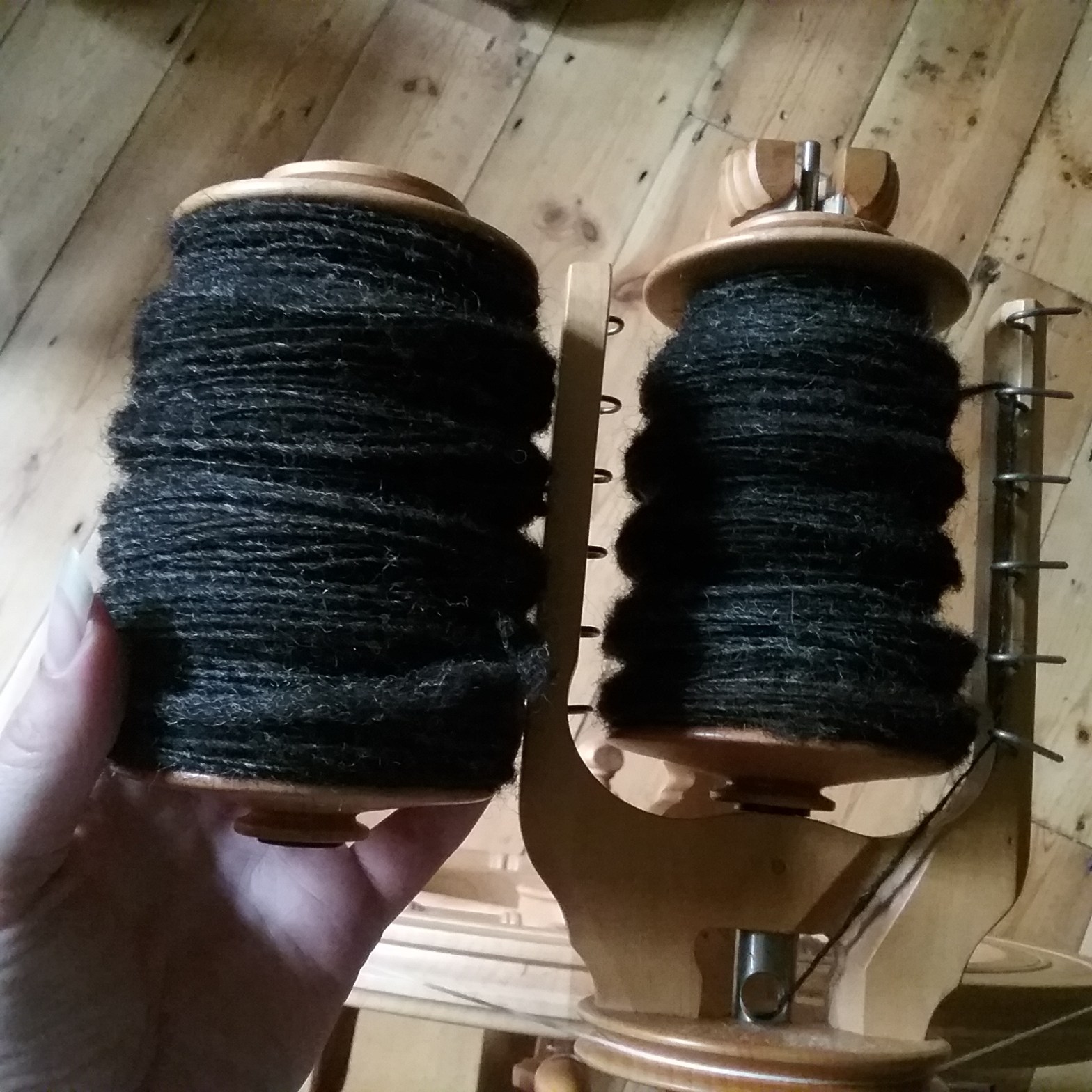
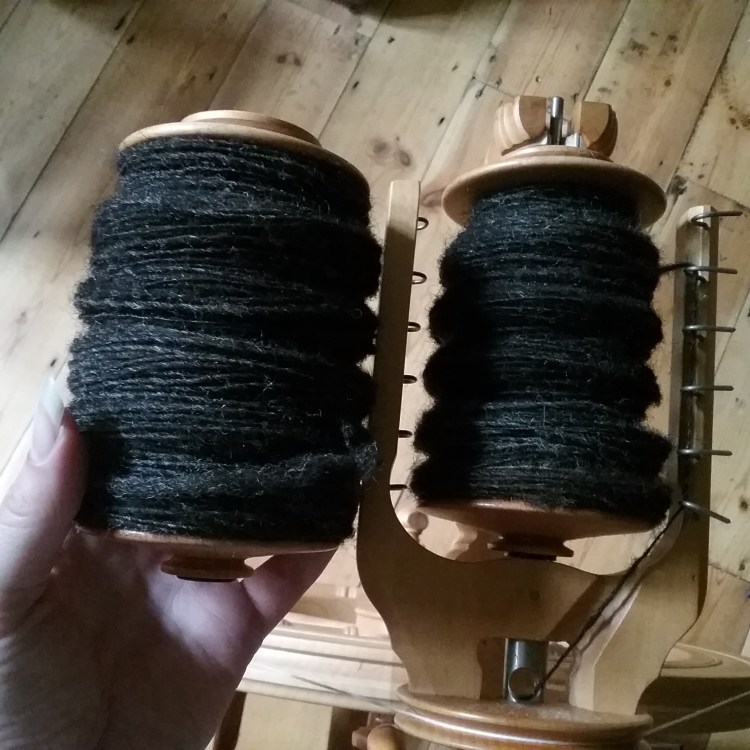
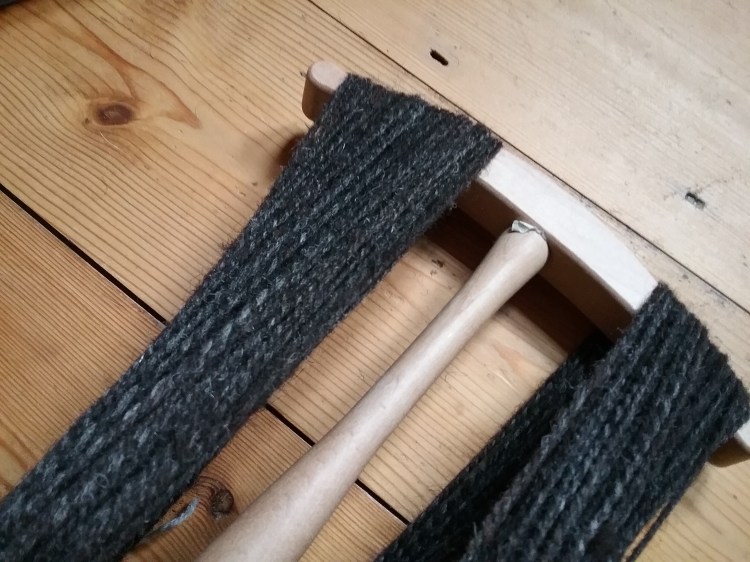
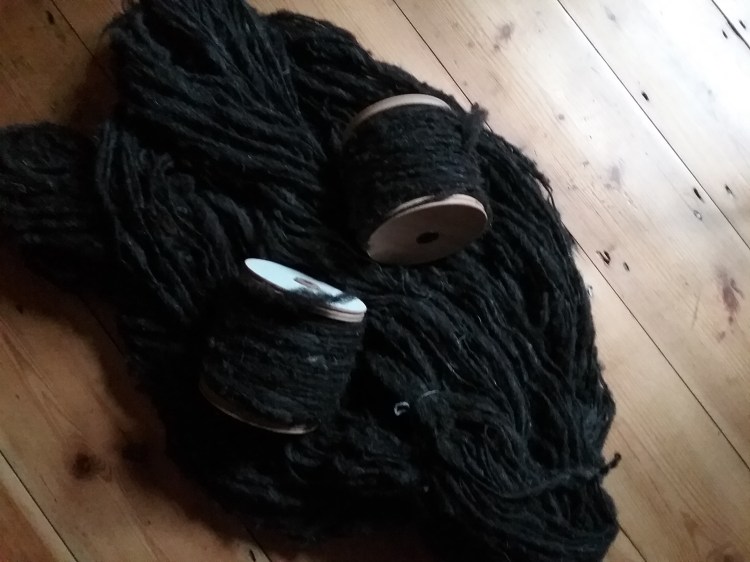
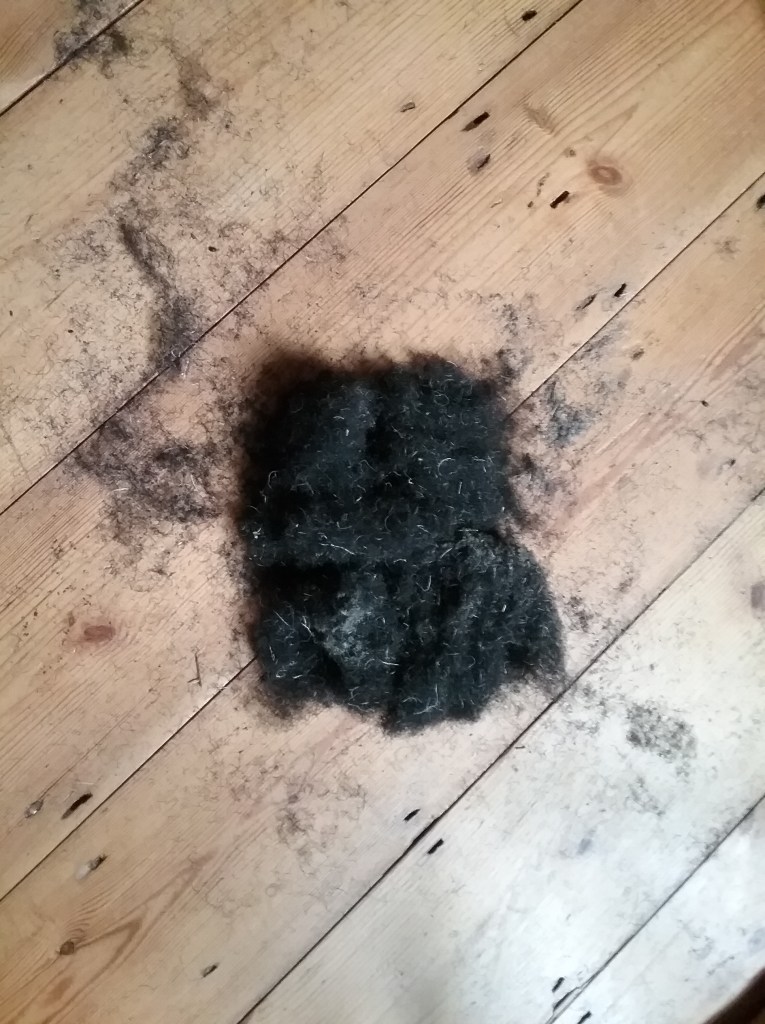
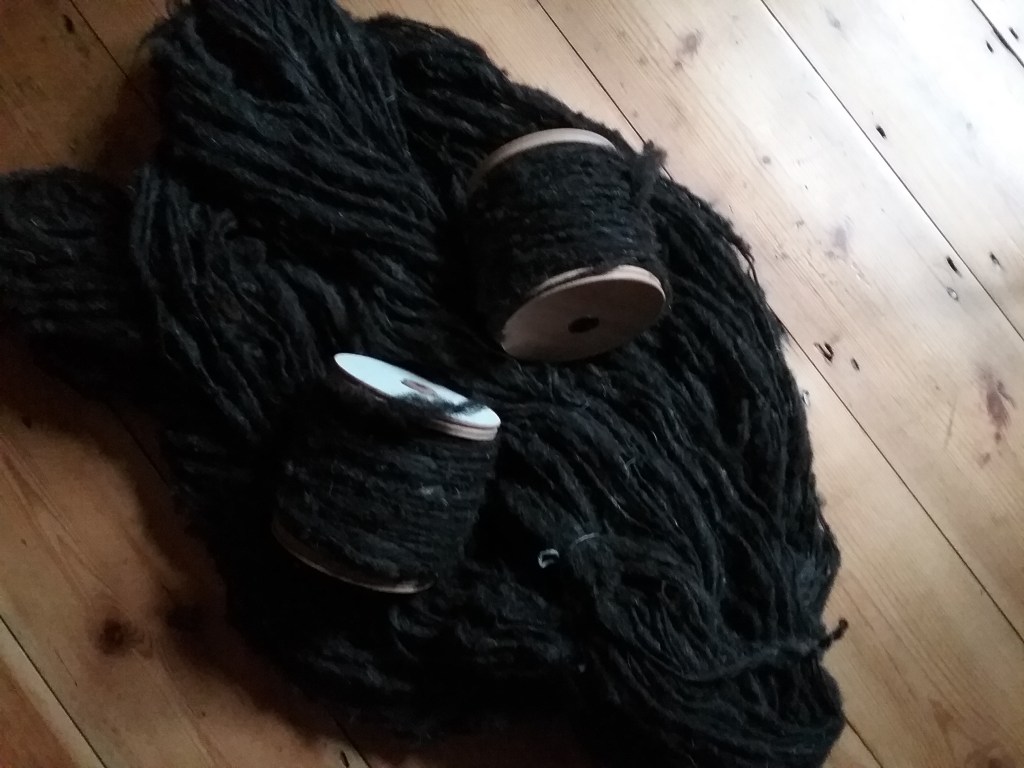
Those of you following along with my BWM journey so far will know that this fleece wasn’t the best quality and I combed it to remove broken fibres, however the resulting yarn was still on the slightly coarser side. So why use it for this project?

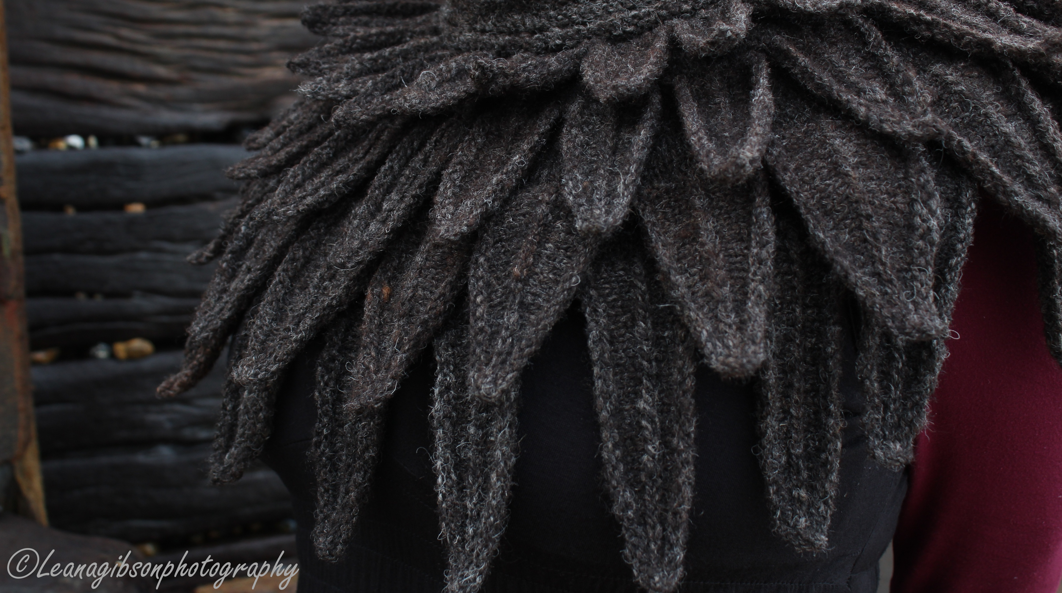
The most obvious reason was the colouring; though the feathers of Scottish ravens that Starmore is replicating are blue tinged, my BWM has tinges of white and grey that do interesting things when they catch the light, much like the feathers of corvids. The slightly coarser nature of the yarn meant it had more stiffness to it, which would help give the collar a more feather-like structure (a drapey yarn would make the feather’s floppy) and also showed off the vein pattern well. Finally, since the collar is not designed to be a next to skin garment, coarser or itchy fibres wouldn’t be a problem. When combing and spinning I’d also separated out the softest fibre to spin a ball of wool specifically for use on the neck portion of the design.

Knitting Feathers

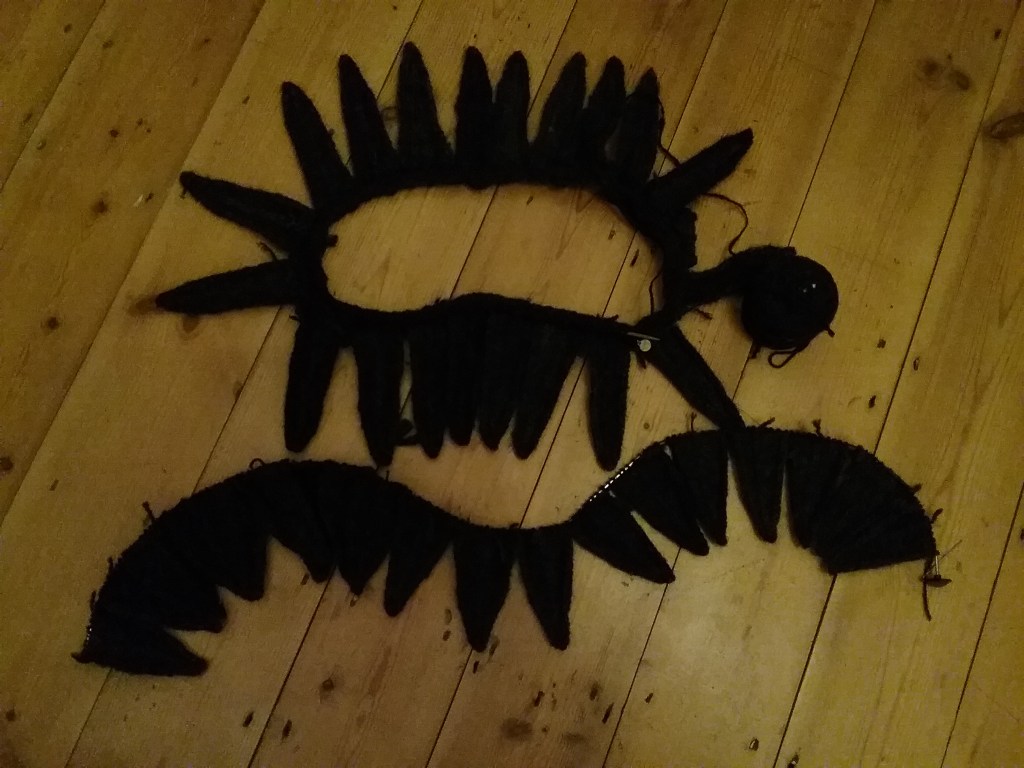
And thus began a long journey knitting 84 individual feathers of different sizes. I love constructional knitting projects, but even after reading through the pattern, I couldn’t quite visualise how the feathers would come together, so it was quite magical watching the first feather evolve before my eyes! I found the pattern easy to follow, although I couldn’t fathom out how to slip the stitches in the correct orientation for the purl double decreases, so ended up using a cable needle to swap stitches, which worked just as well (though I am still so curious how to do this on two needles!). At the start of the fourth layer of feathers, I was running low on yarn and was slightly concerned that I wouldn’t have enough, but somehow finished with yarn to spare!

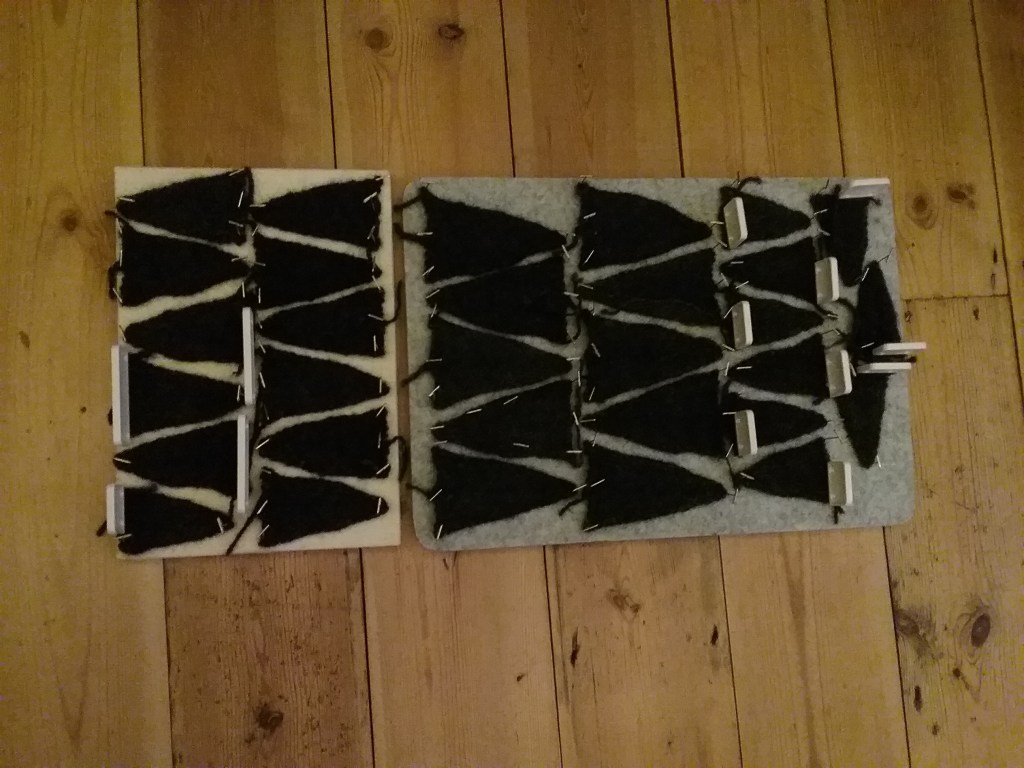
Then came the challenge of blocking. I returned the blocking mats I borrowed for my eagle wrap, but realised that I could use my wool felting mats as a more natural option than foam and block the feathers in batches. I purchased some blocking pins from Hobbycraft and also saw an A3 ironing mat made of wool, so I bought that too (I seem to end up working on my sewing projects on the floor, so thought it would also save me moving back and forth to an ironing board to press seams in the future!). The mats worked well for blocking and unlike foam, the pin holes can ‘rub out’, the only limit being the mat size.

Joining the Layers

Once all the feathers were dry it was time to join them together. This required some calculating for the fourth layer I was improvising, since this layer was knitted first. Unfortunately I was so wrapped up in my stitch and decrease calculations that I didn’t notice the instruction to knit several rows before joining the next layer in the book, so had to frog my first two rows and start again – oops! I found using two sets of circular interchangeable needles incredibly handy for this portion; they are more flexible when joining layers of feathers together and when I accidently left two feathers behind (and didn’t notice until I reached the end of the round too early!), I was able to swap the needles to the other end of the cable and join them on without having to unravel everything.

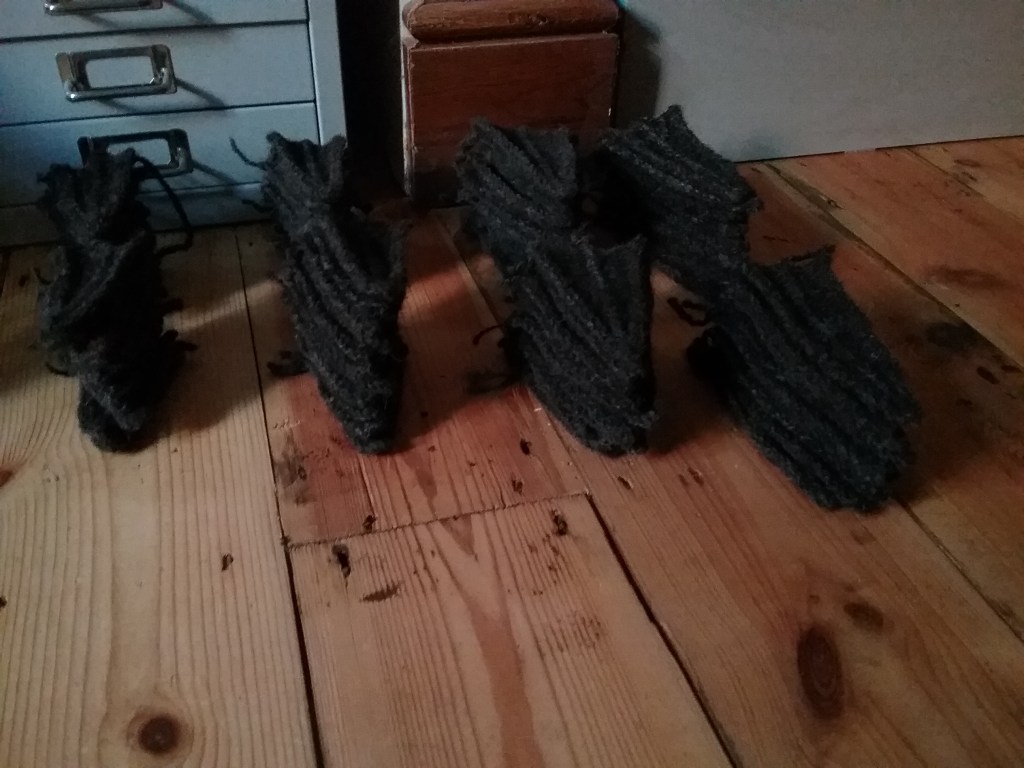
Bottom and third layer of feathers on circular needles

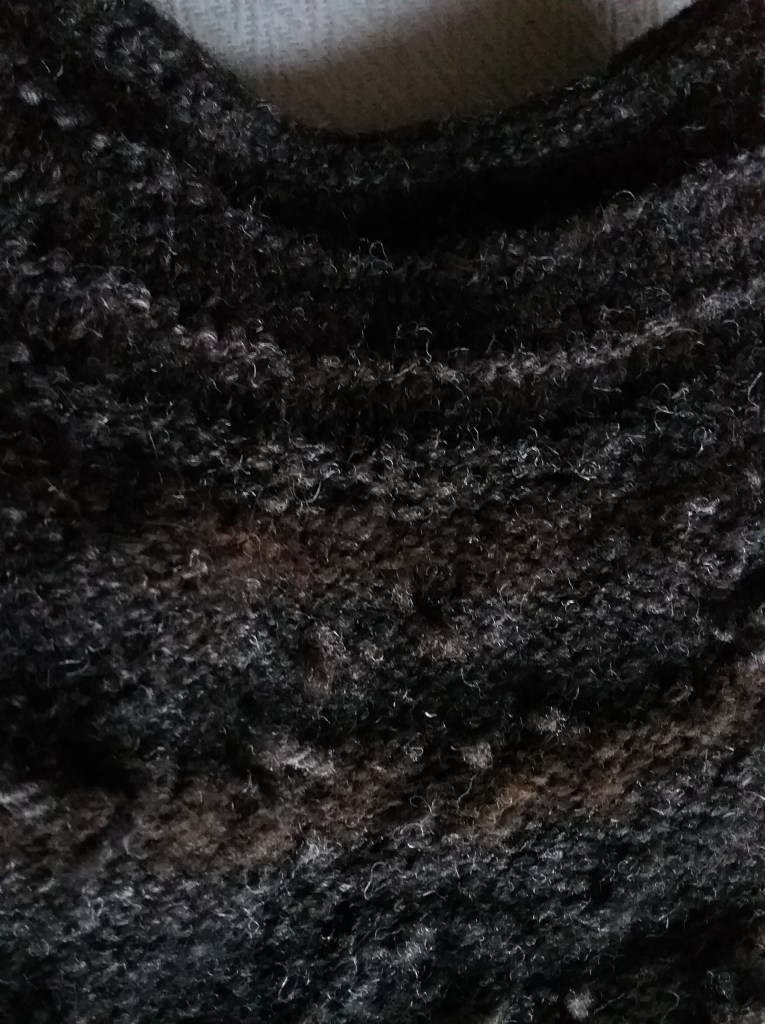
Since my yarn was limited for this project, I decided that I would swap to Zwartbles yarn for the rounds that would be hidden underneath each layer of feathers. This worked well since any colour variation showing through to the front looks like down feathers (although it’s visible as stripes from the inside).

Colour variation of the dark brown Zwartbles between BWM

Once all the layers were assembled I tried the collar on before working out the neck. The neck portion given in the book is more rounded and bumpy, while Starmore’s collar version has a more ruffled appearance and buttons, which I prefer. After examining the pictures closely I felt the ruffle effect was achieved in a similar way to joining the feather layers, while also knitting back and forth for the buttons rather than in the round. At which point I put the pattern down and proceeded to completely wing it. I’d been working on this project much longer than I’d anticipated and was onto my last ball of yarn, so rather than trying to work out ruffle combinations that I might not have enough yarn for, I decided to just go for it. To avoid wasting yarn I worked from both the outside and inside of the ball, making sure I checked I was happy with the position and look of each ruffle before cutting the yarn and attaching it. I would then try on the collar and decide what to do for the next 2-3 rows.

Knitting more instinctively like this gave me an interesting collar pattern that I wouldn’t have thought to plan, and also allowed me to work some additional decreases to better fit my neck that I probably wouldn’t have fiddled with had I been following the pattern.

Finishing Touches

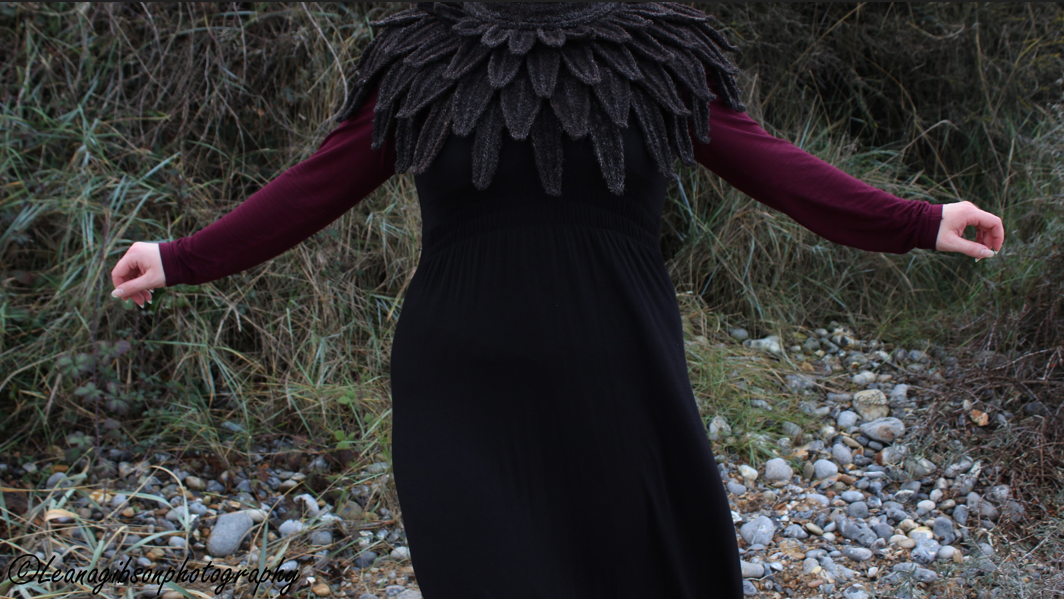
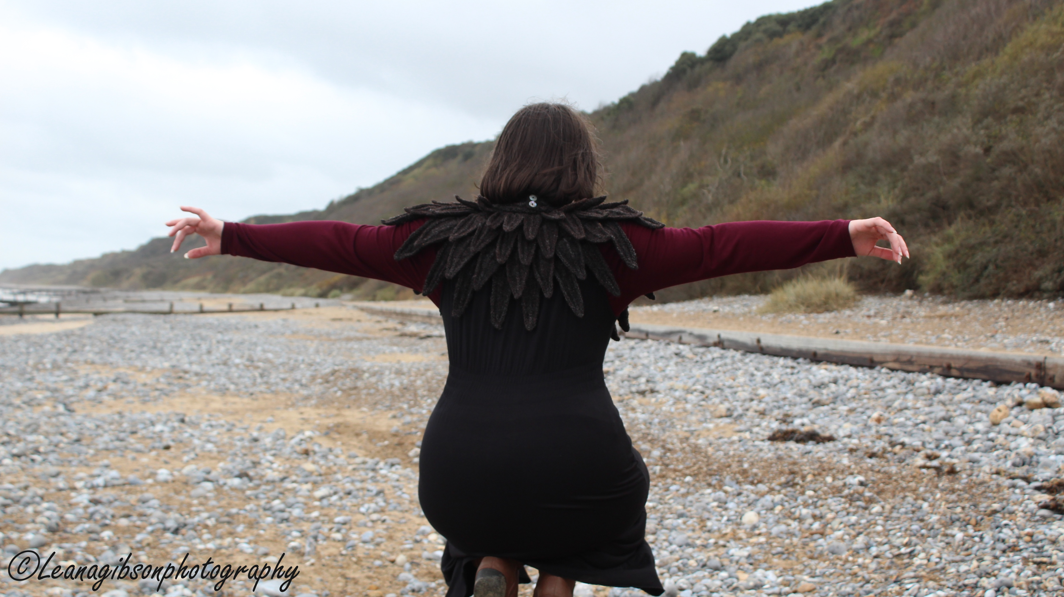
To close the collar I opted for some vintage abalone buttons and picked up and knitted a quick placket to cover them. I then wove in the ends before sitting the collar on my mannequin overnight to rest in position, and finally the project was finished…

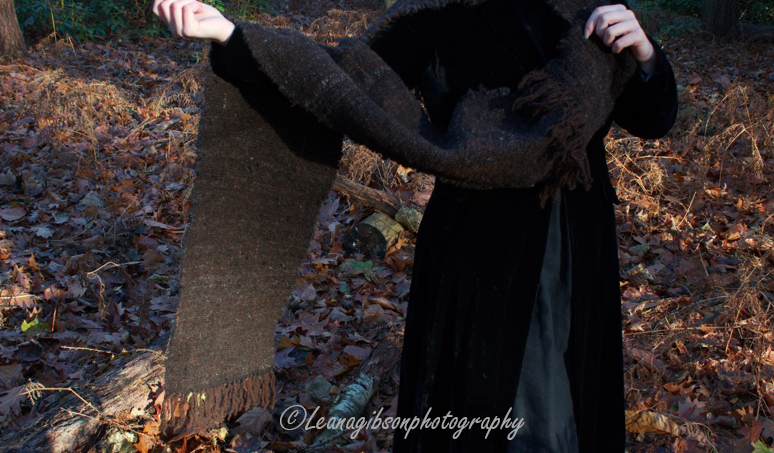
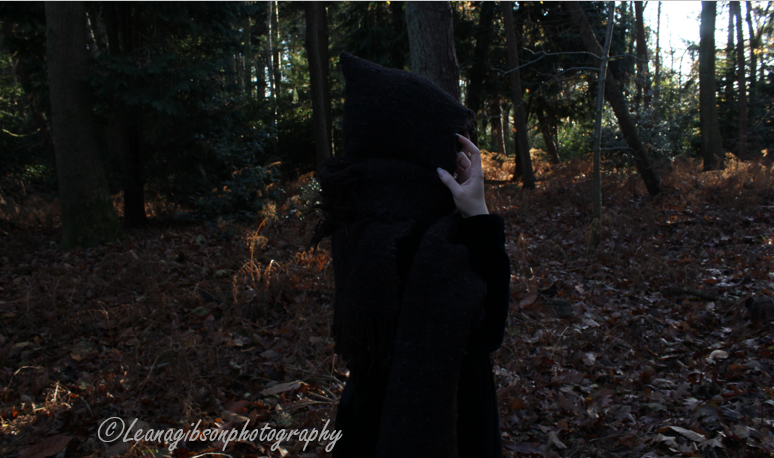
A massive thank you to the wonderful @leanagibsonphotography for another amazing photoshoot – narrowing it down to a few images to share was incredibly difficult as I had so many favourites!

I also have a video showing the whole process of making from raw fleece to collar:

I am very pleased with how this project turned out. I believe every fleece, however imperfect can be turned into something useful or beautiful (or both!) and this is might now be my new favourite accessory. It’s practical – keeping me warm under multiple layers of wool, dramatic enough to dress up any outfit and I’ve learnt some new knitting techniques. So, if you have a fleece that isn’t the best quality, but isn’t bad enough to compost, I hope this inspires you to experiment and see what you can make or learn from working with it.

Happy Crafting!

Wool & The Anthropocene: An Essay

For the past few years I’ve been leading a double life, exploring wool witchery while also undertaking a human geography degree. It was inevitable that at some point these two things would interconnect and the following essay exploring the Anthropocene (a proposed geological epoch defined by humankind’s impact on the environment) through the social and cultural history of wool was the result:

Introduction

Wool is both a natural resource and a representation of the change in values that underpins most Anthropocene arguments. Caught in the entanglements between human and other non-human ‘objects’; it would be impossible to discuss wool without also discussing sheep, just as it is impossible to discuss the historic wool industry without also exploring the rise of colonial cotton production. Focusing on the UK, whose woollen heritage is well documented, I explore the changes in value to resources, work and technology throughout time; illustrating that the Anthropocene is not only about the physical human impact on the environment as first put forward by Earth’s System’s scientists (Crutzen & Stoemer, 2000), but also the underlying political and economic systems that propose certain narratives (Bonneuil, 2015). As a symbol of bygone eras, wool advises caution, but seen as an object of resistance it offers some hope amongst eco-catastrophist outlooks in this precarious epoch.

Sheep: Man’s Second-Best Friend

Sheep have been living alongside humans for thousands of years; the bones of Soay sheep on the Island of St Kilda today, closely resemble those found at Bronze age sites on the British Mainland (Clutton-Brock, 2012; Ryder, 1964), suggesting these sheep moved with early settlers to the islands. While today’s Soay sheep are similar to their ancestors, the genomes of many other domestic sheep are significantly different. Archaeological evidence suggests humans have been making textiles from wool since the late Neolithic/early Bronze Age (Grömer, 2004) and during thousands of years of sheep domestication, we have actively engaged in selective breeding based on desirable characteristics (low kemp/high wool, fine fibre diameter etc.). Clutton-Brock (1992) argues that these biological changes occur as a result of the cultural conditions imposed by the human regime. As we domesticate sheep and use their wool, both sheep and their fibre become property, subject to ownership and economically valuable; they are commodified as humans separate themselves from a perceived ‘nature’. The result of this selective breeding for quality wool yield, means that while primitive breeds can shed their fleece, others require shearing for their health (BBC, 2021; 2023). While high wool yield was valued, humans adapted to careful shepherding, living alongside sheep as companion species (Haraway, 2003), and collectively changing the wider landscape to suit agriculture. However, as the value of wool has declined in favour of meat production (Masters & Ferguson, 2019), this relationship unravels and shearing becomes costly.

Despite centuries of selective breeding sheep have not become homogenous; there are over 60 different pure breeds of sheep within the UK (British Wool Board, 2010), each with different biological characteristics and adaptions to a multitude of British environments, however it was only recently that this genetic diversity has been valued. The near extinction of the Norfolk Horn made them the first entry into Solly Zuckerman’s gene bank at Whipsnade Zoo and the breed would become a founding member of the Rare Breeds Survival Trust (RBST) in 1971 (Monahan, 2024). Today greater importance is placed on genetic diversity since it acts as extinction insurance, however the RBST still lists 27 sheep breeds on their watchlist (RBST, 2021). Gene banks and breed conservation are direct responses to the precarity of the Anthropocene, however this also raises ethical questions; does preserving genetic diversity in gene banks reduce support to maintain it in the ‘wild’ (the RBST faces challenges from both policymakers and farmers (Evans & Yarwood, 2000; Mansbridge, 2004)), and does a reliance on science as a solution to institutional problems lead society too far into eco-modernist approaches?

Malhi (2017) discusses how adopting an early Anthropocene narrative, focusing only on detectable human presence, undermines the need for urgency and risks simply renaming the Holocene. However, despite humans’ early curation of sheep genetics, it is the assigning and reassigning of widespread economic value to sheep/wool over time within capitalist systems that is responsible for characterising the cultural and political norms that have led us into an age of extinctions and conservation in the name of ‘science’.

Work & Industry: The Rise and Fall of Wool

Wool is representative of institutional changes, particularly the value of different types of work. Prior to the industrial revolution, woollen textile manufacture was undertaken as piecework facilitated by wool merchants; a style of working that was particularly conducive to flexible working practices and allowed women to participate in the workforce, alongside taking part in childcare for example. Wool was essential to the UK’s pre-industrial economy, so much so that governments introduced protectionist measures such as the Capper’s Act of 1571, the Burial in Wool Acts from 1666, and multiple import and export taxes (Coulthard, 2021). To represent the importance of wool to national identity and the control the state attempted to impose over woollen textile production, the speaker in the House of Lords had been sitting on the Woolsack since the 14th Century; however, despite the perceived governmental control, piecework allowed spaces of resistance to emerge, from female dominated spinning bees where knowledge was shared, to the lucrative business of wool smuggling (this was particularly prevalent at Romney Marsh with the brutish smugglers hailed as dashing heroes in literary representations (Hollick, 2019)). At both local and national scales, wool was important, and skilled craftmanship was also highly valued. This pre-industrial textile industry generated significant wealth, which Allen (2009) argues was a key driver in funding technological innovation, one of the reasons Britain was first to industrialise, funding its colonial goals and spelling the beginning of the end for wool.

In the mid-17th Century James Hargreaves patented the Spinning Jenny, an industrial device of significant time saving (before the advent of the spinning wheel one worsted cloth took approximately 165 hours to make (Monahan, 2024)). The combination of established European colonialism, decreased production times, and changing fashions as a wealthy elite adopted ‘Oriental’ cotton fabrics, became a slow catalyst to textile industrialisation in the UK. The wool and cotton industries became locked in a battle; politicians were wary of losing the well-established wool industry, while entrepreneurs saw an opportunity to exploit the ‘ghost acres’ provided by cotton plantations and price the Indian handloom industry out of global markets (Hills, 1970, ch.1). New machines were large and manufacture moved from the home into factories, making it easier for the powerful elite to observe workers and disrupt social organisation (Moore, 2002). During the Industrial Revolution, the woollen industry attempted to hold its ground in the home while cotton textile production was concentrated in factories. Despite efforts of the Luddites, skilled woollen weavers could not compete with machines and faced an 80% reduction in wages described as ‘a classic example of the triumph of “economic progress” at the expense of “social welfare”’ (Lipson, 1965, p.194). For the industrial elite, low skilled workers across the empire were now in demand; considered expendable and easy to control, while British women were compelled to enter the new industrial workforce or conduct unpaid domestic labour (Nicholas & Oxley, 1993; Foster & Clark, 2018), the gender inequalities from which are still prevalent in informal care provision for example (Dahlberg et al., 2007).

For historical and political geographers, assigning economic value to both resources and/or labour is core to the argument that the Anthropocene did not begin with human geological impact on the environment, but the organisation of social structures that facilitated exploitation of both the environment and people (Moore, 2015; Barry & Maslin, 2016). Without capitalist involvement in the woollen textile industry, might industrialisation and craftsmanship developed more equitably, and would wool have endured for longer?

Compost, Crafters & Technological Advancement

The Great Acceleration is credited with inspiring a throwaway consumer culture, as wool was replaced with cheaper, more ‘modern’ oil derived fabrics such as nylon during the 1950s/1960s. During this time wool was described as high maintenance and scratchy; a symbol of the past, while synthetic fabrics were advertised as ‘easy-iron’ and ‘quick-drying’ (Schneider, 1994). This fossil fuel driven narrative was incredibly effective, with over 69% of all fibre production today being synthetic, and despite evidence of the environmental harm these plastic fibres can do, this sector continues to grow (Brooks, 2015; Changing Markets, 2024). In response to these environmental problems and the need for sustainable fibres, scientists have in many ways been tasked with reinventing the wheel. Wool is a keratin based fibre and it’s molecular structure makes it insulative, flame resistant, strong, flexible and biodegradable (British Wool, 2023). Wool outperforms synthetics and other natural fibres in insulation and temperature regulation, both for clothing and interior design (Abedin & DenHartog, 2023; Rahm, 2023), yet carbon footprint research remains focused on Life Cycle Assessments, which prioritise footprints in early manufacturing rather than throughout the whole life cycle, a system which favours synthetic fibres and leads to technocentric solutions (Rubecksen & Steinert, 2024). However wool provides an opportunity for new and old to merge, particularly in the clean-up of oil spills where wool’s high absorbency is more effective than existing methods which rely on either chemicals or plastic skimmers (Lim & Khimji, 2013), though widespread adoption of this technology requires a cultural shift within the petrochemical industry.

With sustainability increasingly influencing consumer habits, wool has recently undergone a rebrand. Designer labels such as Chanel have been marketing wool (particularly merino) as a luxury fibre, resulting in an identity dualism; wool is either considered by consumers to be ‘itchy’ and ‘dull’ (Hebrok et al., 2016), or ‘sustainable’ with greater perceived luxury value (Guercini & Rafagni, 2013). High designer price tags make wool unaffordable to many consumers, however the British Wool Marketing Board pay only £1/kg of raw fleece (British Wool, 2024) with transport being at the farmers’ expense. This has led farmers to compost or burn fleece to dispose of it cheaply and protest, releasing more carbon into the atmosphere (BBC, 2020, 2024). Despite high domestic wool availability, the UK imports over 23 million kilograms of wool (Bedford, 2024), raising animal welfare concerns surrounding the treatment of sheep in Australia for example where mulesing (the removal of skin from the hindquarters to reduce flystrike) is still legal, and presenting another barrier to ‘ethical’ consumption, as wool caught in global trade networks has limited traceability.

There is however hope; crafters and designers are increasingly using wool as an object of resistance and valuing local production as part of heritage and identity (Jones et al., 2019). The Campaign for Wool (patroned by the King), Wovember and British Wool month; raise awareness in an attempt to change the culture, while Shetlanders have been finding alternative ways of teaching children lace & Fair Isle knitting to retain its ‘intangible cultural heritage’, since knitting was removed from the curriculum due to spending cuts (Robertson, 2010; ICH Scotland, 2024). There is a place for creativity and innovation in the Anthropocene, particularly in reconnecting us with the non-human. Craft exists beyond mass production and values indigenous/local knowledge in equal measure to scientific discourse (Tarcan et al., 2023); it can help envision multispecies futures (Uğur Yavuz et al., 2024) and already has solutions to some Anthropocene problems, including instigating changes to cultures of value and consumption (Brooks et al., 2017). In this way wool offers an opportunity for individuals to engage with smaller scale participatory practice in the Anthropocene, constructing new, more equitable and caring relationships with nature and wider society.

Conclusion

I write in favour of wool, though I acknowledge it is by no means a magical solution to all environmental problems (the meat and livestock industries have their own ethical and environmental dilemmas), nor should it be used as a way for further justifying mass consumption. Wool supports arguments for multiple Anthropocene onsets; but above all highlights the importance of changing values and the entanglements of the non-human within the wider political, economic and cultural systems throughout time, as being a defining feature of this new epoch. Wool offers a path out of the Anthropocene; we have created power structures and consumerist habits that continue to degrade environments worldwide (Kidner, 2021), but these were socially constructed and can be re-made in more equitable ways. We have changed the genetics of sheep to suit our requirements and therefore have a responsibility to them, as Latour (2011) discusses – moving forward requires a change of perspective.

Technological advancement has become the benchmark for progress; however, it is not the only option. Wool offers an opportunity for widespread interdisciplinary engagement between science and the arts, bringing eco-modernist narratives out of epistemic communities where knowledge enables the powerful elite to retain control, and into the public sphere where it can be critiqued and debated. Historically the decisions that led to the devaluing of wool, work and nature, have been made by an elite few who monopolise economic spaces, but if we are to move forward, we must find ways to involve as many voices as possible. Wool highlights historical fallacy and inequalities that we can learn from and like wool in the present day, we have two options; can we ‘rebrand’ and place greater value on existing technologies, or will we too end up on the compost heap?

If you wish to use this essay please use the following reference:

Patterson, A. (2024) ‘Wool & The Anthropocene: An Essay’, Loose Ends Fibre, 9 November. Available at: https://looseendsfibre.co.uk/2025/11/09/wool-the-anthropocene-an-essay/.

With thanks to Dr Martin Mahony & Dr Dave McLaughlin who teach the wonderful Human Geographies of the Anthropocene module, and to Mark Goldthorpe for featuring my short piece about wool on the ClimateCultures website, which houses contributions from academics and creatives.

Reference List:

Abedin, F. and DenHartog, E. (2023) ‘A new approach to demonstrate the exothermic behavior of textiles by using a thermal manikin: Correction methods of manikin model’, Polymer Testing, 128, p. 108195. Available at: https://doi.org/10.1016/j.polymertesting.2023.108195.

Allen, R.C. (2009) The British Industrial Revolution in Global Perspective. 1st edn. Cambridge University Press. Available at: https://doi.org/10.1017/CBO9780511816680.

Barry, A. and Maslin, M. (2016) ‘The politics of the anthropocene: a dialogue’, Geo: Geography and Environment, 3(2), p.22. Available at: https://doi.org/10.1002/geo2.22.

BBC (2020) ‘Coronavirus: Shepherd scraps wool harvest due to price slump’, BBC News, 22 July. Available at: https://www.bbc.com/news/uk-england-sussex-53501671 (Accessed: 5 December 2022).

BBC (2021) ‘New fleece of life for sheep with 35kg coat of wool’, BBC News. Available at: https://www.bbc.co.uk/news/av/world-australia-56189981 (Accessed: 11 November 2024).

BBC (2023) ‘Resc-ewed: Britain’s loneliest sheep saved from shoreline’, BBC News, 4 November. Available at: https://www.bbc.com/news/uk-scotland-highlands-islands-67321305 (Accessed: 11 November 2024).

BBC (2024) ‘Sheep wool torched in protest over “measly” prices’, BBC News, 13 February. Available at: https://www.bbc.com/news/uk-england-lincolnshire-68253397 (Accessed: 9 April 2024).

Bedford, E. (2024) UK wool imports 2023, Statista. Available at: https://www.statista.com/statistics/412191/united-kingdom-uk-wool-imports/ (Accessed: 22 October 2024).

Bonneuil, C. (2015) ‘The Geological Turn: Narratives in the Anthropocene’, in The Anthropocene and the Global Environmental Crisis: Rethinking modernity in a new epoch. 1st edn. Routledge. Available at: https://doi.org/10.4324/9781315743424.

British Wool (2023) ‘The structure of wool fibres’, British Wool, 1 March. Available at: https://shop.britishwool.org.uk/the-structure-of-wool/ (Accessed: 15 November 2024).

British Wool (2024) Price Indicator | British Wool. Available at: https://www.britishwool.org.uk/price-indicator (Accessed: 9 April 2024).

British Wool Marketing Board (ed.) (2010) British sheep & wool: a guide to British sheep breeds and their unique wool. Oak Mills, West Yorkshire: British Wool Marketing Board.

Brooks, A. (2015) Clothing poverty: the hidden world of fast fashion and second-hand clothes. London, UK: Zed Books.

Brooks, A. et al. (2017) ‘Fashion, Sustainability, and the Anthropocene’, Utopian Studies, 28(3), pp. 482–504. Available at: https://doi.org/10.5325/utopianstudies.28.3.0482.

Changing Markets (2024) Fossil fashion: the hidden reliance of fast fashion on fossil fuels • Changing Markets, Changing Markets. Available at: https://changingmarkets.org/report/fossil-fashion-the-hidden-reliance-of-fast-fashion-on-fossil-fuels/ (Accessed: 15 November 2024).

Clutton‐Brock, J. (1992) ‘The process of domestication’, Mammal Review, 22(2), pp. 79–85. Available at: https://doi.org/10.1111/j.1365-2907.1992.tb00122.x.

Clutton-Brock, J. (2012) ‘Arrival of Domesticates in Europe’, in Animals as domesticates : a world view through history. East Lansing : Michigan State University Press.

Coulthard, S. (2021) A short history of the world according to sheep. London: Head of Zeus.

Crutzen, P.J. and Stoemer, E.F. (2000) ‘The Anthropocene’, Global Change Newsletter, 41, pp. 17–18.

Dahlberg, L., Demack, S. and Bambra, C. (2007) ‘Age and gender of informal carers: a population-based study in the UK: Age and gender of UK carers’, Health & Social Care in the Community, 15(5), pp. 439–445. Available at: https://doi.org/10.1111/j.1365-2524.2007.00702.x.

Evans, N. and Yarwood, R. (2000) ‘The Politicization of Livestock: Rare Breeds and Countryside Conservation’, Sociologia Ruralis, 40(2), pp. 228–248. Available at: https://doi.org/10.1111/1467-9523.00145.

Foster, J.B. and Clark, B. (2018) ‘Women, Nature, and Capital in the Industrial Revolution’, Monthly Review, pp. 1–24. Available at: https://doi.org/10.14452/MR-069-08-2018-01_1.

Grömer, K. (ed.) (2004) ‘“Hallstatt Textiles” Technical Analysis, Scientific Investigation and Experiment on Iron Age Textiles’, in. Hallstatt Textiles, Hallstatt/Austria. Available at: https://d1wqtxts1xzle7.cloudfront.net/105835128/2005_20Hallstatt_Conference_BAR_202005_-libre.pdf?1695207476=&response-content-disposition=inline%3B+filename%3DHallstatt_textiles_technical_analysis_sc.pdf&Expires=1731324010&Signature=ajjLziQHOGd9XNTpChY3tr8YzdBurZQ0qn8BSlDt1XiW-8qJOBY3GJhzqRP~zoDCOA2Ez4EguKAOz9xY8SsHzj2nLOvg2dFiHjqCApCR90MJlwfvR1cIK-rbsHsaMZtgFIMWjRk1UMCWkHeFuNFmOdPcKxxQvyTVkK-EJjQVt5XBLS~ojJyMevhIw-0zlPjwwr7Hd35NviqHZmgE2BrEFCv1HtZ6CQPhFaqPmPJnE7fXeGLuGShOqENSia1SJRWv9TVzU–spSiocpurlOe8WO7dQEBE6VuyNEoiaM89qiZJGAE-hR3VT-8kKwg3F8~yEI-9QTrJGOInLPGD9HiNtA__&Key-Pair-Id=APKAJLOHF5GGSLRBV4ZA#page=125 (Accessed: 11 November 2024).

Guercini, S. and Rafagni, S. (2013) ‘Sustainability and Luxury: The Italian Case of a Supply Chain Based on Native Wools’, The Journal of Corporate Citizenship, 52, pp. 76–89.

Haraway, D.J. (2003) The companion species manifesto: dogs, people, and significant otherness. Chicago: Prickly Paradigm Press (Paradigm, 8).

Hebrok, M., Klepp, I.G. and Turney, J. (2016) ‘Wool you wear it? – Woollen garments in Norway and the United Kingdom’, Clothing Cultures, 3(1), pp. 67–84. Available at: https://doi.org/10.1386/cc.3.1.67_1.

Hills, R.L. (1970) Power in the Industrial Revolution. Manchester: Manchester U.P.

Hollick, H. (2019) Life of a smuggler: fact and fiction. Yorkshire: Pen & Sword Books Ltd.

ICH Scotland (2024) Shetland Knitting | ICH Scotland Wiki. Available at: https://ichscotland.org/wiki/shetland-knitting (Accessed: 15 November 2024).

Jones, L., Heley, J. and Woods, M. (2019) ‘Unravelling the Global Wool Assemblage: Researching Place and Production Networks in the Global Countryside’, Sociologia Ruralis, 59(1), pp. 137–158. Available at: https://doi.org/10.1111/soru.12220.

Kidner (2021) ‘Anthropocene Subjectivity and Environmental Degradation’, Ethics and the Environment, 26(1), p. 57. Available at: https://doi.org/10.2979/ethicsenviro.26.1.03.

Latour, B. (2011) ‘Love Your Monsters: Why we must care for your technologies as we do our children’, Breakthough Journal, 2(11), pp. 21–28.

Lim, P. and Khimji, K. (2013) ‘The Golden Fleece: Innovative Ways to Clean up Oil1’, Canadian Young Scientist Journal, 2013(2), pp. 18–23. Available at: https://doi.org/10.13034/cysj-2013-005.

Lipson, E. (1965) The History of the Woollen and Worsted Industries. Frank Cass & Co. LTD.

Malhi, Y. (2017) ‘The Concept of the Anthropocene’, Annual Review of Environment and Resources, 42(1), pp. 77–104. Available at: https://doi.org/10.1146/annurev-environ-102016-060854.

Mansbridge, R.J. (2004) ‘Conservation of farm animal genetic resources – a UK national view’, BSAP Occasional Publication, 30, pp. 37–43. Available at: https://doi.org/10.1017/S0263967X00041926.

Masters, D.G. and Ferguson, M.B. (2019) ‘A review of the physiological changes associated with genetic improvement in clean fleece production’, Small Ruminant Research, 170, pp. 62–73. Available at: https://doi.org/10.1016/j.smallrumres.2018.11.007.

Monahan, J. (2024) Norfolk Horn: The Saga of a Rare Breed, It’s Place and It’s People. Anglia Print Ltd.

Moore, J.W. (2002) ‘Remaking Work, Remaking Space: Spaces of Production and Accumulation in the Reconstruction of American Capitalism, 1865–1920’, Antipode, 34(2), pp. 176–204. Available at: https://doi.org/10.1111/1467-8330.00235.

Moore, J.W. (2015) Capitalism in the web of life: ecology and the accumulation of capital. London: Verso.

Nicholas, S. and Oxley, D. (1993) ‘The Living Standards of Women during the Industrial Revolution, 1795-1820’, The Economic History Review, 46(4), p. 723. Available at: https://doi.org/10.2307/2598255.

Rahm, P. (2023) The anthropocene style. Available at: https://arodes.hes-so.ch/record/12937?ln=en&v=pdf (Accessed: 15 November 2024).

RBST (2021) Sheep watchlist, Rare Breeds Survival Trust. Available at: https://www.rbst.org.uk/Pages/Category/sheep-watchlist?Take=28 (Accessed: 11 November 2024).

Robertson, J. (2010) Era of knitting lessons in schools to come to an end as cash saving is agreed, The Shetland Times. Available at: https://www.shetlandtimes.co.uk/2010/05/06/era-of-knitting-lessons-in-schools-to-come-to-an-end-as-cash-saving-is-agreed (Accessed: 15 November 2024).

Rubecksen, H.S. and Steinert, M. (2024) ‘Man-Made Adaptations to Wool in the Anthropocene – Proposed Reference Framework for Fibre Comparison’, in Proceedings of NordDesign 2024. NordDesign 2024, Reykjavik, Iceland, 12th – 14th August 2024, The Design Society, pp. 577–587. Available at: https://doi.org/10.35199/NORDDESIGN2024.62.

Ryder, M.L. (1964) ‘The History of Sheep Breeds in Britain’, The Agricultural History Review, 12(1), pp. 1–12.

Schneider, J. (1994) ‘In and Out of Polyester: Desire, Disdain and Global Fibre Competitions’, Anthropology Today, 10(4), p. 2. Available at: https://doi.org/10.2307/2783434.

Tarcan, B., Nilstad Pettersen, I. and Edwards, F. (2023) ‘Repositioning Craft and Design in the Anthropocene: Applying a More-Than-Human approach to textiles’, Exchanges: The Interdisciplinary Research Journal, 10(2), pp. 26–49. Available at: https://doi.org/10.31273/eirj.v10i2.973.

Uğur Yavuz, S., Bektaş, M. and Ayala Garcia, C. (2024) ‘FERAL WOOL. Designing with a vibrant matter with care and cosmoecological perspective in times of troubled abundance’, INMATERIAL. Diseño, Arte y Sociedad, 9(17). Available at: https://doi.org/10.46516/inmaterial.v9.204.
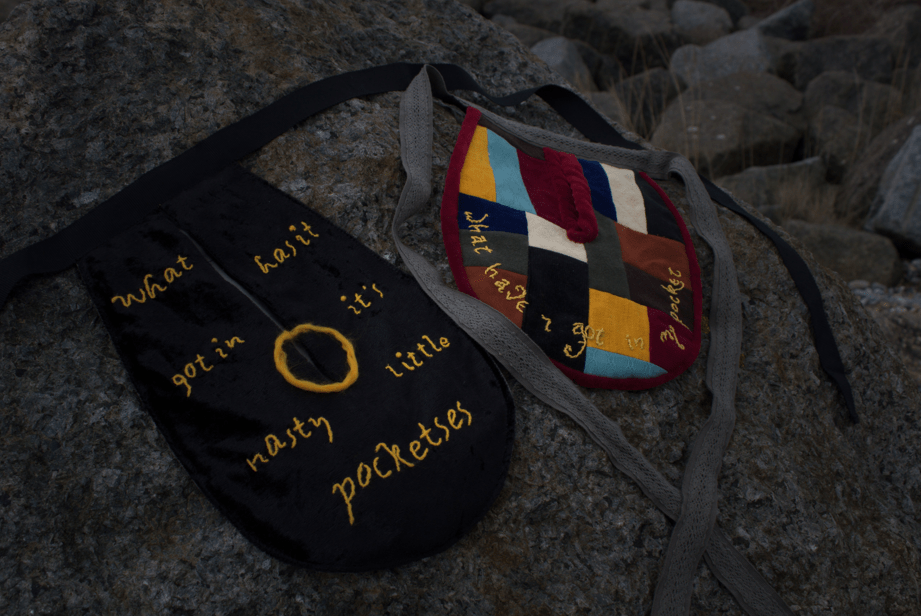
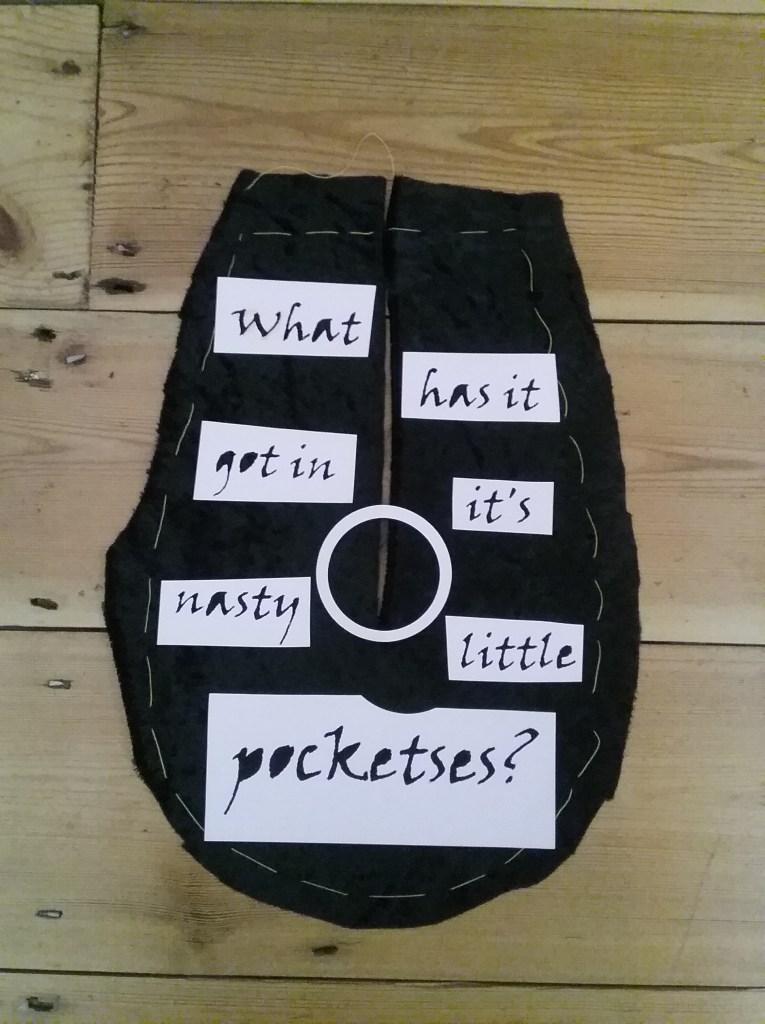
Fibre Representations: Part 1 Fairytale Faux Pas

One of my pet peeves is watching a film or reading a book and seeing spinning, weaving or knitting represented incorrectly. I’ve seen critical commentaries before for period drama’s and sewing representations (particularly on YouTube) and found them both entertaining and informative, however I have yet to see one that looks at fibrecrafts specifically, so thought I would give it a go for a bit of fun, starting off with some well known fairytales! Since we are about to enter the realm of fantasy, I’m suspending my disbelief regarding the magical qualities these objects might possess, rather I’ll be exploring whether what is being shown/described is accurate within the context.
I’ve included images throughout, but sometimes what I’m referring to is clearer in video form – where possible, I’ve linked it to YouTube videos (not mine) showing the scene if you click on the image.

Sleeping Beauty

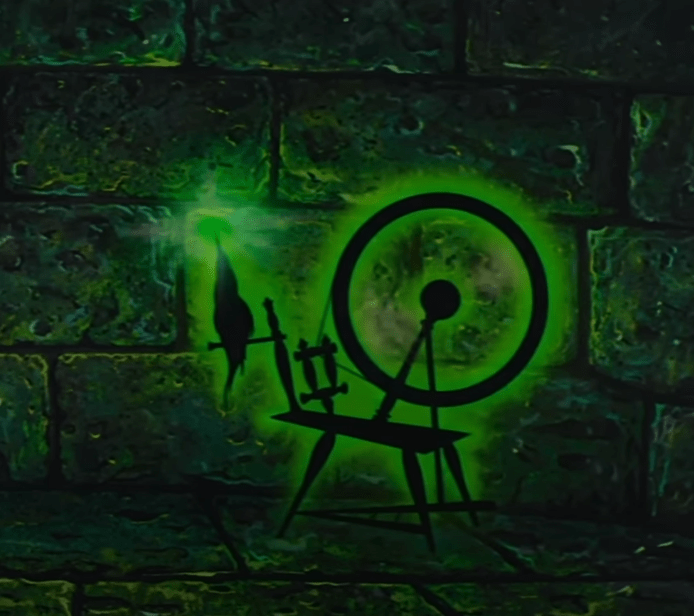
One of the most iconic representations of the spinning wheel is from Disney’s Sleeping Beauty, but it’s also quite a misleading one…

Image: Sleeping Beauty (1959). Walt Disney Studios.

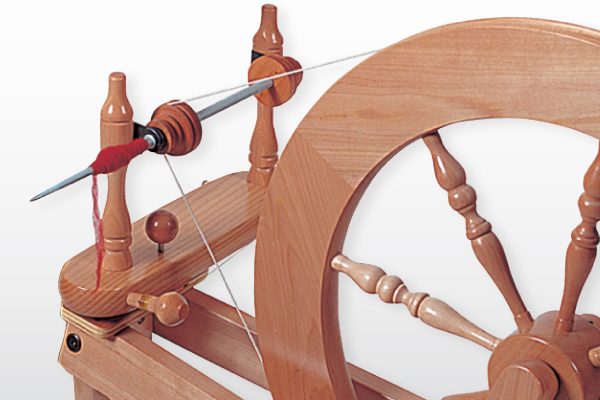
Aurora is cursed to prick her finger on the spindle of a spinning wheel on her sixteenth birthday, but the wheel pictured above is completely spindle-less! Most spinning wheels of the above Saxony style have a bobbin rather than a spindle (though neither is actually depicted here); Charkha’s and Great wheels do have spindles (aka quill spindles) and they can be quite sharp, however these spindles sit sideways on the wheel (see below). Those two types of wheel are also usually hand operated, so would not have a footman (the long pole attached to the centre of the wheel) connecting to a treadle at the base.

Positioning of a quill spindle. Photo: https://www.ashford.co.nz/product/quill-spindle/

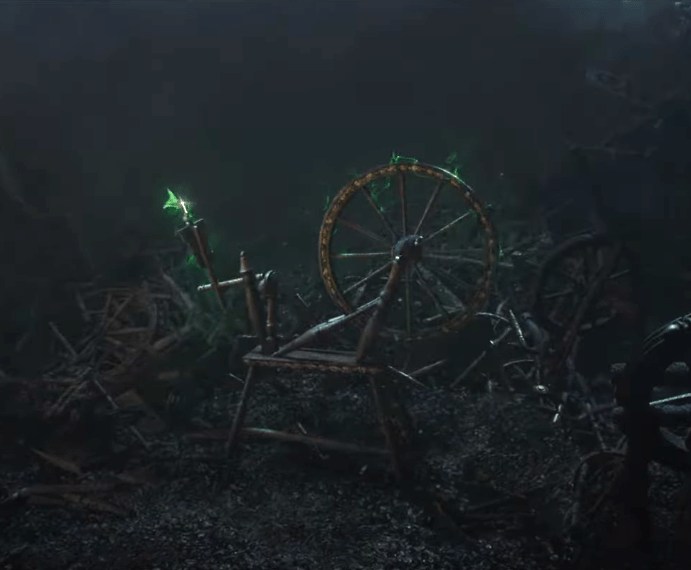
Spindles and bobbins are also designed to hold spun yarn, rather than the loose flax like fibre as depicted in the film, which leads me to the conclusion that what Disney’s Aurora actually pricks her finger on is a distaff (something that could either be attached or separate from the wheel to hold the fibre to be spun). Disney had the opportunity to fix this mistake in the live action Maleficent, but disappointingly never did.

Image: Maleficent (2014). Walt Disney Studios.

This time, as the spinning wheel comes together in the film I can see a bobbin and flyer, meaning this wheel definitely would not have had a quill spindle and distaffs don’t normally have very sharp metal spikes added to the top – someone could get hurt! The spinning wheel ‘graveyard’ does however raise an interesting question regarding the impact of the events of the film on women. Spinning was an important source of income for many women through the ages, so destroying all the spinning wheels would have had a devastating effect on women’s independence, not to mention the impact no spinning wheels would have had on the textile industry as a whole (but perhaps that’s something to explore another time!).

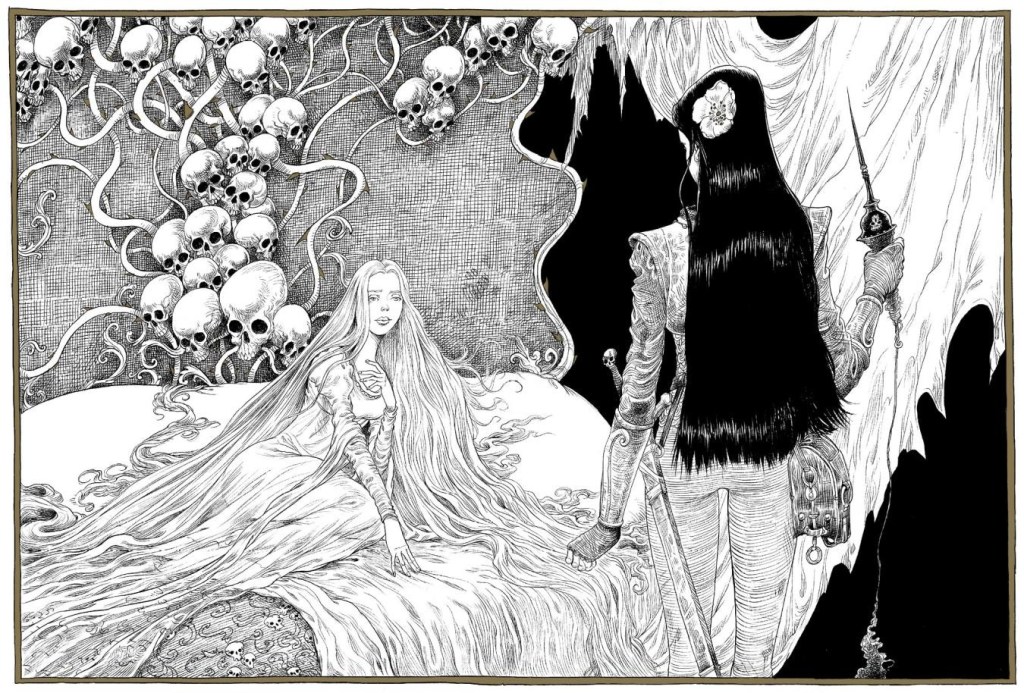
This leads me onto a more plausible depiction of the fairytale in Neil Gaiman’s The Sleeper & The Spindle, which features a strong willed female protagonist forging her own path.

Image: Gaiman, N. & Riddell, C. (2014) The Sleeper and the Spindle. London: Bloomsbury Publishing Plc.

In the book, the spindle in question is a drop spindle and looks to be a bottom whorl (the circular weight is towards the bottom), so the yarn is wound on in the correct manner (the spindle is being held upside down in this illustration). The base is unusually pointed and the whorl heavily embellished with skulls; however drop spindles come in all shapes and sizes and given it is a magic spindle within a gothic narrative, I don’t see why these customisations couldn’t exist.

Rumpelstiltskin

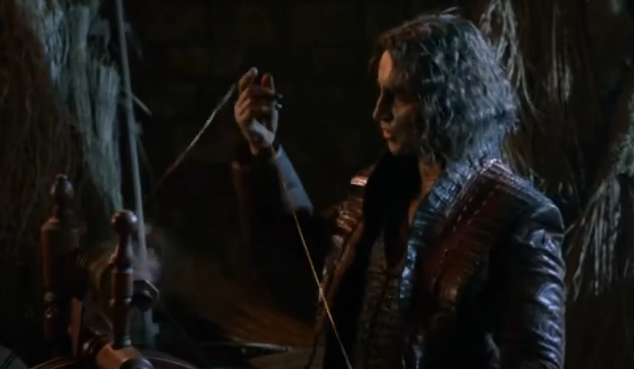
Unlike Sleeping Beauty, the character of Rumpelstiltskin should be adept at using a spinning wheel. One of my friends suggested I look at the spinning in a TV series called Once Upon a Time – I haven’t watched the show, but found a compilation on YouTube of the character at a wheel and was aghast at the spinning crimes being committed!

There are several types of wheel used. In some scenes Rumpelstiltskin uses a great wheel (spindles appear to be in the right place, although there is some questionable drive band placement), however he spends most of the time turning the wheel very slowly while standing or sitting, rather than doing any actual spinning (he would need to walk back and forth to draft and wind if spinning properly). In these scenes the character seems more contemplative, so I’m guessing this could have been a conscious decision for the character and would have made it easier to deliver lines since spinning takes a lot of concentration, particularly as a beginner.

There are some scenes where the actor is sitting in the right position and even appears to attempt some spinning (or at least go through the correct motions) BUT on many more occasions things have gone horribly wrong!

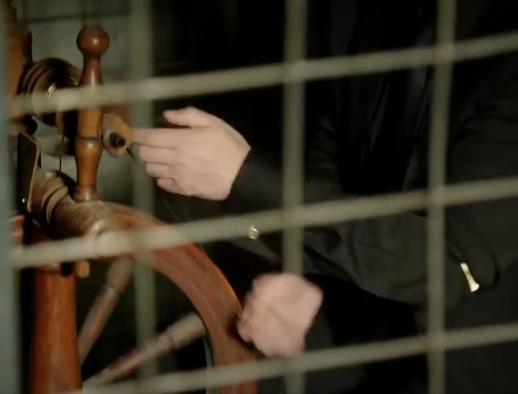
In several scenes (including one where the character appears to be teaching someone else) Rumpelstiltskin is sitting at the side of the spinning wheel pulling gold thread from the bobbin at speed with his hands. Anything being spun on the castle wheels in the above pictures should be going through the orifice onto the bobbin.

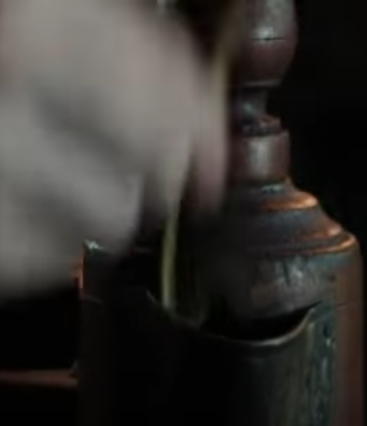
I assumed that perhaps the straw thread turned to gold during the unwinding, but then I saw a clip where straw was being pushed into some sort of holder on the side of the mother of all which houses the flyer and bobbin, implying it would somehow be fed through that onto the bobbin. I’m left questioning why this would be needed when it could just be threaded through the orifice as usual?

Image: ‘Once Upon a Time’ (2011-2018). ABC Studios.

I also need to return to the unwinding; it is unwise to start removing yarn from the bobbin without having something like a niddy-noddy or skein/ball winder to hand, lest your hard work end up a tangled mess. During the unwinding depicted the flyer is moving quite fast, which suggests the tension hasn’t been released in these scenes (fully release the tension and only the bobbin should be moving). Unwinding under tension makes the process harder and could lead to yarn breakages, but flyers also have metal hooks which could catch on yarn being unwound, or the spinners hand at speed.

I will close on a literary depiction (thank you to the legend of YA fantasy @kbbookreviewer for suggesting this one to me!). I haven’t read Gilded, however Marissa Meyer has clearly done her research into spinning.

The straw was nothing like the thick, fuzzy wool she was used to, but she inhaled a deep breath anyway and loaded the first empty bobbin onto the flyer. […] Usually she started with a leader yarn, to make it easier for the wool to wrap around the bobbin, but she had no yarn. Shrugging, she tied on a piece of straw. The first one broke, but the second held. Now what? She couldn’t just twist the ends together to form one long strand.
Could she?
She twisted and twisted.
It held sort of.
“Good enough,” she muttered, running the leader yarn through the hooks, then out through the maiden hole. The entire setup was beyond precarious, ready to fall apart as soon as she pulled too tight or released those weakly connected strands. Afraid to let go, she leaned over and used her nose to push down on one of the wheel’s spokes, so that it gradually started to turn. “Here we go,” she said, pressing her foot onto the treadle. The straw pulled from her fingers.

(Meyer, M. (2021), p.99, Gilded. London: Faber & Faber.)

I enjoyed this description of an attempt to spin straw into gold for two reasons; the process is described accurately, from the loading of the bobbin to the use of a leader and the threading of the yarn through the orifice, but I also think the nerves and failure described, resonate with all spinners trying out a new fibre for the first time. There’s nothing worse than getting set up at your wheel, only to find you haven’t secured your yarn properly to the leader and watching it get snatched from your hands. For first time spinners, spinning any kind of yarn can seem just as impossible as spinning straw into gold does for this character, and I think that giving it a go despite the odds stacked against you is a good message to end on.

I hope you’ve enjoyed this journey into fairytale spinning – there’ll be a part 2 later in the month that won’t be so spinning focused. If you have any more depictions of good or bad spinning, weaving, or other fibrecrafts that you think I should see, do let me know in the comments below!

Welcome to Wovember 2025!

Happy Wovember!

This is my 5th year taking part in Wovember – a month celebrating everything wool. If you’re curious about how Wovember started you can visit the original website here and also the newer Love Wovember website. In previous years I’ve explored what wool is, given book recommendations, investigated the connections between wool and fairytales/mythology and released some Wovember Wind Down videos (I have a new Wovember’s Past page should you want to explore the archive).

This year I’ll be exploring how accurately spinning & weaving are represented in film and literature, sharing academic contemplations and tackling some projects using the Black Welsh Mountain fleece I’ve recently been processing (if all goes to plan, by the end of Wovember I’ll be looking more like the wool witch I’ve been affectionately termed!). There’s no word prompt challenge on Instagram this year, (though I’m sure Wovemberists will still be sharing woolly gems of information throughout the month), but I thought it would be fun to share some woolly knowledge in the comments section too; so do feel free to share any fun and interesting wool facts, references/bloggers/woolly people you recommend, or questions you have about wool on any posts throughout the month!

I look forward to joining you over the coming weeks – and if you or anyone you know is also running with Wovember in their own way do let me know!

Fibre Prep: Black Welsh Mountain

The Fleece

I purchased this fleece from an online marketplace several years ago when I was just starting out and hadn’t heard of yarn shows, made connections with local flock owners, or discovered breed societies selling fleece online. I also didn’t know that when buying fleece, it’s always good to check for weaknesses in the yarn by tensioning a lock in your hands as any snapped fibres indicate a poorer quality fleece. The seller contacted me apologising that the fleece had got unexpectedly damp in storage and that they could dry it out before sending it to me, or refund me, and I opted for the former as I was happy to take a chance and the fleece wasn’t pricey.

I’ve since read several spinning books which suggest that any fleece that isn’t up to standard is only good for compost, and while wool contains a lot of nutrients, I’m of the opinion that all but the most dirty, tangled fleeces can be used for something – it just takes a bit more preparation and thinking outside the box, so hopefully these BWM posts will serve as inspiration for anyone wondering what to do with an imperfect fleece.

Washing

Once the fleece arrived I inspected it (there was very little VM or particularly dirty areas), washed it in the suint bath and then detergent, dried it thoroughly and stored it in a cloth sack indoors until I had time to process it. Unfortunately I don’t have any photos of the washing as I didn’t record as much in my early days of blogging!

Combing

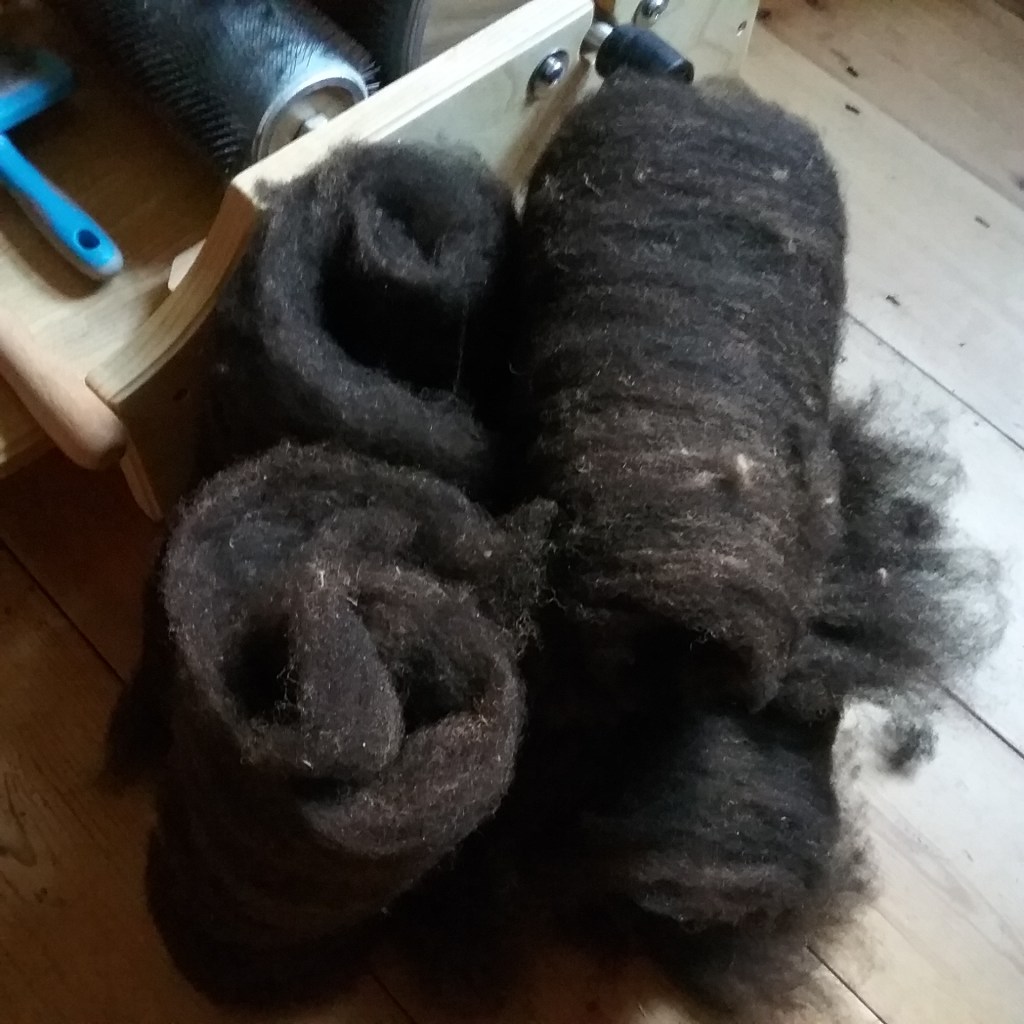
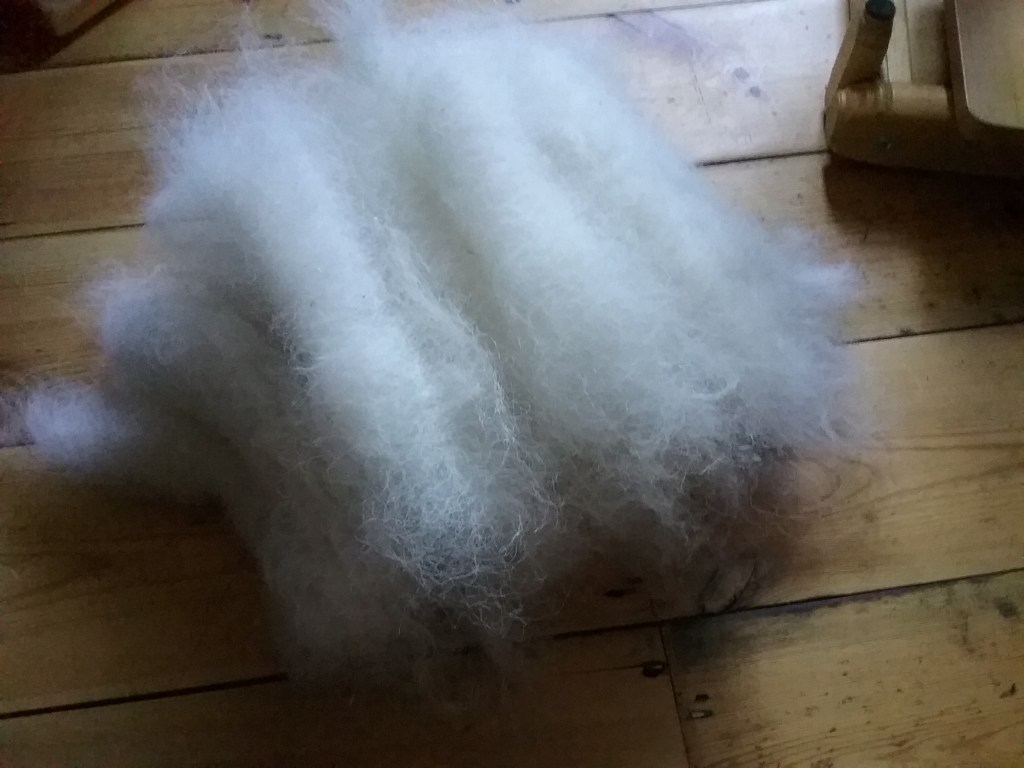
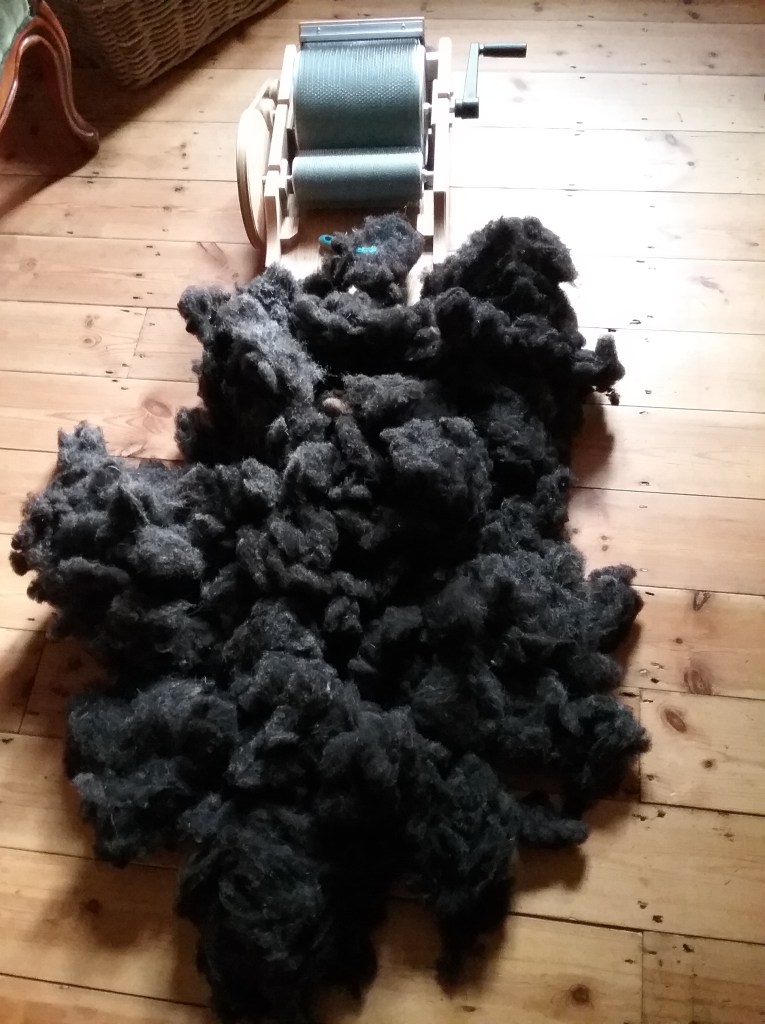
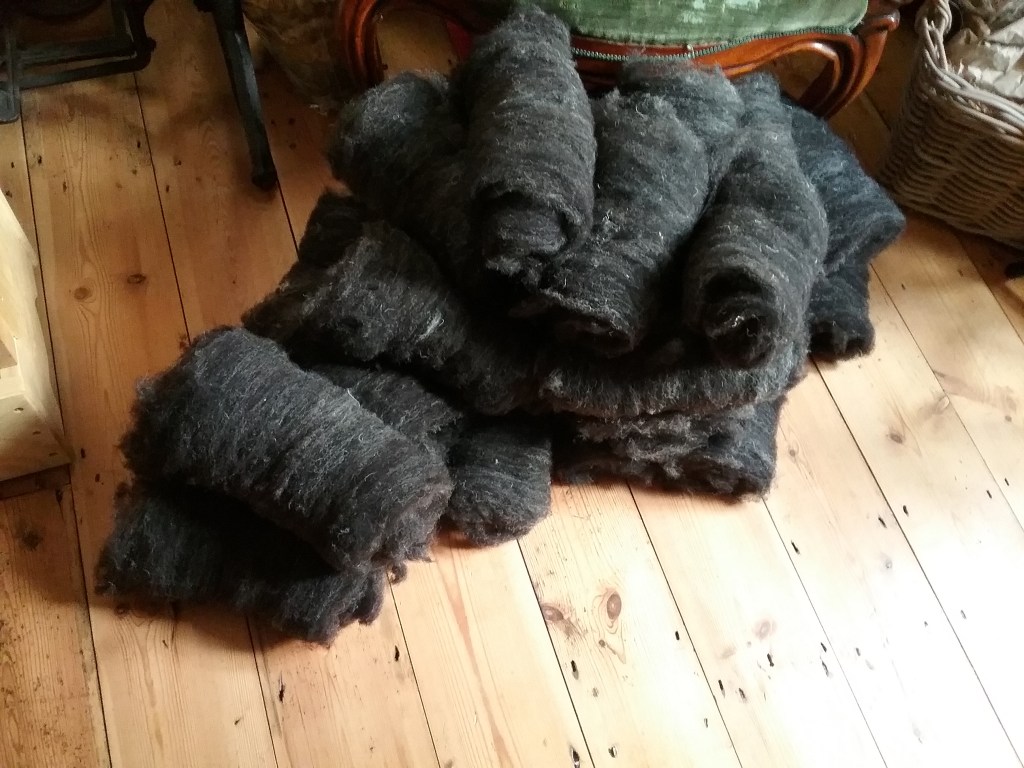
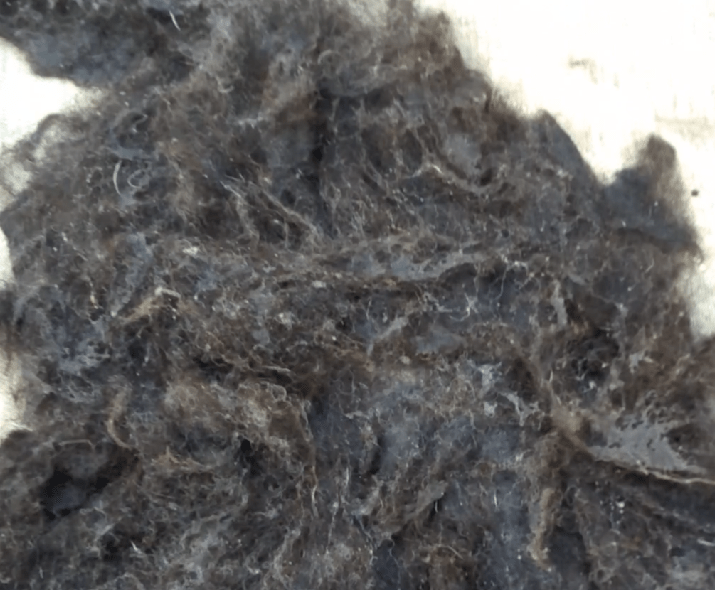
When I got the fleece out ahead of this year’s TDF I tested to see if the fibres snapped in my hands – some did, but most of the fleece seemed ok. I decided to comb rather than card as combing separates out the longer and shorter fibres and would also separate out any broken fibres from the combed tops. This would give me the best fleece to spin with and mean that I could use the combing ‘waste’ to felt with, as any broken fibres wouldn’t matter.

Baskets of combing waste, combed nests and some very dusty wool combs

Combing was fairly straightforward, although some areas had a shorter staple length, which made combing a little more challenging. It produced more combing waste than I was expecting, which is good for the felting project, not so good for spinning, but happily the project I have planned for that shouldn’t require too much yarn!

Since my experience with this fleece is likely to be different to working with better quality BWM fleeces, do feel free to share your experiences in the comments below!

Happy Crafting!

Further Reading about Black Welsh Mountain:

  • Breed Society Website – https://blackwelshmountain.org.uk/
  • British Sheep & Wool by the British Wool Marketing Board – ISBN 9780904969108
  • The Field Guide to Fleece by Deborah Robson & Carol Ekarius – ISBN 9781612121789
  • The Fleece & Fiber Sourcebook by Deborah Robson & Carol Ekarius – ISBN 9781603427111

A Little About: Black Welsh Mountain

A Black Welsh Mountain Sheep
photo credit to https://www.bcsba.org.uk/

History

Black Welsh Mountain sheep are some of the only sheep in the UK to produce a purely black fleece as opposed to a very dark brown (although sun bleaching over time causes the tips to become shades of brown as seen in the photo). The breed is referred to in writing dating back to the medieval period when the fleece colouring was highly desirable, but has since undergone selective breeding to create a more pure black colour1. As the name suggests, the sheep originate from Wales and although this remains the primary location of Black Welsh Mountain flocks, in 1972 three rams and thirteen ewes were imported to North America, from which North American flocks today derive2 .

Fleece Research

This fleece has a gorgeous natural colour, so there’s no need to dye it (although overdying dark fleeces can produce interesting results). It reportedly has little to no kemp with easy to separate locks, therefore fibre preparation should be quite straightforward. Although not the softest of fleeces, it has historically been used in Welsh woollen clothing, but it is durable enough to be used in rugs and blankets; a good all rounder. I should note at this stage that the fleece I will be working with over the coming BWM posts was an online marketplace purchase gone awry from my early days of spinning, so my experience with BWM is very unlikely to be typical of all fleeces of the breed (but I’ll talk more about that in the fibre prep post).

Useful Links:
  1. British Wool Marketing Board (ed.) (2010) British sheep & wool: a guide to British sheep breeds and their unique wool. Oak Mills, West Yorkshire: British Wool Marketing Board.
    ↩︎
  2. Robson, D. and Ekarius, C. (2013) The field guide to fleece: 100 sheep breeds and how to use their fibers. North Adams, MA: Storey Publishing.
    ↩︎

Suint Fermentation Drying Update

Back in 2020 I wrote about my experience washing fleece using suint fermentation and somehow that blog post about a bucket of dirty water has gone on to be the most viewed thing on my blog and something I get asked the most questions about. One year later I wrote about some of my updates to optimise the suint method, including bagging the fleece and having a lidded container, but something I have still struggled with is getting fleece dry in the unpredictable UK weather.

A wet fleece fresh out of either the suint bath (or a tub if you’ve opted to wash it with detergent) can take around 2-4 days to drip dry completely depending on temperature and wind (wool can absorb around 30% of it’s weight in water). If you’re in the midst of a heatwave you can leave the fleece outside for as long as you need, but if rain is forecast, or it’s nearing the end of the summer and you still have one last fleece to dry, you might find yourself as I did, in a cycle of moving partially dried fleece undercover and then laying it out again. It can be quite tricky to squeeze all the water out of a fleece by hand (and depending on the fleece, handling it too much might risk felting). I’ve spoken to some people who use electric spin dryers on low/no heat, but I’m not sure how it would cope with suint water, and it’s not the most sustainable option.

But, thinking along the lines of laundry drying did give me a good idea – why not use a mangle? It can be tricky to find working mangles nowadays with many people using them as decorative garden ornaments, however I was lucky to come across one on Gumtree that had been well looked after, despite being outside. The rollers could do with a sand, the wooden handle is falling to pieces and it’s missing it’s wooden shelves (something on my to-make list), but the moving parts all work and since I planned to put the fleece through the mangle in it’s sack, it wouldn’t get caught on the rollers. Thankfully it worked (I tried two passes through the mangle, but the second didn’t really make much difference) and my drying time was decreased to a day, though I did opt to put the fleece out again the following day just to be on the safe side before storing it away. So, I’m hopeful that next year with the help of my mangle, I’ll be able to get a lot more use out of my suint bath.

Since I’ve been delving into the realm of video making I thought it was about time for another update to my suint process (mangling included):

As ever, let me know in the comments if you have any questions or suint bath tips and tricks of your own to share!

Happy Crafting!

A Side Quest in Sewing

(or an ode to the projects you think will ‘only take a day’)

Falling down the fibre rabbit hole has led me to explore sustainability, particularly of clothing. There are many problems with fast fashion; environmental pollution from synthetic materials and dyes, overconsumption, and worker exploitation to name but a few. Working with and researching wool over the years has made me acutely aware of this and I’ve found myself becoming a bit of a fibre snob, checking labels and avoiding fast fashion to slowly curate a more sustainable wardrobe. I also have a fascination with historical clothing, which has given me a good excuse to try my hand at sewing my own garments. My foray into sewn garment making has been relatively recent and I never thought to document the first few garments I made (hence this is my first blog post that isn’t about wool), however after my deluge of wool posts during Tour de Fleece, I thought this little side quest might provide some alternative reading!

The Plan

A few months ago I acquired some red brushed cotton fabric that used to be curtain linings, thought them too nice a fabric to use for making clothing mock-ups, and thought they would work well as a cosy autumnal skirt. I wasn’t sure how the fabric would behave as a skirt, so wanted to avoid cutting the fabric as much as possible, should I change my mind later in the process. Happily one of the easiest (and zero fabric waste) skirts to make is an 18th Century petticoat; 2 rectangles, 2 seams and a waistband that is adjustable, so while my red brushed cotton was not the most historically accurate of fabrics, I proceeded, naively thinking this project would only take a day…

Making Pockets

Before starting on the skirt I had to make some pockets. Unlike modern pockets, historical pockets can fit all manner of objects from books to spindles and fibre, being either sewn into the waistband (directly as I did here, or with a support), or tied around the waist as a separate ‘garment’ (hence pockets could be ‘picked’). You can easily make a pattern for these, however I already had the free pattern printed from Truly Victorian, so opted to adapt this instead.

Since the pockets won’t be seen when wearing the skirt, I cut them out of some grey cotton/linen blend fabric and French seamed them around the entire edge leaving the top edge free. I then cut a slit long enough to get my hand in on one side so they opened at the ‘front’ rather than in the seam. I then covered the raw edges in bias binding from my stash, which by happy coincidence was red! In hindsight, it would have been easier to bind the edges before French seaming the pockets together, but my sewing machine is quite well behaved when it comes to fiddly corners.

The Skirt Body

I then stitched both brushed cotton rectangles together at the short ends leaving around 3″-3.5″ open at the top. The idea is that the front and back panels each get gathered down into half the waist measurement and attached to separate waistbands; the back then ties around your front and the front ties around your back so the skirt overlaps at the sides where the pockets go, hiding the gap at the side seams and meaning the skirt is adjustable (this makes more sense in the photos towards the end of the post).

I finished the raw edge on the front panel and sewed the pockets onto the raw edge of the back panel after which it looked something like this:

The Waistband

I dug out some ribbon and twill tape from my stash intending to make the waistband ties – once the waistband was gathered and sewn on, my final step would be finishing the hem and side seam edges – easy! However, the ties I had found either didn’t complement the red or were not sturdy enough to hold the weight of the brushed cotton. I delved back into my fabric stash and found some long scraps of black corduroy which contrasted nicely with the red fabric and were sturdy, but thick corduroy would have been too bulky to successfully tie around the waist front and back. Rather than go back to the drawing board I decided to get creative and overengineer it, so my simple one day project continued on and off for the rest of the week!

I focused first on the back waistband; I couldn’t tie it, so joined enough length in scraps to fit around the back of my waist and overlap slightly at the front where it would be fastened with hook and eye closures (retaining the adjustable nature of the waistband since I could install multiple closures). I ran a gathering thread through the skirt panel and pinned the centre back of the waistband to the centre back of the skirt panel right sides together. I then measured 1/4 of my waist either side from the centre back of the waistband and pinned this to the front pocket edges before gathering the fabric down by eye:

Skirt gathered into the waistband right sides together

This was then stitched down, after which the waistband could be turned to conceal the raw edge. However, since I was working with scraps my waistband wasn’t wide enough to turn on it’s own, so I stitched another length of corduroy to the top of the waistband, pressed the seam and topstitched it to avoid puckering at the same time as I finished the other edges. I opted to finish the seam by hand felling along the back of the skirt panel to avoid a black stitching line showing at the front.

I then stitched hook and eye closures to secure the back waistband at the front.

The process was much the same for the front waistband (I had to join several more scraps of fabric on the inside of the waistband, but piecing fabric was very common historically); however rather than fastening all the way at the back, I decided to fasten the front waistband to the sides of the skirt. Originally I was going to use hooks and eyes again, but decided that the black and red was looking quite dramatic and I should make more of a feature of it. I dug out some red buttons which were a near perfect match to the fabric, and proceeded to mark out and hand stitch the buttons and buttonholes with silk twist.

The following slideshow illustrates the order in which the closures work:

Finishing Touches

Waistband secure, I finished off the side seams with the red bias binding and then turned up the hem so it wasn’t dragging on the floor. There was quite a bit of seam allowance, but in the interests of not cutting my fabric, I treated it like a facing to give the skirt some body and it seems to work quite well.

With all the contrasting elements on the waistband the skirt itself was looking quite plain and I decided that since I’d gone to all that effort, I might as well add some decoration. I have a habit of accumulating vintage velvet trim, so decided to stitch a black stripe around the skirt hem that would strategically cover the hem line stitching.

Final ‘Reveal’

Excuse the rain – the weather changed just as I was taking a photo!

Since it’s only secured at the sides the front waistband has a habit of slipping, so I may add some more buttons to the front (which opens up the possibility of adding braces too), and I’m not sure if I need to add some more decoration to the hem. But, on the whole, I’m pleased with how this project turned out – I used supplies that I already had, it fills the ‘cosy skirts’ gap in my wardrobe and is suitably dramatic (and slightly pirate-y)!

If you would like me to try and remember to document future sewing adventures (either by photo or video) do let me know in the comments. For anyone interested in making their own skirt, but completely confused by my ramblings – there’s a short Youtube tutorial here which might help clarify things!

Happy Crafting!

Spinning: Castlemilk Moorit

Spinning Singles

Way back when I did my initial research into this breed, I was forewarned that due to its short staple length, this fleece is usually blended with other longer fibres to make spinning easier. While I’m quite happy to experiment with blending, I’m keen to explore how each fleece works on it’s own where possible, so pressed on with spinning it ‘pure’ from the batts I carded during Tour de Fleece.

When working with a new fleece I’m often tempted to start spinning using a shorter draw until I’ve felt how the fibre behaves, but with such a short staple this proved more challenging. After some trial and error I found the best way for me to spin was tearing the batts into three sections and use a supported long draw (woollen) technique; as long as there was enough twist travelling up the yarn I could spin a relatively thin single. My biggest challenge was maintaining consistency. After two passes through the drum carder my batts looked pretty good, but small clumps where the tips were sun-bleached still managed to slip through, and as the strips I was spinning grew smaller the fibres weren’t held together as well so were prone to clumping up. Slubs aren’t an aesthetic problem for me, but with the short staple length any sudden changes in yarn thickness would risk fibres separating, and on several occasions I re-joined my fibre to give a more gradual variation in diameter and hopefully strengthen the yarn.

Plying & Setting the Twist

This was fairly straightforward and I opted for a simple 2 ply as this was a small fleece, so I wanted to maintain as much length as possible to ensure I had enough for a final project. Lots of the coarser fibres fell out during spinning, less so during plying and washing, and what’s left doesn’t seem to be poking out too much. Despite having carded it well, this was probably the dustiest fleece I’ve worked with so far – my carder, spinning wheel and floor were covered in a layer of dust and it was still coming out during winding!

In all, this fleece gave me a total of 1,106m of 2-ply yarn, but around 1/4 of that is made up of yarn with more of the coarser fibres. I’d initially planned for this fleece to be turned into a jumper from a pattern I bought at EAYF, but I will need to swatch to see if it feels too scratchy for a next to skin garment. If the less coarse yarn will work then I could use it as the yoke and use another yarn as the base so I have enough, but if it’s too coarse, it is quite a stiff yarn (it sort of crunches when squished), so I reckon it would also work quite well being woven.

Happy Spinning!

Tour De Fleece 2025 – Week 3 Final Wrap-up

And that’s a wrap on another year of Tour de Fleece! I was going to start by reflecting on how the challenge has flown by, but looking back at last year’s post I think that’s a recurring theme! I try to pack a lot into TDF, so my challenge often feels quite fast paced, which is at odds since spinning is slow and mindful. It also means that it’s not until the final wrap-up that I slow down and see what I’ve managed to achieve; so if you’re also wondering where July has gone, I strongly encourage you to gather together everything you’ve spun during TDF, take a picture, measure it, compare with any initial to-do lists and give yourself a moment to properly take it in.

But before I get carried away reflecting on the whole challenge, I should first address week 3. I had to switch from the Black Welsh Mountain as the rain stopped me from combing outside and the fleece is too dusty to process indoors, but it did give me the opportunity to experiment with mint & ramie fibres. Halfway through spinning cotton on my wheel I decided to card it (my carders are only 72tpi so I wasn’t sure it would work, but it did make drafting easier), so the mint fibre roving replaced the cotton as my portable project. I also completed my final Tuesday Challenge, which was perhaps the trickiest – spinning with my hands behind my back (the full attempt is in the video below)

Final Reflections

This year I spun for 5.62km (that’s the length x3 to account for any plying) which is the longest total yarn distance I’ve managed during a TDF, and I’ve kept on top of my daily and weekly posting. I’ve also made weekly videos which has been a learning curve and probably contributed to how quickly my challenge passed as I’ve spent a lot of time editing too. The videos are a little different to the project videos I’ve made previously, so do let me know if you’ve enjoyed them or not and feel free to leave any suggestions for the future. I wrote a to-do list out at the start of the challenge, so let’s see how I did:

  • Castlemilk Moorit – For the first time in a TDF I carded, spun & plied a whole fleece! Castlemilk Moorit are one of the smaller sheep breeds and their fleece has a very short staple, but this one has been waiting to be processed for a long time, so it’s satisfying to see it finished. I can now write up the spinning post for it and think on the final project (which might differ from what I planned now it’s spun).
  • Black Welsh Mountain – I’ve made a start on this one – I’ve probably combed through about 1/4 of the fleece (but spun less since there’s a lot of combing waste ready to be carded up later). This one has been fun to work with and I have exciting projects lined up for both the yarn and combing waste, so this should give me motivation to continue gradually working on it over the coming months.
  • Cotton – My first attempts at cotton spinning went well considering the fibres were purchased secondhand and probably meant for blending, coupled with the fact that my carders aren’t the right size for fine fibres. I swapped from the spindle to the wheel to give me a bit more control as I had both hands free to manage the twist and reduce slubs (but I love cotton fabrics that show imperfections in the weave, so it worked out quite well!).
  • Challenges – I completed three Tuesday Challenges and don’t think any were a total failure, and hopefully they’ve helped improve my spindle control.
  • Things not on my list – I also managed to spindle spin some mint fibre I had been ‘commissioned’ to turn into embroidery thread and experiment with a 50g sample of ramie fibre I’d forgotten was in my stash. I have some other plant fibres from last year’s TDF which I’m planning to turn into a project, so the ramie may be able to join them.

Thank you to everyone who has followed along with my challenge this year – my next task will be thinking up some projects to use all the spun yarn! I’m currently knitting a jumper in gorgeous Zwartbles which I’m hoping will be ready to share in the next few months and also have some plans for upgrading my suint bath set-up, so stay tuned for future blog posts (albeit more sporadically!). If you’ve completed TDF this year, do let me know how your ‘wrap-up’ has gone in the comments below!

Happy Spinning!