In part 1 I explored spinning in Fairytales, and this week I’m sticking with the childhood theme since fictional representations of fibrecrafts are very prevalent in these stories (and probably the reason for my fibre obsession now!). This time we’ve abandoned spinning in favour of weaving and knitting and although it wasn’t planned, there is quite a focus on cats!
As before, I’ve included images throughout with links to Youtube videos on the picture or text where relevant.
Bagpuss
I’m not sure how well known Bagpuss is outside the UK, but for those who unfamiliar with the premise, in each episode a lost ‘thing’ often needing fixing or tidying up would be brought by Emily to Bagpuss the cat and his friends to look at. Between all the characters they would find out what the object was, learn about it (often through stories and songs) and clean/repair it before placing it in the shop window in case the owner came to find it. In episode 10 Emily brings home a loom and some ‘old man’s beard’ (clematis vitalba), and there’s a deceptive amount of textile history hidden in this episode.
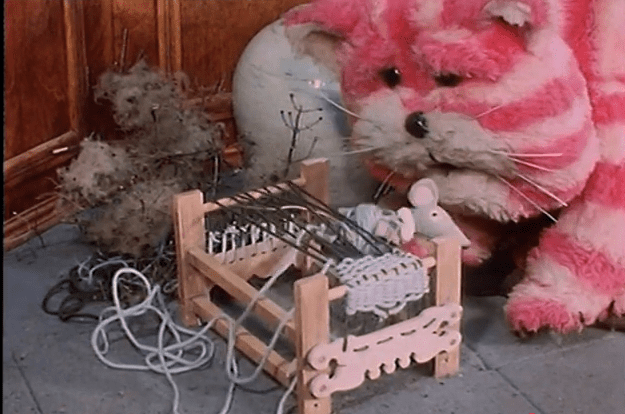
Bagpuss’ story about the king’s beard alludes to several historical realities of the textile industry, while remaining child friendly; the beard becoming trapped in the loom is representative of the numerous horrific accidents caused by industrial textile machinery, while the character of the “young rug weaver” hints at the dark history of child labour behind cloth production. It also makes reference to the historic power cloth merchants held over the textile trade.
The weaving song contains several key weaving terms and the visuals depict the steps in the right order, but most impressive in my opinion, is when Charlie Mouse decides to become the shuttle and demonstrate how the loom works. Since Bagpuss is filmed in stop motion it would have been easy for the animators to cut corners, however Charlie Mouse goes under every other warp thread as he should, pulls the weft thread through on a slight diagonal (this helps the selvedge stay straight as the yarn doesn’t pull when the shed (the gap between the warp threads that the shuttle passes through) closes), and on several occasions gets Bagpuss to ‘beat’ the weft thread towards the front beam with his paw.
For a bit of fun (and to embrace my inner child), I enlisted the help of Janey Mouse to help spread the warp for my next BWM project. All credit to Peter Firmin & Oliver Postgate who animated Bagpuss – it’s harder than you’d think to fit a mouse through a loom!
Kittens & Knitting
Anthropomorphic animals are quite a common occurrence in children’s books from Beatrix Potter to Paddington Bear. Below are some illustrations from the Ladybird book Smoke & Fluff, a story written in rhyme about two kittens causing havoc around the house starting with a ball of wool.
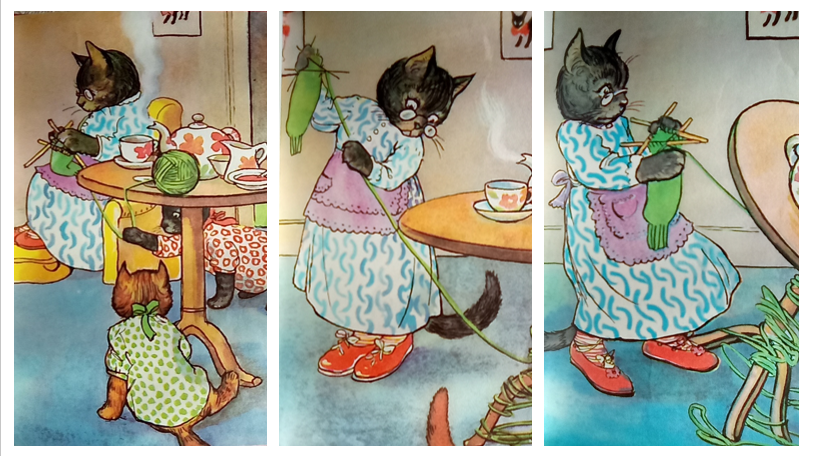
While there isn’t too much to unpick here, the illustrations do become a bit of a spot the difference! The double pointed knitting needles (DPN’s) change size between pictures (strangely, so do Mrs Cat’s shoes!) and the fourth ‘working’ needle is missing from the first two pictures. It could be hidden behind her right hand in the left picture, however the middle and right pictures are set only moments apart and the needles go from being set up in a triangle shaped start/end of round to a square shape mid-round, so this seems like an oversight (or else Mrs Cat can knit incredibly fast!).
However, perhaps the most accurate thing in these illustrations is the expression on Mrs Cat’s face as the table overturns about to take her knitting with it. I’m sure whenever I nearly drop a stitch (or the time the needle slipped out of the whole row) my face does something very similar!
Weaving Stories
Authors are often described as ‘weaving’ tales, and while this is meant as a metaphor, for years fabric has been used to tell stories. I was therefore very happy when researching these posts to discover that Diana Wynne Jones (the author of one of my favourite books Howls Moving Castle) had written about this very concept in The Spellcoats. I will disclaim that I haven’t read this book in full (my tbr list is very long, but it is on there!), and it is part of the Dalemark Quartet, so I will be exploring the weaving at face value rather than commenting on the wider plotline, however the story revolves around the protagonist weaving their story as it is being told into cloth for a rugcoat – an item of clothing popular in the prehistoric fictional Dalemark.
“THIS IS TO BE a very big rugcoat. We have been here in the old mill for days and days now, and though I am weaving close and fine, I have still not half finished my story. […] When Uncle Kestrel first brought me my loom and my wheel and my wool, I was sick with impatience, and it all went so slowly. I had to spin my wool and set up the threads on the loom, and even when I began to weave, it took half the morning on the first sentence. But now I have found how to go fast. I set the first part of the pattern and cast the threads, there and back, and then the row to hold it, and while I do that, I am thinking of my next line. By the time I have finished that band of words, I often have the next three or four ready in my head. I go faster and faster, click and clack, change the threads with my feet, click and clack with the shuttles, and so on. And the story grows in the loom.”
(Jones, D.W. (2017) The Spellcoats. (p.59) S.l.: HarperCollins Publishers.)
Despite the story revolving around the weaving of rugcoats, there are very few detailed descriptions of the process, however this extract does contain the bare bones. Jones discusses how the weaving is faster than preparing the loom, and that in some weaving styles/patterns, plain rows are woven between to help with the structure. She also mentions the noise that weaving can make depending on the size of the loom, however there are a few things that don’t sit quite right.
I’m not sure what shape rugcoats are – there are several descriptions of the colours and patterns, but very little on the shape. Lots of characters wear them and different coats for different seasons are mentioned, so I’m assuming they could come in lots of shapes and sizes and are named ‘rugcoats’ due to their resemblance to wool rugs. However since an entire story is being woven into one (using patterns and symbols) and that Jones’ other witches and wizards often wear flamboyant clothing, I’m making the assumption that the rugcoats being woven in this book are long sleeved and around ankle length, which makes me question what type of loom is being used.
In the extract the protagonist describes a loom with treadles to change the shed (something perhaps similar to a counterbalance loom). Yet the loom is later described as being transported by boat “perched on top” of a vast pile of wool, something I think would be tricky with a counterbalance loom, on what I assume is a rowing boat. A rigid heddle or warp weighted prehistoric loom would better fit on top of a pile of wool and still be large enough to weave a substantial width of fabric, however neither of these have treadles or make a particularly loud clacking sound, so unless the world of prehistoric Dalemark has designed a loom that has both, I’m not quite sure what the protagonist is using.
I do however love the premise of stories woven into cloth. Textiles have been used for years to tell stories, from pictorial tapestries and ethnic patterns and shapes, to morse coded messages hidden in knitting patterns, and it does get me thinking – if authors weave stories, are weavers also authors in their own way?
I hope you’ve enjoyed this journey into childhood stories – If you have any more depictions of good or bad spinning, weaving, or other fibrecrafts that you think I should see, do let me know in the comments below – I may be able to continue this critical commentary series next Wovember!
 Loose Ends
I like this topic too. The video of the mouse going through the shed is great! I don’t know if I would have noticed the double pointed needle discrepancies but the differences in the shoes are very obvious!
LikeLiked by 1 person
I wasn’t quite sure if I could get her to fit through the shed as she’s quite a bit bigger than the version used in the original show! Interestingly, I didn’t notice the DPN’s at first as the illustrations are each on separate pages, so it wasn’t until I put all three together and looked a bit closer that I noticed anything was wrong.
LikeLiked by 1 person