One of my pet peeves is watching a film or reading a book and seeing spinning, weaving or knitting represented incorrectly. I’ve seen critical commentaries before for period drama’s and sewing representations (particularly on YouTube) and found them both entertaining and informative, however I have yet to see one that looks at fibrecrafts specifically, so thought I would give it a go for a bit of fun, starting off with some well known fairytales! Since we are about to enter the realm of fantasy, I’m suspending my disbelief regarding the magical qualities these objects might possess, rather I’ll be exploring whether what is being shown/described is accurate within the context.
I’ve included images throughout, but sometimes what I’m referring to is clearer in video form – where possible, I’ve linked it to YouTube videos (not mine) showing the scene if you click on the image.
Sleeping Beauty
One of the most iconic representations of the spinning wheel is from Disney’s Sleeping Beauty, but it’s also quite a misleading one…
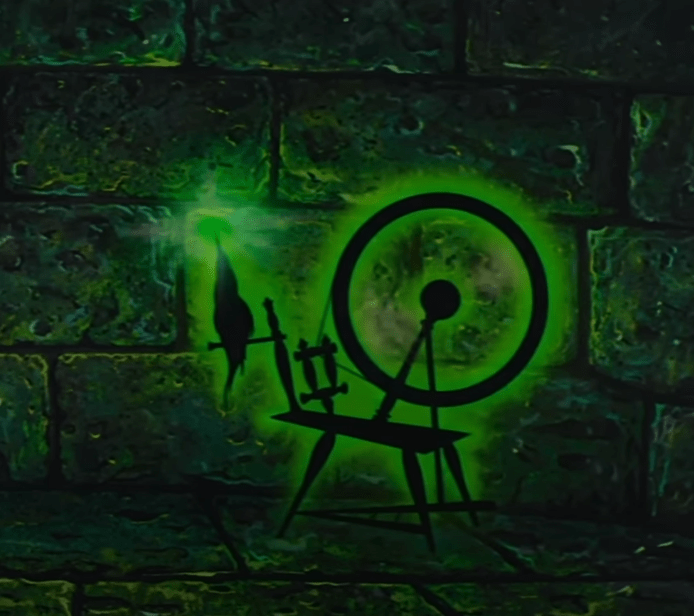
Aurora is cursed to prick her finger on the spindle of a spinning wheel on her sixteenth birthday, but the wheel pictured above is completely spindle-less! Most spinning wheels of the above Saxony style have a bobbin rather than a spindle (though neither is actually depicted here); Charkha’s and Great wheels do have spindles (aka quill spindles) and they can be quite sharp, however these spindles sit sideways on the wheel (see below). Those two types of wheel are also usually hand operated, so would not have a footman (the long pole attached to the centre of the wheel) connecting to a treadle at the base.
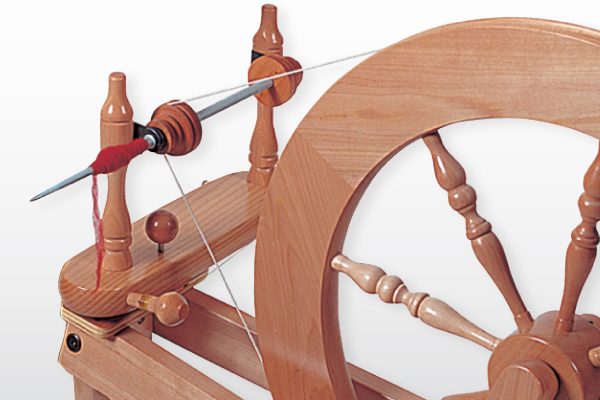
Spindles and bobbins are also designed to hold spun yarn, rather than the loose flax like fibre as depicted in the film, which leads me to the conclusion that what Disney’s Aurora actually pricks her finger on is a distaff (something that could either be attached or separate from the wheel to hold the fibre to be spun). Disney had the opportunity to fix this mistake in the live action Maleficent, but disappointingly never did.
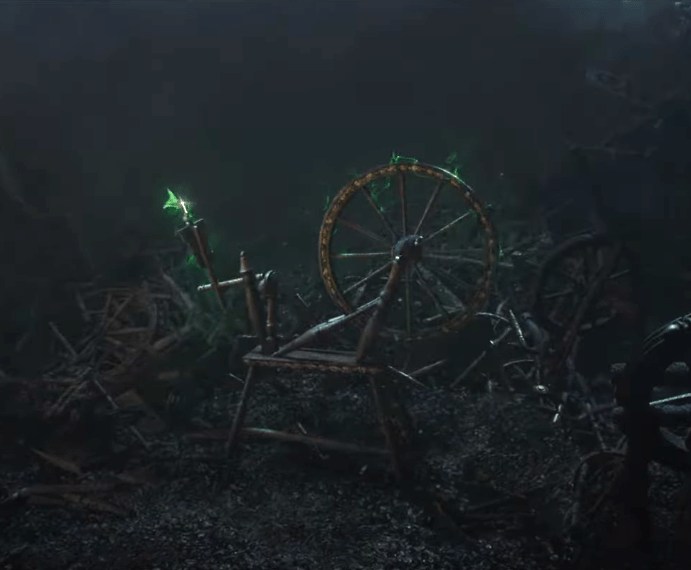
This time, as the spinning wheel comes together in the film I can see a bobbin and flyer, meaning this wheel definitely would not have had a quill spindle and distaffs don’t normally have very sharp metal spikes added to the top – someone could get hurt! The spinning wheel ‘graveyard’ does however raise an interesting question regarding the impact of the events of the film on women. Spinning was an important source of income for many women through the ages, so destroying all the spinning wheels would have had a devastating effect on women’s independence, not to mention the impact no spinning wheels would have had on the textile industry as a whole (but perhaps that’s something to explore another time!).
This leads me onto a more plausible depiction of the fairytale in Neil Gaiman’s The Sleeper & The Spindle, which features a strong willed female protagonist forging her own path.
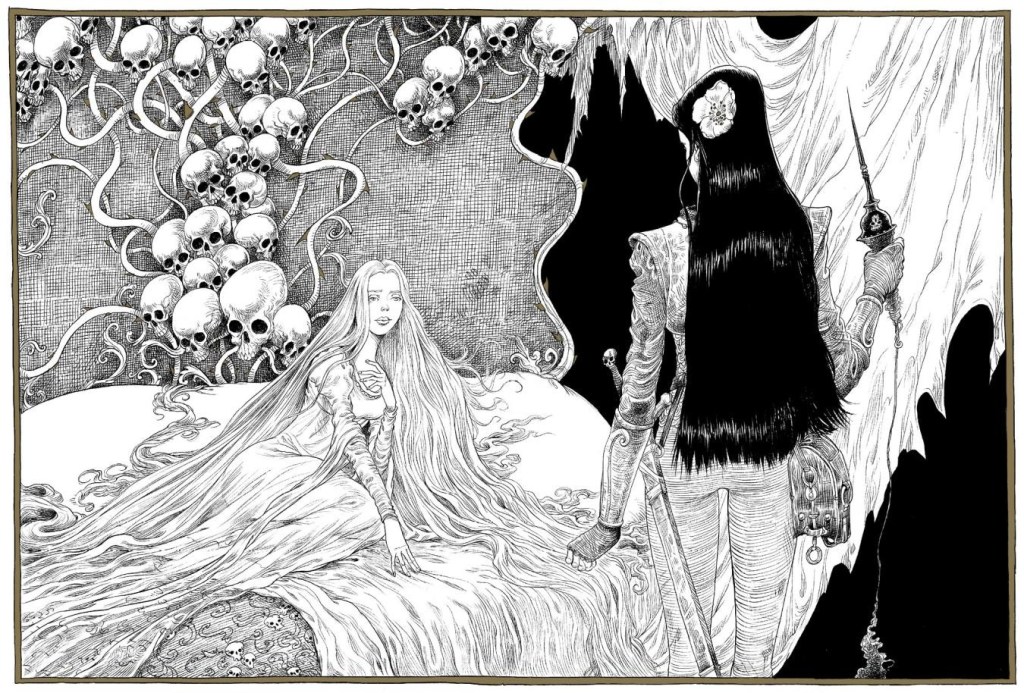
In the book, the spindle in question is a drop spindle and looks to be a bottom whorl (the circular weight is towards the bottom), so the yarn is wound on in the correct manner (the spindle is being held upside down in this illustration). The base is unusually pointed and the whorl heavily embellished with skulls; however drop spindles come in all shapes and sizes and given it is a magic spindle within a gothic narrative, I don’t see why these customisations couldn’t exist.
Rumpelstiltskin
Unlike Sleeping Beauty, the character of Rumpelstiltskin should be adept at using a spinning wheel. One of my friends suggested I look at the spinning in a TV series called Once Upon a Time – I haven’t watched the show, but found a compilation on YouTube of the character at a wheel and was aghast at the spinning crimes being committed!
There are several types of wheel used. In some scenes Rumpelstiltskin uses a great wheel (spindles appear to be in the right place, although there is some questionable drive band placement), however he spends most of the time turning the wheel very slowly while standing or sitting, rather than doing any actual spinning (he would need to walk back and forth to draft and wind if spinning properly). In these scenes the character seems more contemplative, so I’m guessing this could have been a conscious decision for the character and would have made it easier to deliver lines since spinning takes a lot of concentration, particularly as a beginner.
There are some scenes where the actor is sitting in the right position and even appears to attempt some spinning (or at least go through the correct motions) BUT on many more occasions things have gone horribly wrong!
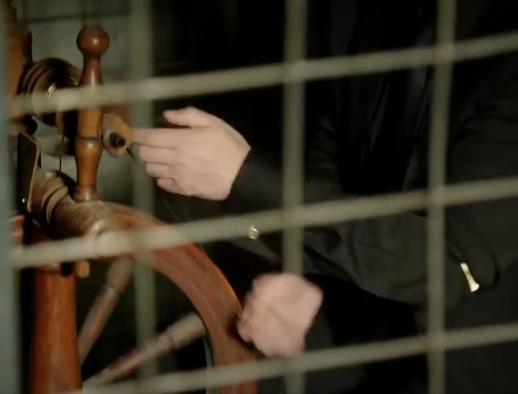
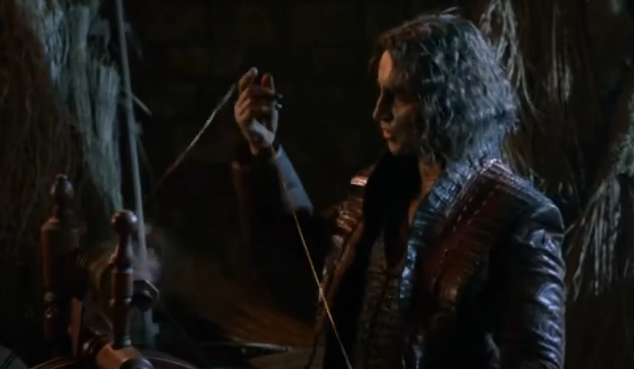
In several scenes (including one where the character appears to be teaching someone else) Rumpelstiltskin is sitting at the side of the spinning wheel pulling gold thread from the bobbin at speed with his hands. Anything being spun on the castle wheels in the above pictures should be going through the orifice onto the bobbin.
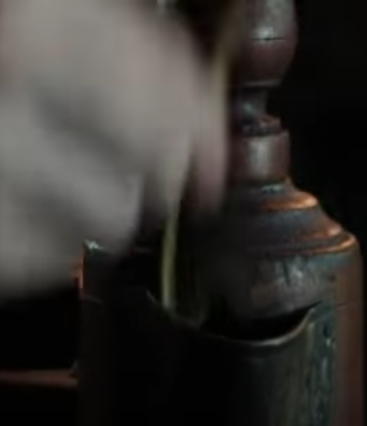
I assumed that perhaps the straw thread turned to gold during the unwinding, but then I saw a clip where straw was being pushed into some sort of holder on the side of the mother of all which houses the flyer and bobbin, implying it would somehow be fed through that onto the bobbin. I’m left questioning why this would be needed when it could just be threaded through the orifice as usual?
Image: ‘Once Upon a Time’ (2011-2018). ABC Studios.
I also need to return to the unwinding; it is unwise to start removing yarn from the bobbin without having something like a niddy-noddy or skein/ball winder to hand, lest your hard work end up a tangled mess. During the unwinding depicted the flyer is moving quite fast, which suggests the tension hasn’t been released in these scenes (fully release the tension and only the bobbin should be moving). Unwinding under tension makes the process harder and could lead to yarn breakages, but flyers also have metal hooks which could catch on yarn being unwound, or the spinners hand at speed.
I will close on a literary depiction (thank you to the legend of YA fantasy @kbbookreviewer for suggesting this one to me!). I haven’t read Gilded, however Marissa Meyer has clearly done her research into spinning.
“The straw was nothing like the thick, fuzzy wool she was used to, but she inhaled a deep breath anyway and loaded the first empty bobbin onto the flyer. […] Usually she started with a leader yarn, to make it easier for the wool to wrap around the bobbin, but she had no yarn. Shrugging, she tied on a piece of straw. The first one broke, but the second held. Now what? She couldn’t just twist the ends together to form one long strand.
(Meyer, M. (2021), p.99, Gilded. London: Faber & Faber.)
Could she?
She twisted and twisted.
It held sort of.
“Good enough,” she muttered, running the leader yarn through the hooks, then out through the maiden hole. The entire setup was beyond precarious, ready to fall apart as soon as she pulled too tight or released those weakly connected strands. Afraid to let go, she leaned over and used her nose to push down on one of the wheel’s spokes, so that it gradually started to turn. “Here we go,” she said, pressing her foot onto the treadle. The straw pulled from her fingers.“
I enjoyed this description of an attempt to spin straw into gold for two reasons; the process is described accurately, from the loading of the bobbin to the use of a leader and the threading of the yarn through the orifice, but I also think the nerves and failure described, resonate with all spinners trying out a new fibre for the first time. There’s nothing worse than getting set up at your wheel, only to find you haven’t secured your yarn properly to the leader and watching it get snatched from your hands. For first time spinners, spinning any kind of yarn can seem just as impossible as spinning straw into gold does for this character, and I think that giving it a go despite the odds stacked against you is a good message to end on.
I hope you’ve enjoyed this journey into fairytale spinning – there’ll be a part 2 later in the month that won’t be so spinning focused. If you have any more depictions of good or bad spinning, weaving, or other fibrecrafts that you think I should see, do let me know in the comments below!
 Loose Ends
I have found this annoying too. My granddaughter has a board book showing activities with Grandmothers and their grandchildren. On one page the grandmother is knitting, but the image is so so wrong. There are 2 knitting needles coming straight up on each end of the row. So wrong!
LikeLiked by 1 person
Oh dear! It is particularly frustrating when children’s books are wrong (I’m taking a look at some dodgy knitting illustrations in part 2). At least you are able to show your granddaughter how it’s done properly!
LikeLiked by 1 person
Things like this drive me mad. The edition of Grimms’ fairytales I read my kid mixes up spinning and weaving in several places. I think I remember a scene where sleeping beauty enters the tower, sees a woman spinning, the shuttle flying back and forth.
No, I could not read that without commenting on what utter nonsense that is.
LikeLiked by 1 person
Oh no, that’s a huge mistake! Considering the amount of editing books pass through, you’d have thought someone would have picked it up. At least you were able to explain what they’ve got wrong, and your child can proudly say they know how spinning works.
LikeLike