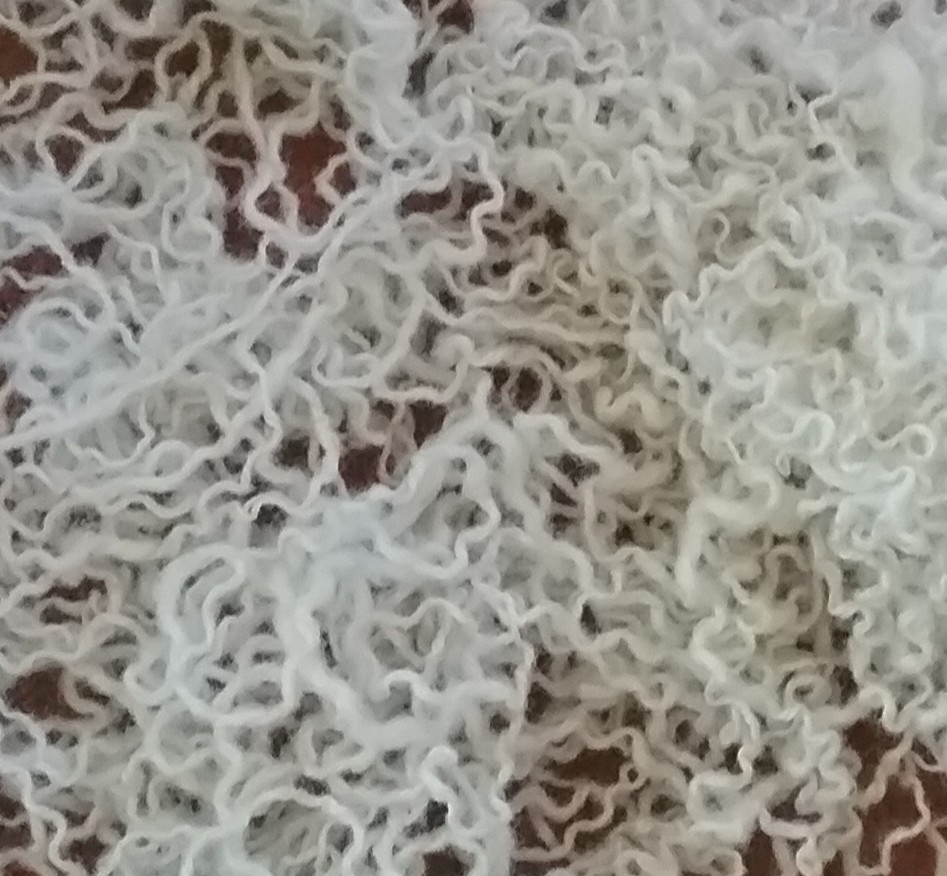
This is a question that many spinners find themselves asking after skeining their yarn and can be quite a frustrating and time consuming task. If the only piece of equipment you have to hand is a niddy noddy to wind your skein onto, then the easiest way to calculate yarn length is to multiply the number of strands by the length of skein the niddy noddy makes (i.e. the length of yarn to wind around it once). My Ashford niddy noddy makes a 1.5m skein so if there are 50 strands I have approximately 75m of yarn.
There’s nothing wrong with this method, but after finding myself frantically counting skeins en masse at the end of Tour de Fleece the last couple of years, I felt there must be a more efficient way. An online search brought up meterage/yardage counters, but they were either part of expensive yarn winding set-ups, or would have required quite a bit of fiddling to make suitable for yarn. Quite by chance, I came across someone selling a vintage Leclerc yarn measuring counter second hand online and decided to see if it would work.
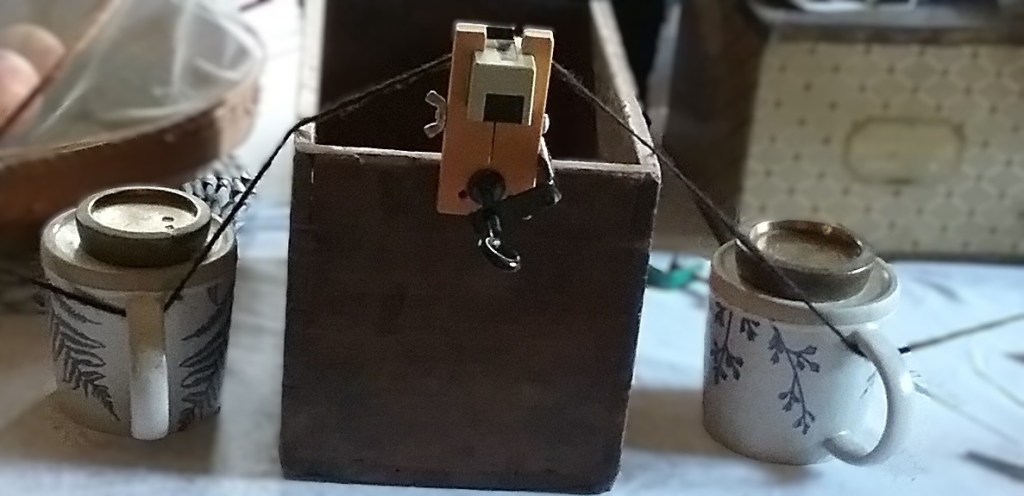
Before making a base, I decided to check how the wool needed to be positioned for it to wind. My plan was to have the measurer between my yarn swift and ball winder so the yarn was measured as I wound. The photo below shows my first set-up, which despite looking like a prototype from Wallace & Gromit, actually worked!
I then decided to make a simple base, screwing the yarn measurer into the side of a spare piece of wood and placing two screw eyes either side of the wheel close enough to ensure the yarn retains some tension over the wheel while winding. This is still a work in progress and I might replace or add a larger set of eyes for thicker yarn, but it should make this year’s TDF much more efficient.
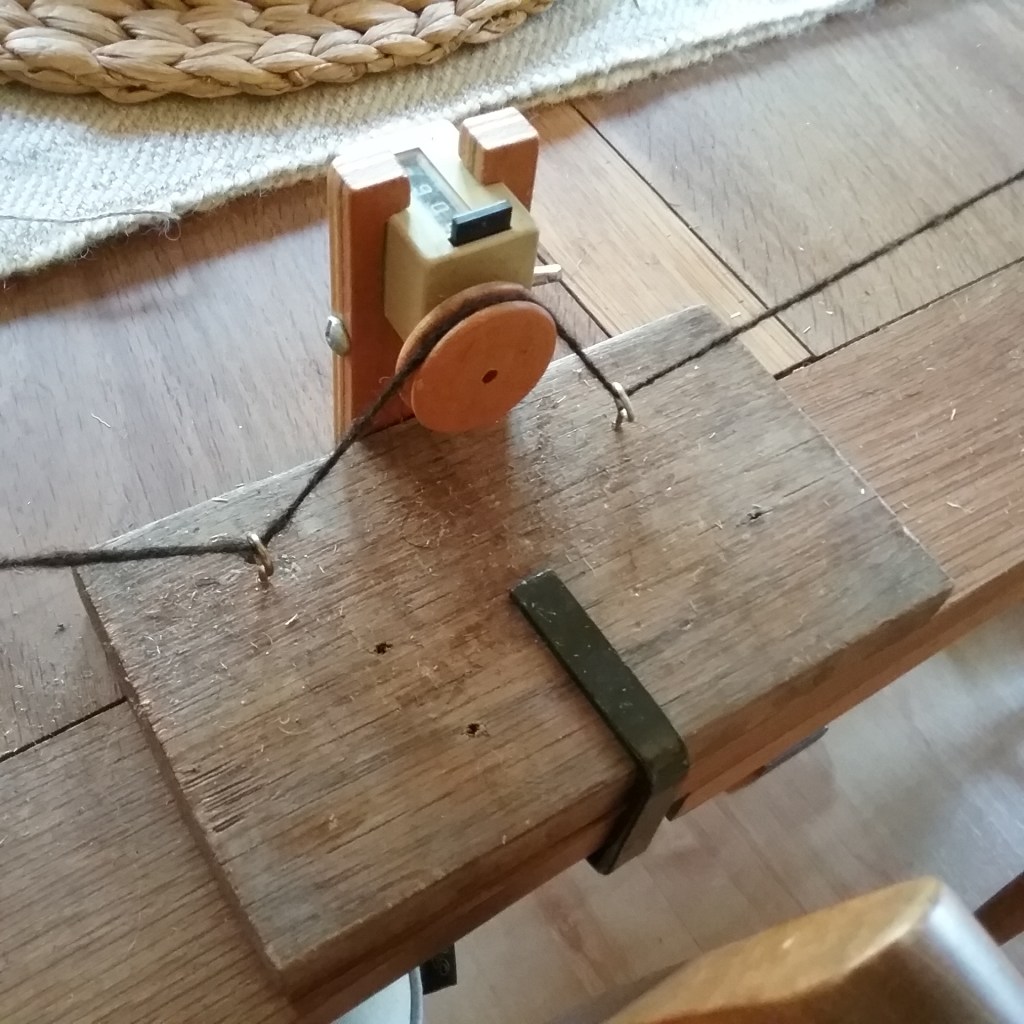
I also needed to find out what units it measured in. Leclerc are a Canadian brand and I’m not sure how old my measurer is, so I expected it to measure in yards, but I ran a couple of commercial yarns through that showed the length in metres and while the dial wasn’t exact (likely due to differences in tension while being measured), it was much closer to the metres measurement than yards. One revolution/the inner wheel circumference is also exactly 10cm. Considering I round down when measuring to accommodate for human error, and always allow extra in my calculations for projects requiring specific amounts of yarn, I think I’m happy to assume my measurer is metric.
Tour de Fleece starts this coming Saturday and I’m on the hunt for spinning challenge suggestions! Last year I attempted spinning while balancing things on my head, tap dancing, blindfolded and on two spinning wheels at once and had so much fun I’d love to do it again this year. So, if you have a fun/silly/technical challenge you’d like to see me try, leave a comment and I’ll pick some at random to complete between 5th – 27th July!
 Loose Ends
I have always just measured my yarn on the niddy noddy, but another gadget specifically for measuring would be great. Good luck with your vintage thing. I have never participated in Tour de Fleece, due to it being a very busy time of year for me generally. Last year we were out of the country. This year I will be home and plan to participate. I have a longer term goal of spinning yarn for socks, which seems very impossible since I have never spun anything remotely that thin, even with 2 plies. I believe for sock yarn the key is a lot of twist and tightly plied, ideally with 3 plies. My last spin was thinner and more tightly plied, I thought, but it came out similar to my default yarn. For Tour de Fleece I am going to work through a couple of online classes from the School of Sweet Georgia (https://www.schoolofsweetgeorgia.com/) called “Spinning up a Level” and “Spin to Knit Socks”. I guess worse case scenario I can make thick socks out of the yarn.
LikeLiked by 1 person
Measuring from the niddy noddy is handy as you don’t have to set everything up where it can be clamped down, but the measurer seems to fit in well between my usual yarn winding set up, so I’m keeping my fingers crossed it makes things a bit easier. I’ve done TDF for a few years now, some where I’ve had more time than others, but it’s always been good fun and helped me to get into a routine of spinning. Your challenge sounds like it will be good fun and working through the courses will help give some structure. One piece of advice I heard a few years ago was that sometimes it’s not always technique that can hinder spinning thin yarn, but also the wheel you have. I love spinning on my Ashford Traditional and it can do a lot, but my Kromski Sonata seems to naturally spin a thinner yarn (the person who mentioned it swore by their Louet wheel for spinning lace weight yarn). You could try chain plying for socks as that can even out any thicker areas (and since you’re plying it onto itself it means that you don’t have to wait to fill 3 bobbins before plying)!
LikeLiked by 1 person
I have a Lendrum spinning wheel. I love it and it has a jumbo flyer / bobbin for really bulky yarn and for plying, in addition to the regular one. If I completely fill up 2 regular bobbins, I can fit the entire plied yarn on the bulky bobbin. It also has a “very fast flyer” for thin yarn that I have never used!!! I guess it is time!
LikeLiked by 1 person