Happy Wovember! This year I’m travelling back in time to explore the lasting impact wool has had on our culture. I’ll be exploring various magical and mythological stories and imagery to see what links them to wool and if there was any truth in these tales.
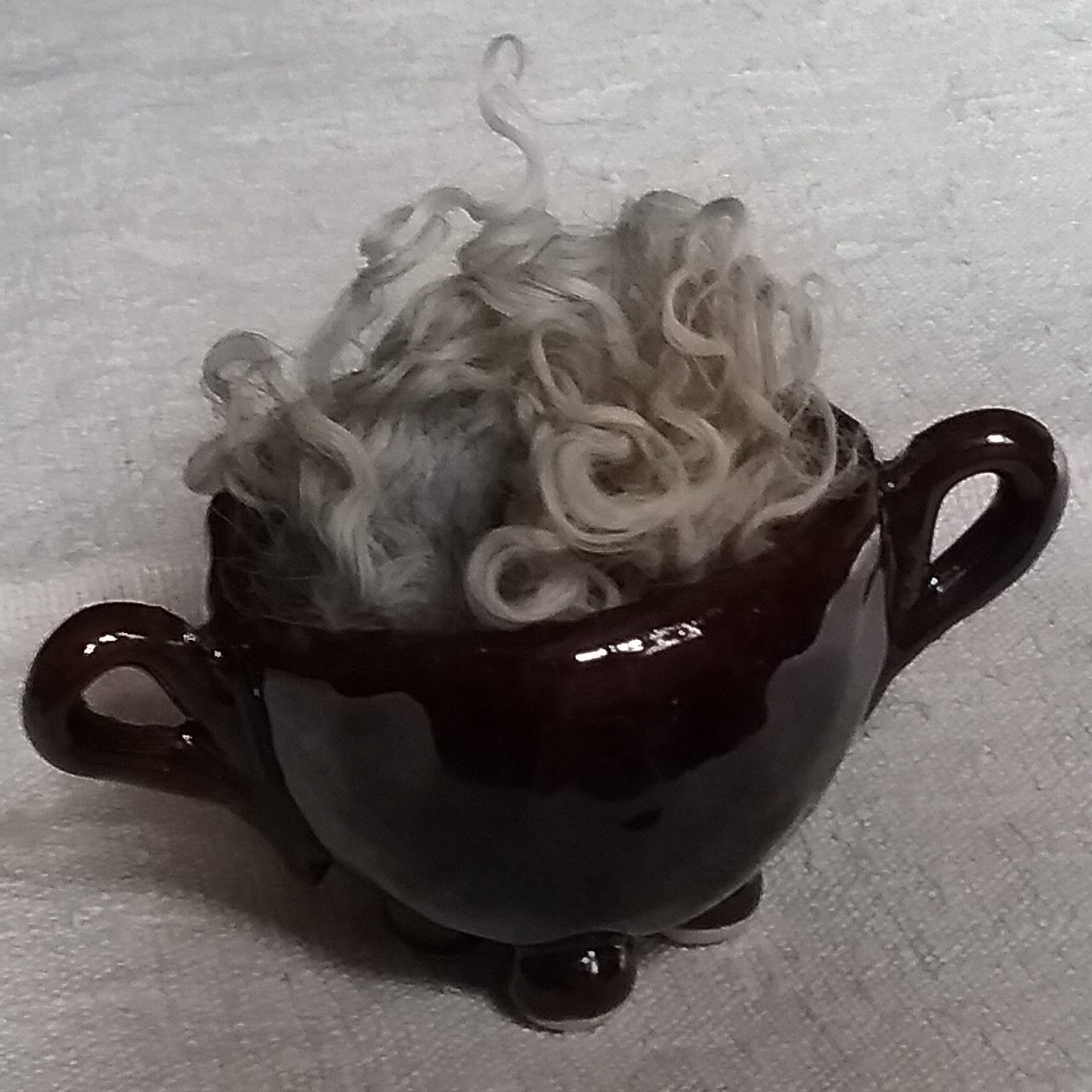
Ancient Magic
The ancient Greeks were not the only ones to worship beings of fate; The Norns were the old Norse equivalent to the Moirai and could weave a person’s destiny. Norse women could also practice Seidr, a type of magic often using a symbolic distaff to bring about a change of fate for good or evil1. Women who practiced this magic would have been highly respected, but also probably feared (any men practicing Seidr were ridiculed as the practice was seen as ‘unmanly’). Archaeological evidence shows that drop spindles were often buried with their owners, perhaps to occupy them in the afterlife, or perhaps because these tools were so important, both practically and spiritually. Even today, the intent with which something is done is considered important in everything from modern witchcraft to mindfulness. As crafters we make with intent, whether this is to improve our skillset, explore something new, or simply to unwind.
Gatherings of Witches
In the early 20th century, household witches in Finland were reported to cut wool from neighbours’ sheep to weave invisibility cloaks and bring about bad luck2. This may therefore have linked the practice of witchcraft to those who could spin. The beginning of an account from an American periodical in 1880 describes a gathering of witches at their ‘headquarters’ where the author is greeted by a woman spinning3. This description is reminiscent of the spinning bees of the 18th century in the American Colonies.
Women would gather and chat while they spun in order to boycott buying goods from Britain4; it was a way for women to have political expression and would have been an ideal place to gossip and share knowledge (through spinning songs for example). Around the world, groups of spinners through the ages would bring their work together to save lighting and keep each other company. Spinning bees were places predominantly occupied by women and were often portrayed as being unruly gatherings (paintings portraying spinning bees are filled with innuendos). Whether this was invented by those who disapproved of women having a space of their own, or had a ring of truth, I cannot say, but it is not out of the question for spinning bees to have subsequently been associated with witchcraft.
Though the link between wool and witchcraft has historically had negative connotations, many practices remain today. There is a wonderful global community of spinners, weavers, and fibre artists all teaching and keeping each other company, and we value items that have taken time, skill, and energy to create. We marvel at the beautiful creations of others and the process of creating itself. Though it is doubtful that spinning and weaving can magically change another’s fate, they are expressive and mindful crafts that bring people and ideas together and I think perhaps that there is a magic in that.
I hope you’ve enjoyed this tumble down the rabbit hole into the weird and wonderful cultural history of wool. I have tried to include a variety of different stories focussed on magic and myth, but there is much more, so if any of this has piqued your interest then I heartily encourage you to look into this further – I had a lot of fun researching the more unusual wool history to write these posts.
As we reach the end of Wovember it only remains for me to encourage you to use wool, check your labels for fibre content and visit Team Wovember or Love Wovember for lots more information. I will be taking a break from posting in December while I catch up on projects and making gifts, but I will return in the new year hopefully with some new finished projects.
Happy Crafting!
Wovember posts from previous years can be found below:
- Celebrating Wovember: What is Wool?
- Wovember: Fibre Library Part 1
- Wovember: Fibre Library Part 2
- Wovember: Fibre Library Part 3
- Wovember 2022 – The Importance of Wool: Wool & the Environment
- Wovember 2022 – The Importance of Wool: What is Wool?
- Wovember 2022 – The Importance of Wool: Fast Fashion
- Wovember 2022 – The Importance of Wool: Care & Repair
- https://norse-mythology.org/concepts/seidr/ ↩︎
- Stark, L. (2018) ‘Narrative and the social dynamics of magical harm in late nineteenth- and early twentieth-century Finland’, in W. De Blécourt and O. Davies (eds) Witchcraft Continued. Manchester University Press. Available at: https://doi.org/10.7765/9781526137975.00008.
↩︎ - https://www.proquest.com/openview/75aeb7b2256a41db/1?pq-origsite=gscholar&cbl=3060 ↩︎
- https://wams.nyhistory.org/settler-colonialism-and-revolution/the-american-revolution/spinning-wheels-spinning-bees/ ↩︎
 Loose Ends
Right! We take lighting and heating for granted. We turn the lights on or turn up the thermostat with no connection or realization of what resources are needed to make that happen.
LikeLiked by 1 person
Interesting. I had not thought of a group of women working together on a craft (whether spinning or quilting or whatever) as a way to share lighting.
LikeLiked by 1 person
I know! I was really surprised when I was researching spinning bees that I hadn’t thought of the more practical elements of lighting and heating before.
LikeLiked by 1 person