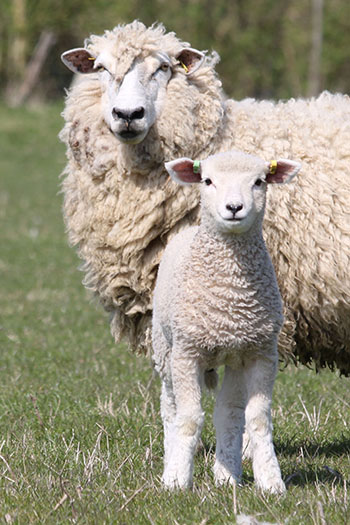
Photo Via romneysuk.com
History
Romney Sheep were established on Romney Marsh, a wetland between Kent & East Sussex, in the 13th Century and their fleeces were highly desirable to the British wool trade at its peak. Romney sheep are quite a good example of natural selection in action; the first sheep to inhabit the marsh suffered from many health conditions caused by the wet, damp conditions, but over the centuries the sheep adapted, and became less susceptible to parasites and foot rot. To further improve wool quality, shepherds on the marsh began selectively breeding sheep until the Romney breed could produce high quality wool in unfavourable conditions. These characteristics were highly desirable to farmers and led to the breeds export over time.
In the Medieval era taxes were imposed on wool being exported and these exports were only permitted to take place from designated ports. During the 15th Century however, the domestic price and demand for Romney wool declined, leading to an increase in smuggling wool abroad for higher profit. Romney Marsh was considered the perfect place for smuggling, due to its close proximity to the English Channel and the vast numbers of sheep that lived there. Those smuggling wool on Romney Marsh earned themselves the nickname ‘owlers’ due to using owl calls to communicate with one another. Despite many years of government policies that aimed to prevent smuggling, Romney Marsh was notorious with ruthless gangs and even inspired a series of books Doctor Syn: A Smuggler Tale of Romney Marsh in 1915. Smuggling had become such a problem that in 1816 a Coast Blockade was set up to patrol the waters between Kent and Sussex.
Fleece Research
Romney sheep are classed by the British Wool Board as having a medium fleece with a 10-17cm staple length. Each fleece weighs around 3-5 kg. Romney wool is versatile; having both crimp and natural lustre so is highly desirable for use in textiles. According to my research, the fleece has a low grease content so can be spun ‘in the grease’ if desired. The medium staple length means the fleece can either be carded, combed or spun from the lock; and its durability means it can be used for anything from clothing to carpets – a good all-rounder.
I read with interest that some Romney sheep are carriers of ‘hairy’ genes, the first of which was isolated by Professor FW Dry of New Zealand in 1929. Sheep with these genes produced coarser wool and were selectively bred to produce wool for carpets. In New Zealand these sheep were called Drysdale, whilst in Australia there are three different carpet wool breeds derived from ‘hairy’ Romneys.
As the Romney fleece is an all-rounder and can be prepped in many ways, I’m curious to see how the fleece naturally behaves – will it lend itself to woollen, worsted or something in-between? Romney, although fine, is reported to be quite resistant to felting so hopefully there should be less chance of felting whilst washing. There is some debate as to whether Romney fleece is too coarse to be worn next to the skin, this appears to vary between fleeces, but the general consensus seems to be that it is more suited to outerwear.
Further Reading
The following sources have been used for reference
- Breed Society Website – romneysuk.com
- British Sheep & Wool by the British Wool Marketing Board – ISBN 9780904969108
- The Field Guide to Fleece by Deborah Robson & Carol Ekarius – ISBN 9781612121789
- The Fleece & Fiber Sourcebook by Deborah Robson & Carol Ekarius – ISBN 9781603427111
- Romney Marsh Visitor website – theromneymarsh.net/sheep
 Loose Ends