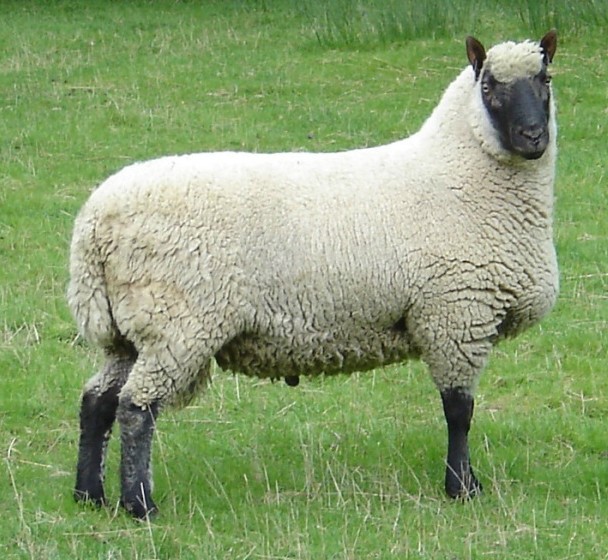
Photo credit to Dunja Roberts of ‘Travelly’ Clun Forest sheep
History
Clun Forest sheep resided on the hills near Clun, a small town in the South of Shropshire from the 19th century, however it is thought the breed originated in the 10 centuries before and were descended from ancient local breeds. At the start of the 19th century the Clun Forest was described as being white faced and hornless, but over time was crossed with other breeds in the area causing the face to darken until it reached the dark grey/brown it is today. By the end of the 1800’s the breed had become more dispersed across the UK and became popular commercial flocks due to their hardiness. Over time Clun Forest sheep were exported to Europe and North America where they became very popular. Although their popularity in the UK has declined in recent times, many flocks are still well established.
Fleece Research
Clun Forest fleece is not commonly used by fibre enthusiasts, yet is reportedly excellent to work with. The British wool board classify the fibre as fine – the same category as the Dorset horn, so I anticipate that Clun Forest will have very similar qualities and behave in a similar way. The fleece is reported to have very little kemp, which will make fibre prep much quicker and has lots of crimp, so will be ideal for woolen spinning. As the fleece is coloured white, I can use it to experiment with some natural dyeing and hopefully achieve bright clear results. My research stated that ‘industrial felts’ were amongst it’s many typical uses, suggesting that the fibres might be willing to felt, so I may need to experiment to find the ‘felting point’ before attempting to wash it or dye it it hot water.
Further Reading
The following sources have been used for reference
- Breed Society Website – https://www.clunforestsheep.org.uk/
- British Sheep & Wool by the British Wool Marketing Board – ISBN 9780904969108
- The Field Guide to Fleece by Deborah Robson & Carol Ekarius – ISBN 9781612121789
 Loose Ends